What’s going to happen now? What should I do?
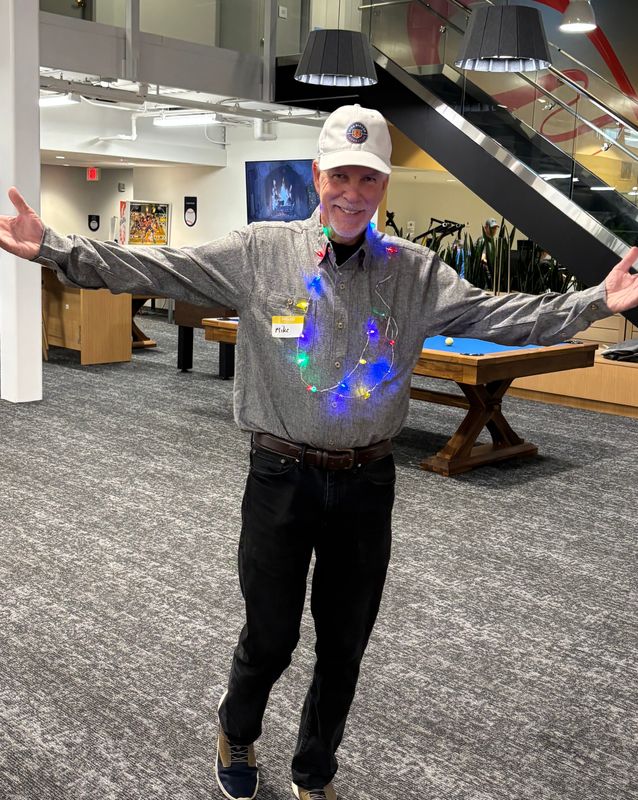
Mike Doran had just been diagnosed with Parkinson’s disease – finally, putting a name to a long list of strange symptoms that he’d been experiencing – but he didn’t know where to turn. He was depressed and confused, feeling alone and overwhelmed. “I was reeling,” he said.

A doctor gave Doran some pills and basically said: See you in six months.
“So, you start looking online,” Doran said.
It was March 2025, and Doran came across a story about Kirk Gibson, the former Tigers great, who was planning to open a state-of-the-art center for people with Parkinson’s.
But what the heck is that? What would they even do there?
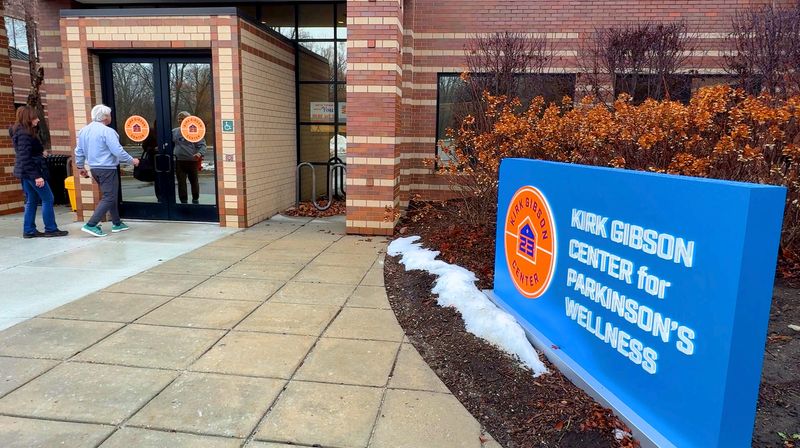
Doran drove to where it was being built off the Northwestern Highway in Farmington Hills. “Just to see the building,” said Doran, 67, of Waterford. “I didn’t know what to do.”
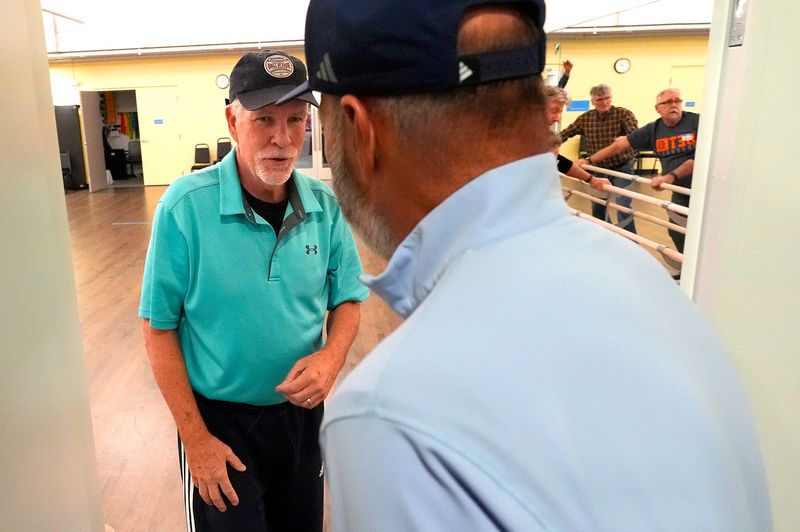
Doran walked up to the door with his wife, Colette. “All of a sudden, this figure came down the sidewalk,” Doran said. “And I realized, oh my god.”
Doran knew that silhouette.
“Kirk?”
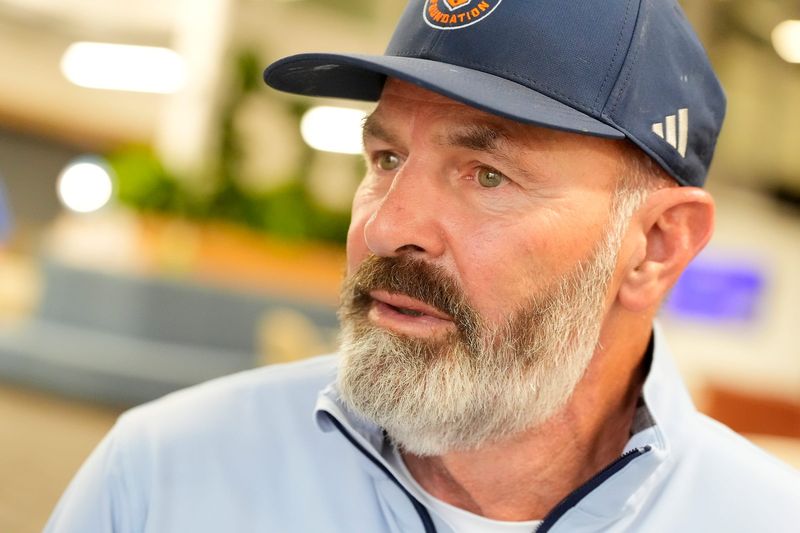
“Who’s asking?” Gibson replied, his voice gruff but soft. Parkinson’s has a way of stealing somebody’s voice.
“Oh, I’m just a guy that just got diagnosed,” Doran said.
It is estimated that 90,000 people are diagnosed with Parkinson’s every year in the U.S., making it the second-most common degenerative neurological disease diagnosed (behind only Alzheimer’s disease), according to the Parkinson’s Foundation.
“We’re just here to see, hopefully, if we can find out more information about the center that you’re going to open,” Doran said.
Truth is, he didn’t even know what he was looking for.
“Come on in for a minute,” Gibson said.
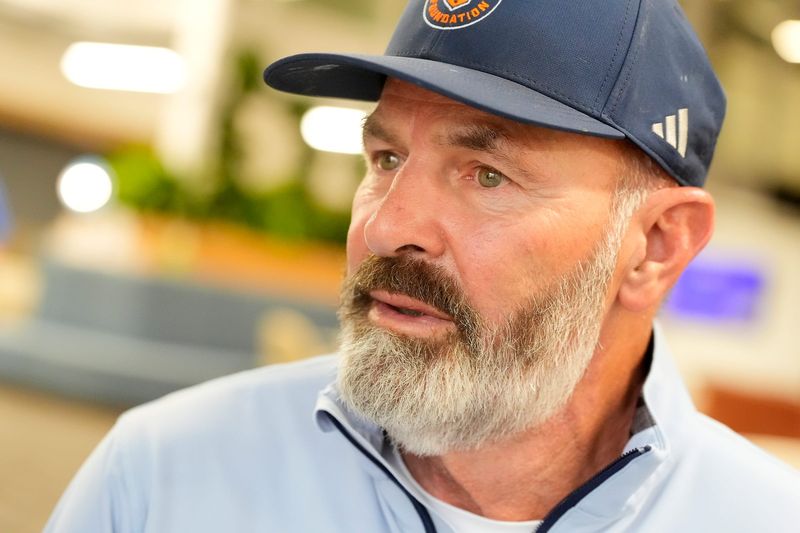
They sat and talked for 45 minutes. Gibson treated Doran like a new teammate – a rookie who had just entered a clubhouse for the first time – and offered him encouragement and advice. “Just stay tough,” Gibson said. “You got to work hard.”
Then, the conversation took a twist.
“I got a question for you,” Gibson said. “If someone came up and punched you in the nose, what would you do?”
Doran didn’t know how to respond.
“What would you do?” Gibson repeated.
“Under the right circumstances,” Doran said, “I guess I’d have to punch him back.”
“That’s what I like to hear,” Gibson said.
“Basically, he was asking me, ‘Are you a fighter?’” Doran said.
Because that’s what it takes to battle Parkinson’s.
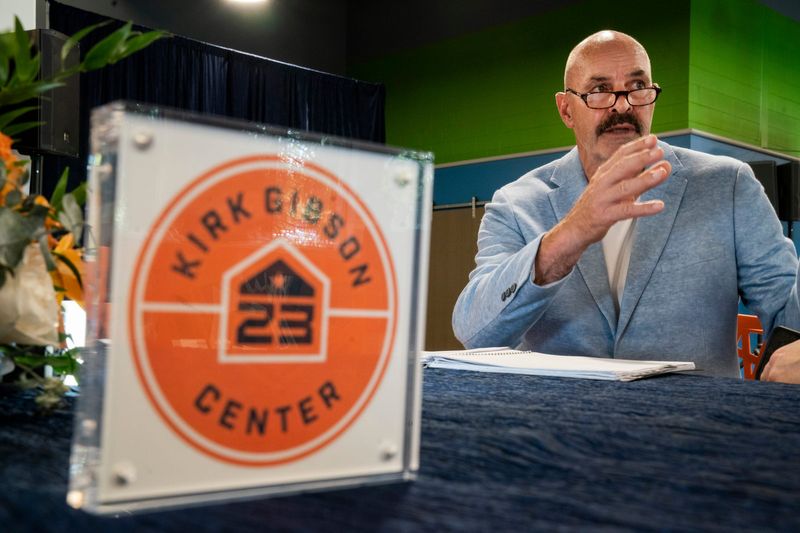
That’s the essence of the Kirk Gibson Center for Parkinson’s Wellness. It’s a beautiful, sparkling, state-of-the-art facility with an amazing vibe, full of inspiration and hope – the first center of its kind in Michigan to offer a complete program for free.
But it’s also something else. At its core, it’s a battleground for fighters. A place to punch back. Gibson didn’t just put his name on this place. He injected his hair-on-fire spirit, run-through-a-wall intensity and never-ending will to win against this evil disease.
Then, after the center opened, something amazing happened.
It started to feel as magical as his 1984 Tigers did.
How the symptoms showed up
Now, looking back, Gibson realizes he was experiencing Parkinson’s symptoms for years.
In the early 2000s, something strange happened when he was shaving. “I noticed my left hand started clutching,” he says. “I just thought it was a cramp in my forearm.”
More symptoms arrived as he managed the Arizona Diamondbacks from 2010-14. When he would go to the mound to talk to a pitcher, Gibson’s arm contorted against his body, pulling into himself – that was the disease trying to make him small, one of the hallmarks of Parkinson’s.
“They thought it was my neck, which maybe it was a little bit, but trust me, it was Parkinson’s,” Gibson said. “I could tell, my hands started shaking and stuff.”
It became harder to button his shirts, and his gait changed.
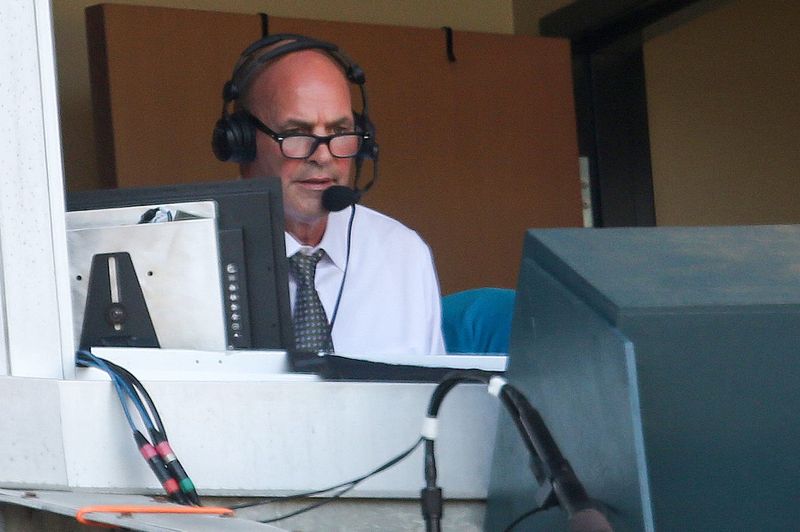
Then, while broadcasting the Tigers’ Opening Day on April 6, 2015, Gibson got on TV and couldn’t talk. He just locked up.
He went for testing and was diagnosed in 2015. “I came right out,” Gibson says. “Told people right away – a lot of people don’t do it because you lose your job. People are gonna treat you differently; that’s just the way it is.”
After he made the announcement, Gibson sought advice from actor Michael J. Fox, who has Parkinson’s, and Deborah Brooks, the CEO of the Michael J. Fox Foundation for Parkinson’s Research.
“They met me the next day at Metro airport, and I realized right then and there, this was different,” Gibson says. “I was going to have a new normal.”
Scientists don’t know the exact cause of Parkinson’s disease but genetics, environment and aging are considered likely factors, according to Fox’s foundation.
For three weeks, Gibson went through an intensive therapy program in Grand Rapids. “Drove to Grand Rapids every day,” he says. “They put me through the ‘Big and Loud’ program. It helped me. It’s big! Loud!”
Gibson made a concerted effort to project his voice. “There’s a poem on YouTube,” Gibson continued. “It’s called ‘Smaller.’”
It was written by Andy McDowell, who was trying to explain Parkinson’s to his children. Gibson finds the video on his phone and plays it.
The poem begins: “My world got smaller, my handwriting, my voice, my walk, my spirit, my balance, the space in the world I take up. It crept up on me in micro-increments. Those are big words for small and slow until it arrived with a name. And then it became big and scary. I didn’t want it but now I had a face, a reason for all the smallness. And so it became what it is. I may be smaller, slower, but I’m still me.”
Gibson watches the video with me.
“You have to remember you’re still you,” Gibson says, as it ends. “It’s not easy.”
To Gibson, learning about Parkinson’s was like reading a scouting report, studying his foe. Figuring out a way to defeat it. Because everything is another challenge to Gibson. An opponent to demolish.
“You got to understand what you’re up against,” Gibson says. “It’s like playing a baseball game: Who’s pitching? Who’s hitting? What are their strengths or their weaknesses? And you got to learn how to just deal with it and prepare.”
Joining a new team
Gibson could have kept his battle silent. Could have focused all of his energy and attention on himself. Could have gone Up North and kept living and hunting and traveling and working out on his own.
But that’s not Gibson, a remarkable two-sport athlete who played baseball and football at Michigan State, then spent 17 years in MLB, including 12 with the Detroit Tigers.
That’s not this man who hobbled to the plate for the Los Angeles Dodgers in Game 1 of the 1988 World Series and hit a dramatic, pinch-hit home run – basically on one leg. “High fly ball to right field, she is gone!” announcer Vin Scully famously intoned. “In a year that has been so improbable, the impossible has happened.”
That’s Gibson, putting an entire team on his back – no matter how bad he might feel physically – and swinging for the improbable.
“This is his new team,” Cam Gibson, Kirk’s son, says of his father. “He’s still that same guy. It’s just a different team.”
A new fight.
“He’s still helping people through the things he knows,” Cam says. “Being a motivator – he knows very well. He’s still that coach. He’s taking that team and he’s moving it. It’s just a different team, different sport.”
After the diagnosis, Kirk started the Kirk Gibson Foundation for Parkinson’s, holding charity golf tournaments and raising more than $3 million for research grants and programs to help people living with the disease. But after a while, he started to wonder: What more could they do? How could he refine the mission?
“We saw this gap, a fragmentation,” says Steve Annear, the foundation’s CEO.
There were several organizations trying different things but “they are uncoordinated and underfunded because insurance doesn’t cover group classes for people with Parkinson’s,” Annear says.
They started tossing around ideas. There were different programs to help people but they were spread out and scattered. How could they help people live with it? How could they truly impact lives?
“We had a couple of new board members that helped kind of toss some ideas around,” Annear says. “Kirk felt we could do more, and we could have a much more direct impact on people living with the disease and that really became the focus of what he wanted to do with the foundation.”
They had a new mission but still needed a plan.
They spent nine months researching what organizations across the country were doing to help people live with this disease. “What we found was the whole approach was very fragmented,” Annear says. “So there was no coordination. It was lot of people doing things with big hearts and very little resources, doing the best they could to deliver programs.”
They came across InMotion – a wellness center near Cleveland that offered exercise, education, and support all in one place, using an “evidence-based approach” – that’s a fancy way of saying the stats and research guide the programming.
Numbers and stats. Yes, Gibson responds to numbers. Wins and losses. Hits or strikeouts.
Look at the results, adjust and make a new plan.
“That was a real light bulb moment for us,” Annear says. “We said that’s exactly what we want to do.”
Gibson drew a picture of what he envisioned the center would be. “My vision kept getting bigger and stronger,” he says.
He wanted a one-stop shop where people battling Parkinson’s could get all the help they needed at one place. And he wanted to make it completely free.
“So everybody can come in, knock it all out, then you can go home,” says Cam, who works at the Center.
How Marian Ilitch sparked this center
Gibson started chasing his dream, like he was chasing down a fly ball in Tiger Stadium, barreling straight ahead, with all his energy and focus, determined to come through – I got it, I got it.
“We kept following it, pursuing it,” Gibson says.
But to build this kind of center – and keep it free – they would need cash. A lot of it.
And yet, there were skeptics on his own board of directors. “Some [of the board members] were really for it, and some had reservations that we could pull it off,” Gibson says.
They figured they needed $30 million to run a center for 10 years. Where could they get that kind of money? Gibson started by going to Marian Ilitch, whose family owns the Tigers and Detroit Red Wings, and asked for her support.
“We got on the plane, Mrs. Ilitch and some of her family,” Gibson says. “We flew down there and we saw InMotion.”
Ilitch was the key to getting this center started. “I think Mrs. Ilitch won’t care if I tell you, but she stepped up, No. 1,” Gibson says. “I’m not going to tell you the number but she was instrumental. She was No. 1.”
But she didn’t just give Gibson a check. She gave him a challenge.
“She made it be a matching gift,” Gibson says. “I had to find somebody to match it, and I did.”
Another huge benefactor? Joan Secchia, renowned for her philanthropic work and community involvement. Her late husband, Peter, was U.S. ambassador to Italy from 1989-93 and a huge Michigan State football and basketball supporter.
“She put in $2 million,” Gibson says.
Next, they needed a place to build it and they found an ideal location: Farmington Hills
Why there? Because it is estimated that 8,000 people with Parkinson’s live within a 30-minute drive.
Construction on the 32,0000 square-foot facility began in March 2025. “We finished end of August,” Annear says.
It officially opened in October, and the response has been overwhelming. Classes fill up so fast members have to sign up a month in advance to make sure they get a spot.
They have seen consistent, off-the-charts growth. More than 1,400 people with Parkinson’s have registered to become a member and more than 800 have completed orientation – those are numbers they didn’t expect to reach until it was open for a year. Already, they are adding more classes and hiring more coaches.
“We probably have 30 employees, and next year we expect to triple in size,” Gibson says.
Something magical happening here
They arrive at the Center feeling alone. Feeling depressed. Feeling small. Shaking and uncertain and forgetting things – where did I put my keys?
Some needing help to get through the front door. Others, still in the early stages, able to walk without assistance.
Past the reception desk with the cheerful volunteers – “How are you feeling today? What class are you taking? Go and work hard. Have a great time!”
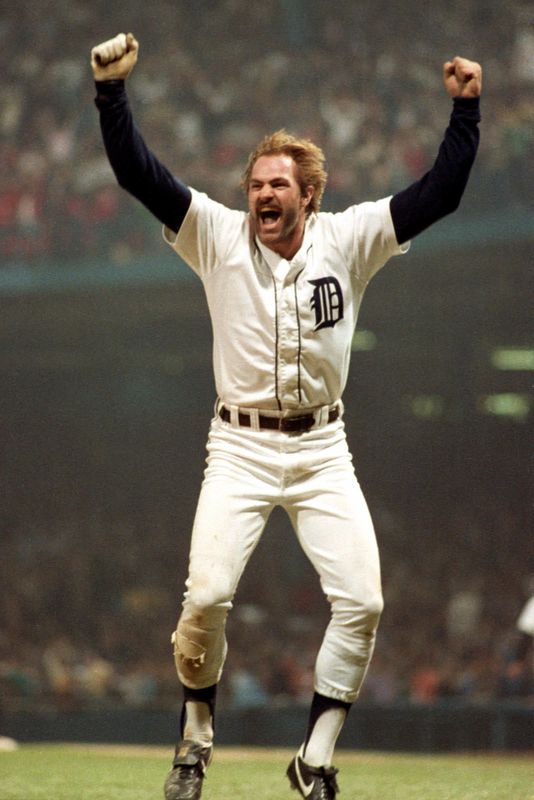
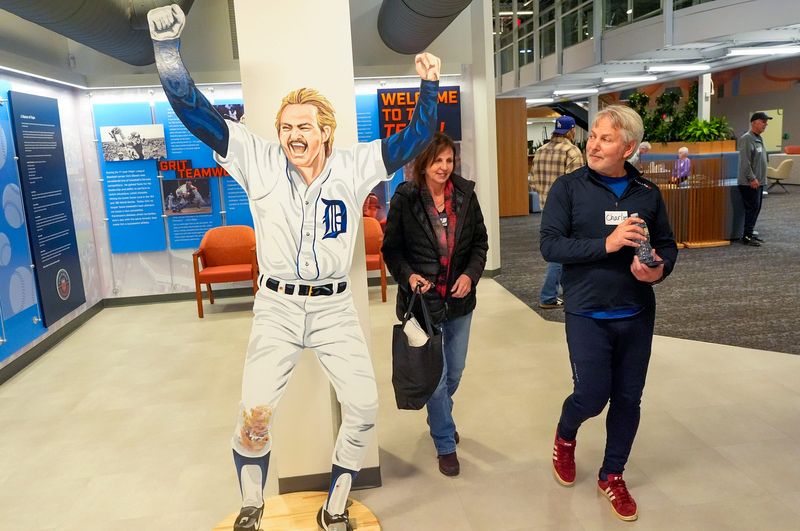
Down the hallway, toward a familiar oversized photo of Gibson wearing the old English “D.” Both his arms are raised, fists clenched after hitting a home run off San Diego’s Goose Gossage in Game 5 in the 1984 World Series. It was taken by Mary Schroeder for the Detroit Free Press; now, it is featured in a timeline of Gibson’s career, emblazed with the words: “Grit. Preparation. Attitude. Teamwork. Leadership. Welcome to the team.”
Just a few feet away, at the front of the center, Gibson has an office – like a baseball manager’s office, just outside the clubhouse. Peek inside and you see a simple desk and chair. When he’s not hunting somewhere – living life, as he says – he greets people with a challenge: “You wanna play ping-pong?”
“It’s not just Kirk’s name on this,” Annear says. “He has been involved in this every step of the way. It’s so important to have his desk up there, up front, and to always be involved.”
Keep walking into the massive room. Keep moving. That’s the key to all of this. Don’t be afraid. Everybody is the same here. No judgments. No funny looks if you stumble or your face shows no emotion – frozen like a mask – or your voice has shrunk to a halting whisper. There’s no reason to tuck your hand in your pocket trying to hide the tremors. There is only one thing here: Acceptance, for all.
There’s a sense of shared understanding. A true team.
“We don’t refer to it as rehab,” says Mary Lynn Foster, the CEO. “It’s not just one class and go home. You can come and enjoy multiple classes and camaraderie.”
No. This isn’t rehab. This is a brawl against a disease.
You enter a giant, open room, which they call the infield. It’s the center of everything. The room is filled with people. Some doing art. Some sitting at tables, piecing together jigsaw puzzles – keeping their minds sharp while exercising fine motor skills. That happened organically. People just started to bring in the puzzles.
Others are in a music room, playing electric guitar. “Everything you could do as a little kid, you can do here,” Gibson says. “It makes you feel like a little kid. Makes you feel better than sitting at home by yourself getting stiff.”
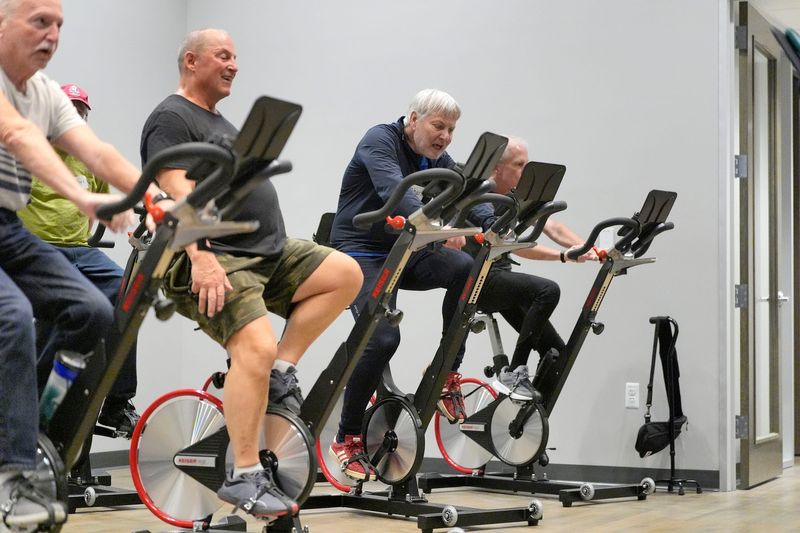
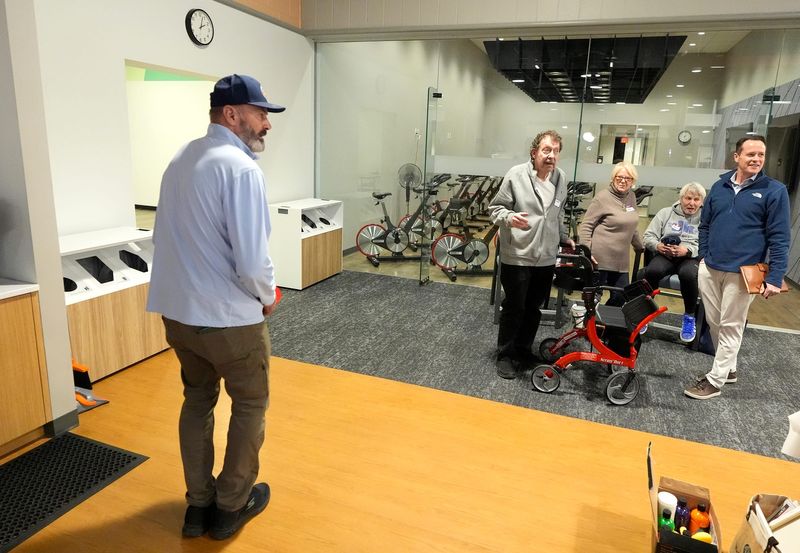
Take a look around. There are people are in the cycling room or doing yoga or tai chi or dance or working out in the weight room. Planet Fitness donated treadmills, bikes and resistance machines. The center also has Keiser resistance machines – some of the fanciest, safest, high-tech weightlifting machines you could ever imagine. Instead of using weights, these machines use an air pressure system, so that someone who experiences a sudden tremor aren’t risking injury.
To start any machine, you have to punch in a personal code which brings up preset, customized workouts. Everything is recorded and computerized. Gibson needs data; he wants to prove to insurance companies that this approach works.
This entire place is based on movement. Getting stronger. Living life. And fighting Parkinson’s.
But they also have dugouts where a care person can hang out when somebody is taking a class and they also have quiet rooms where you can be alone and just chill.
“People with Parkinson’s, especially with my dad, their sleep gets really messed up,” Cam Gibson says. “They’ll sleep in two-hour increments, wake up, sleep another hour, wake up, it makes their sleep habits just all wonky. So if you put the quiet rooms over there, you put these chairs in here, come in here, turn the lights off and just conk out. We don’t care. Do whatever you want when you come in here; if sleeping is one of your pieces of therapy that helps you, then come and do it.”
In another room, more than a dozen people are sitting around a table, taking a speech class.
“The goals of this class are to improve your speech and voice, maintain and retain swallow function and engage the brain,” says Jennifer Tondreau, the instructor.
Everything here is intentional. From the classes to the warm, inviting vibe.
And the most amazing thing has happened.
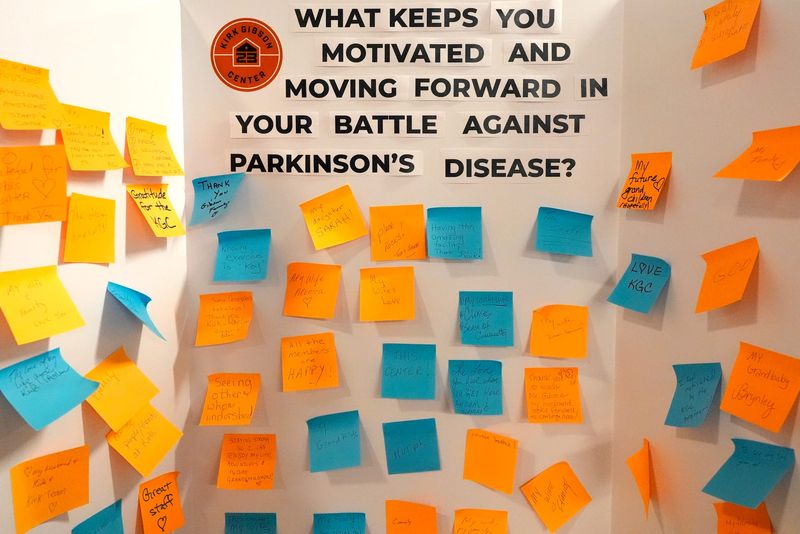
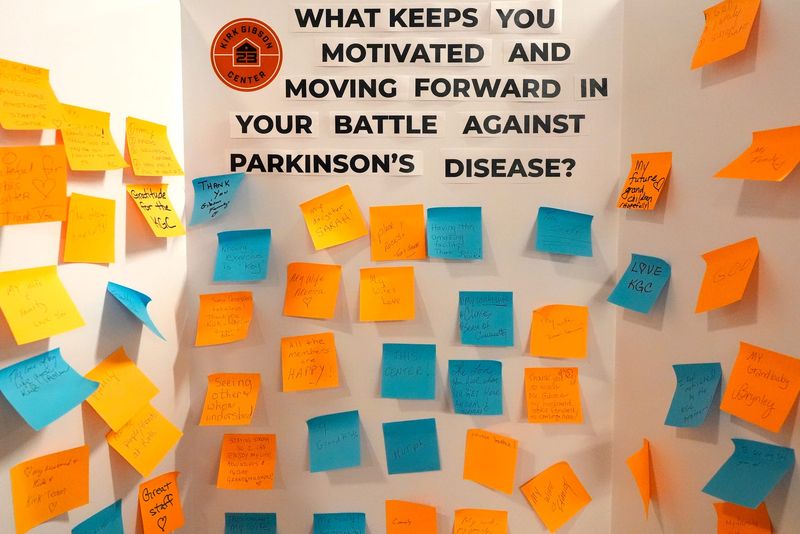
People who have been suffering in silence suddenly have found comfort in community.
“It really gives us another family and team, teammates, camaraderie, no one feels like they’re being judged because we all have the same disease,” says Kenny Mahn, a 79-year-old from Plymouth who was diagnosed 10 years ago. “We’re rooting for each other.”
It’s a place where everybody understands each other. A place where nobody stares.
“You can feel something special here,” I say.
“I say there’s a secret behind that,” Gibson responds.
“There’s a secret? What is it?” I ask.
“There’s a secret about this place,” he says. “We’re gonna figure some [stuff] out. And the first step to being successful, I guess, and to advance an agenda – whether I was playing football, baseball, parenting, speaking – is to believe you can do it.”
Punching Parkinson’s in the nose
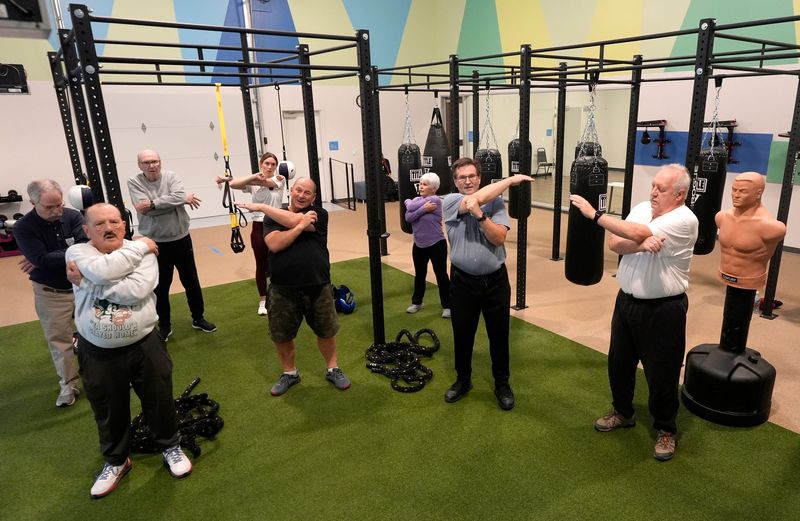
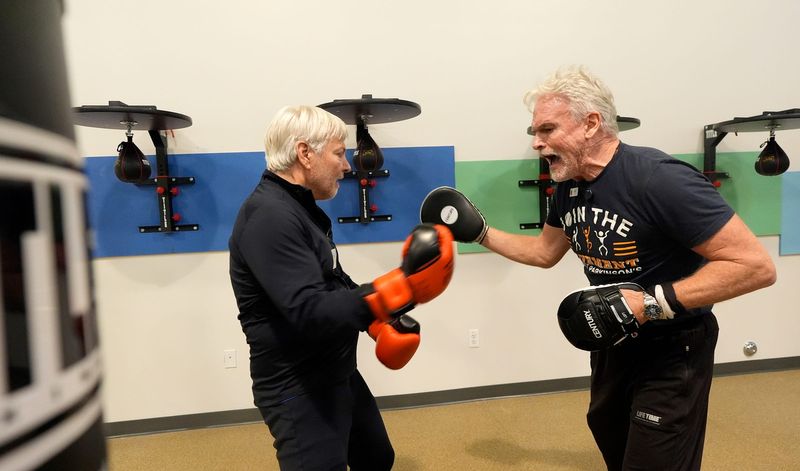
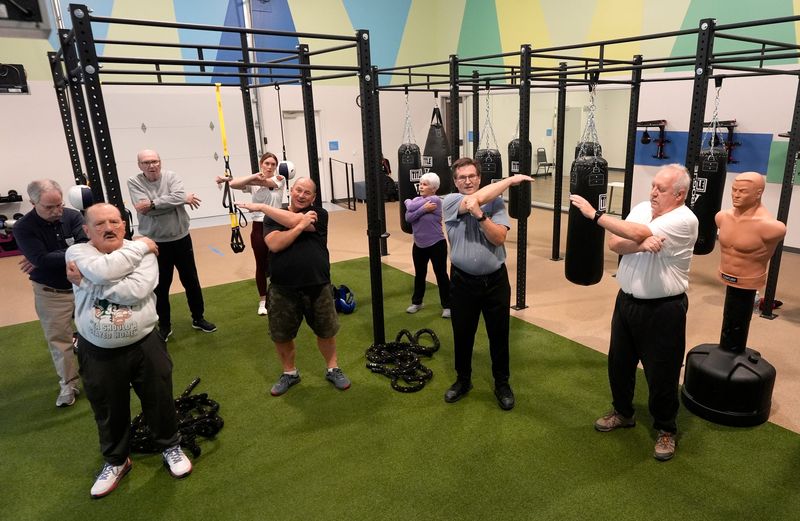
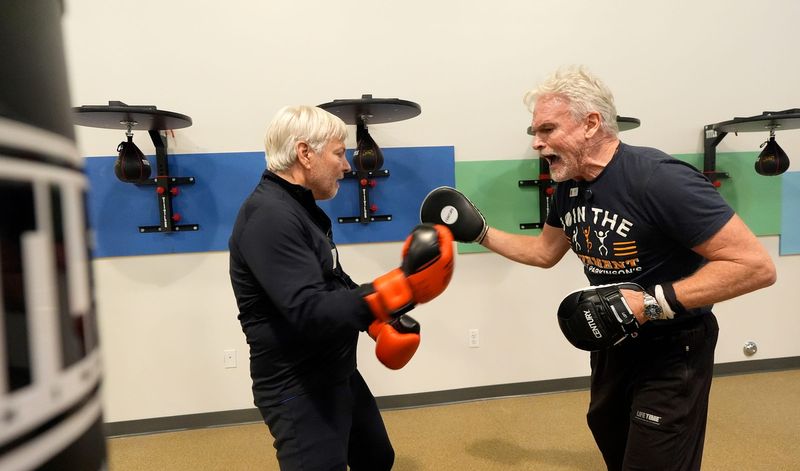
Now, into the boxing room. That’s coach Rob Murphy calling together a class of men and women.
“Let’s make our semicircle of athletes,” he says. “We’ll get to our athlete introductions.”
How long has it been since somebody called them athletes?
“What is one word to describe your battle with Parkinson’s?” Murphy asks those in his class. Most are men, which isn’t surprising; men are 1½ times more likely than women to get Parkinson’s disease.
“Grit,” somebody says.
“I love it!” he says.
They go around the room, answering his question.
“Victory.”
“Challenging.”
“Brawl.
“Joy.”
“Discouraged.”
“Determination.”
“Perseverance.”
“Challenged.”
“Exhaustion.”
It’s clear that the fight against Parkinson’s disease is different for everybody, and it seems to change daily.
“I love all those words,” Murphy says. “My word is ‘hope.’ Faith, love and hope. Hope there is a cure. But through exercise, hope we can win today’s battle against Parkinson’s. All right, so today, athletes, we are going to move and groove.”
They start warming up for a 50-minute class that is a combination of calisthenics and bagwork.
After the class, he gathers everybody together.
“Bring it on in, athletes,” he says. “I loved all the words, but the one I probably have to lean to is ‘perseverance.’ There are days when we don’t want to come. I guarantee you will not regret the workout you do, it’s the ones you don’t do.”
He hugs Charlie Rashid, 65, of Royal Oak, who was diagnosed with Parkinson’s at 39.
“This place has given me new life,” Rashid says. “It’s given me motivation. It has given me enthusiasm and it’s given me spunk. I have reason to get up now in the morning, I look forward to coming here. I can see a vast improvement in my strength. My balance is better, my endurance is better, my coordination is better, and I think that I’m better person.”
For the first time in a long time, Rashid feels like an athlete again. He wrestled at Detroit Catholic Central, and this reminds him of those days. It’s the same mantra: never give up. He loves how Coach Murph treats him.
“Treats you like a man,” Rashid says, his voice gruff. “Not everyone can handle being pushed. And I happen to enjoy it. He will demand the best – hit that bag! Hit that bag!”
Rashid feels whole here. Part of a family. And he doesn’t feel judged, like he does in public. “Everyone here is so friendly,” Rashid says. “You walk into a restaurant, and you look like a goof. With the face and the stumbling. But here, you can walk in and, everyone looks the same.”
That sense of community is one of the most important parts of this center.
“When you’re out in the real world, sometimes you feel like a spectacle,” Rashid says.
Over the years, Rashid has struggled with depression – one of the common effects of Parkinson’s. But he says it has improved since coming to this center.
“I can see that’s alleviated, and I don’t feel the need for the pills,” he says.
Gibby’s new challenge
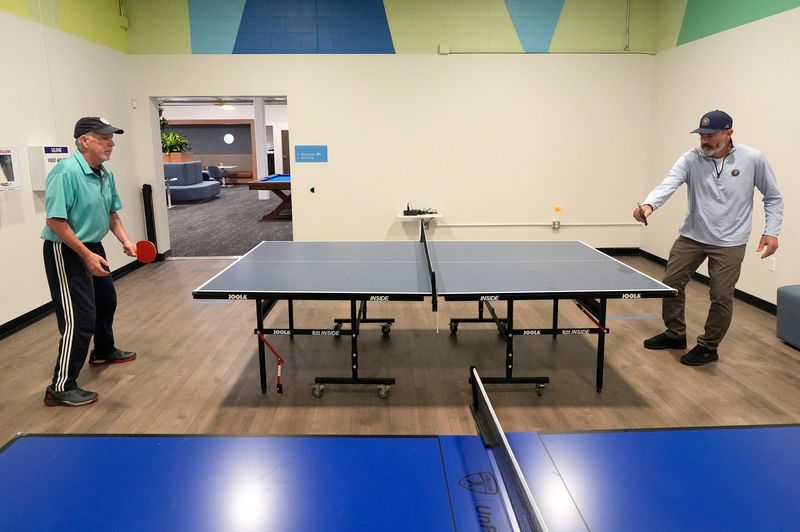
Now, go into the clubhouse, as they call it. To the ping-pong room.
“Are you looking to play?” Gibson asks.
“Yeah,” Doran says.
Doran grabs his personal paddle, rather than one of the house paddles.
Doran was one of the original members at the Center and it has changed everything for him. He’s getting stronger and lighter and he has found acceptance of the disease. He’s not giving in. Just learning to make the most of what he has.
“You have your own paddle?” Gibson asks.
“Yep, don’t you?” Doran says confidently.
Ooh, game on.
“We played Game 1,” Doran says.
And Doran beat Gibson.
“He said, ‘Let’s go again,’ after the first game, the second game, the third game, the fourth game, and then five games that day,” Doran says.
Gibson didn’t know that Doran was an accomplished competitive ping-pong player.
“What is Gibby like when he’s losing?” I ask.
“He was getting a little impatient, making mistakes that he wasn’t making earlier. But, I mean, he’s a competitor, right?”
But maybe that’s the secret of this place. The friendly competitions. The training and intentional hard work wrapped in encouragement.
“It’s just, the camaraderie and the togetherness and you’re in it, I’m in it,” Doran says. “Let’s pull together for each other.”
Doran feels a sense of family at the center – a beacon of light – and his wife volunteers at the front desk.
“My wife and I just made a modest contribution because even though it’s free, we don’t feel like taking something like this, this blessing, for granted,” he says.
Gibson, for one, has always hated to lose.
So, he got a new paddle, and kept playing, kept practicing, kept improving.
And in mid-January, he beat Doran.
Gibson’s battle keeps changing
Gibson sits outside one of the workout rooms, watching several people walk out of a class.
“See that?” Gibson asks, noticing a man walking hunched over with poor posture, shuffling along. “That’s Parkinson’s.”
This disease tries to make everything shrink and collapse.
“You start walking bent over,” Gibson says. “It’s grabbing me.”
He demonstrates, pulling his body into a ball.
“You just start shrinking down and you don’t use your muscles,” he says. “They shrink but get them out there. Get those toes up, lean forward.”
Like a coach instructing himself, he starts doing it as he talks, stretching out his legs.
He has some simple exercises to work on his posture. To be big. To not collapse.
“Get those toes up, lean forward, hands up, and you squeeze those knees together,” he says. It’s like he uses every moment to keep moving, keep fighting back. “You just got to work on your posture. That’s one of the greatest things.”
But even with all the work, even with this new center, Gibson is experiencing the effects of the disease. His ability to walk has changed over the last six months or so. “My legs feel dead,” Gibson says.
About six months ago, he tried to get out of bed and collapsed: “I just went down.”
He thought it was a nerve in his hip. But then it moved to the other hip.
This disease is never the same. It seems to move like an evil force, landing in different spots, depending on the day.
Gibson still travels around the country to go hunting. But it’s getting harder. “The long drives are just harder for him now, because if he sits for too long, he’ll stiffen up a little bit,” Cam says.
Gibson’s gate has changed and he has a “mask face,” as he says. “Not much emotion in it.”
He starts to rattle off his other current symptoms. “My left hand clutches,” Gibson says. “I slobber. I did a joke when we opened [the Center] up. I just said, before we get started here, everybody know you may have noticed that I have this slobber cloth in my hand, and you’ll also be able to bid on that in the auction.”
He pauses, waiting for my laugh.
I break into a smile and his face remains blank.
One of the effects.
Stacking the wins
Gibson approaches this center like a baseball manager.
First, he focused on getting the culture right.
“He stresses to us every day, this is about culture,” Annear says. “As you probably know, he changed the course of two World Series. He’s all about locker room culture. He knows how important that is, and that’s what he wants here. We define community as people feeling like they belong. That comes from Kirk.”
Then, he started stacking wins.
Every detail here was chosen to make people feel comfortable. From the color scheme to the dugouts where people can hang out to specific chairs in the giant group room, all of differing sizes because Parkinson’s doesn’t hit people the same way. Nothing is one-size-fits-all.
“Parkinson’s is a really isolating disease,” Annear says. “It’s a hidden disease. People are not aware of how prevalent it is in the United States and in the developed world right now. It’s a massive problem that’s getting worse. So until a cure is found, what Kirk wants to do for the people of Michigan is provide them a way of feeling better, feeling great about themselves, but also getting physically better and slowing down the onset, which is what movement does.”
Gibson will try to motivate everybody, just like he did when he was a manager.
“He knew how he wanted his team to operate when he was a manager,” Cam says. “He wanted to have fun, but he also wanted to get things done that they needed to get done. That’s what he wants to do here. It’s almost like this is his team, and he’s the manager here. He’s gonna challenge you, whether you’re sitting there and he’s like, let’s go play ping-pong, or let’s go play pool.
“He’s gonna interact with everybody. He wants them to know that they can come to him if they need him. That’s why his office is front and center.”
“So, you are the bench coach?” I ask.
“What am I?” Cam asks rhetorically. “I’m like the batboy. I just get all this [crap] done that nobody else wants to do.”
Focusing on what is next
Has this been an incredible success? By every measure, the answer is a resounding yes. And Gibson doesn’t want to hear it.
He acts like a manager who is leading a division in August. Refusing to even acknowledge the wins. Focusing on what could go wrong until the champagne sprays throughout the clubhouse.
“This is going and the story’s good, and we’re keeping our fingers crossed that we will continue to find out good things,” he says. “But I’m working on what we’re doing four years from now right now.”
“What is your vision?” I ask.
“I can’t tell you,” he says.
Then, he offers a clue: “The data is golden, but how do you store it? What does it mean?”
They want to do years of research so they can show – no, they want to convince insurance companies to pay for this kind of treatment to strengthen bodies, slow the disease, reduce falls and save money on the back end. They want to show reduced hospitalization rates for people with Parkinson’s who come to a center like this.
But it’s going to take years.
And like any great manager, Gibson is preaching “process.”
One step at a time. One win at a time. Stack the good days together.
Due to the Center’s rapid growth, they are planning to begin construction this spring on another gym within the Center, which will provide for even more group classes. After averaging nearly 110 classes per week in early December, it was bumped up to nearly 130 a week by the end of January.
When people approach Gibson and thank him, he feels guilty. “I certainly didn’t execute it without 30 others,” Gibson says.
OK, maybe more than that.
Gibson credits the amazing dedication of volunteers and generous donors and the tremendous coaches and the talented people on his board. “They’re freakin’ incredible,” Gibson says. “They’re so invested in it.”
He is quick to spread the credit. Like a pitcher giving credit to his teammates after a win.
Nobody can do this alone and Gibson knows this fight is bigger than him. The Center has formed a partnership with the Michigan Parkinson Foundation to provide educational and support services.
“Maybe your loved one has just been diagnosed,” says Mary Lynn Foster, the CEO. “You’re just leaving your neurologist and you don’t know what’s next.”
Well, they want you to turn to the Center.
Even though this center is already helping hundreds of people around Detroit, Gibson worries about everybody else. Who is helping a farmer in rural Michigan, or somebody in the Upper Peninsula?
Who is taking care of them? How are they getting services?
“We’d love to get satellite facilities around the state,” Gibson says, focusing his attention years from now.
He hints at other changes. “There’s a rumor that I’m gonna put a golf simulator in later,” he says with a twinkle in his eye.
Yes, there’s so much more to do, so much to accomplish, and Gibson is on a mission. This is his new team. His new battle. His hardest challenge.
And you know something?
While those World Series rings represent championships and incredible memories for countless fans, this feels bigger and far more important. Gibson has taken his passion, power, status and ability to motivate, and he has transferred it to a far more noble cause: helping hundreds of people who desperately need it.
What an amazing legacy. What a lasting impact. Creating a team and a culture, bringing together those suffering in silence, making lives better and trying like heck to beat this horrible disease.
It’s, by far, the most important swing of his life.
Trying to make the impossible happen, one more time.
Contact Jeff Seidel: jseidel@freepress.com. Follow him on X @seideljeff.
MORE FROM SEIDEL: How a Charlevoix crash survivor earned his own Christmas miracle
This article originally appeared on Detroit Free Press: Kirk Gibson’s legacy grows bigger and stronger every day
Reporting by Jeff Seidel, Detroit Free Press / Detroit Free Press
USA TODAY Network via Reuters Connect