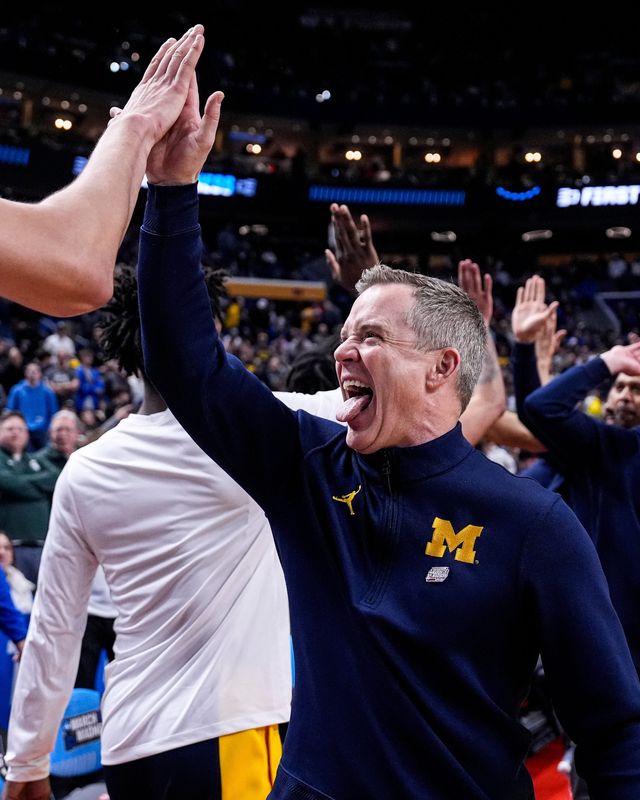
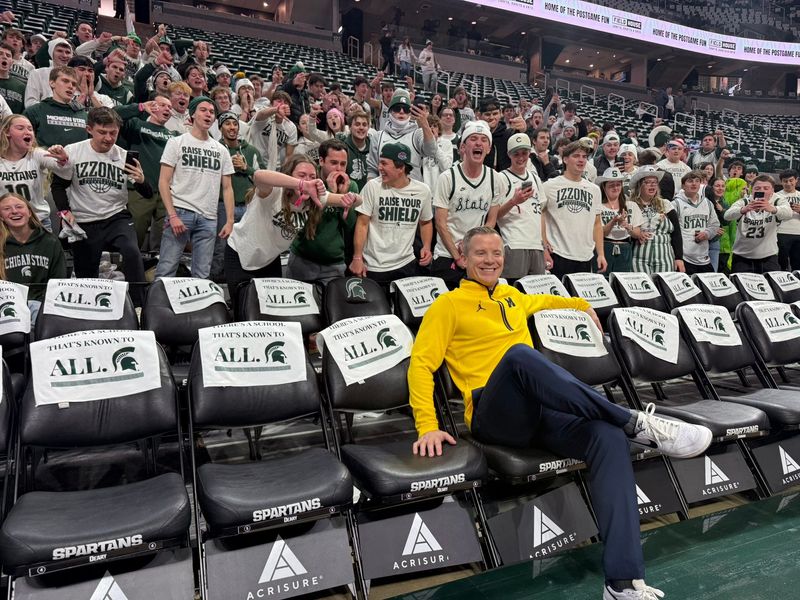
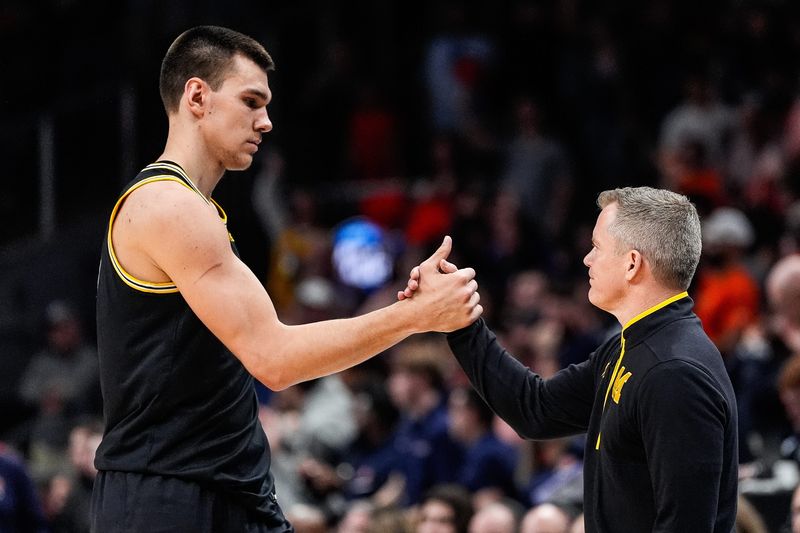
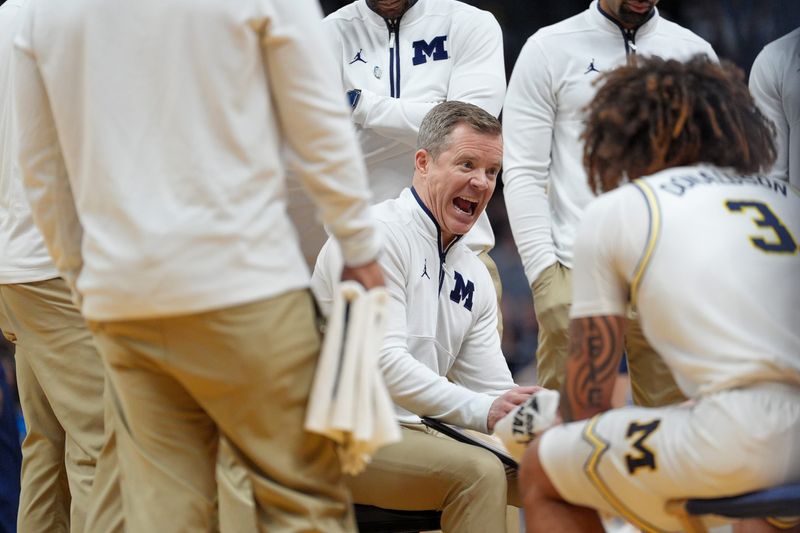
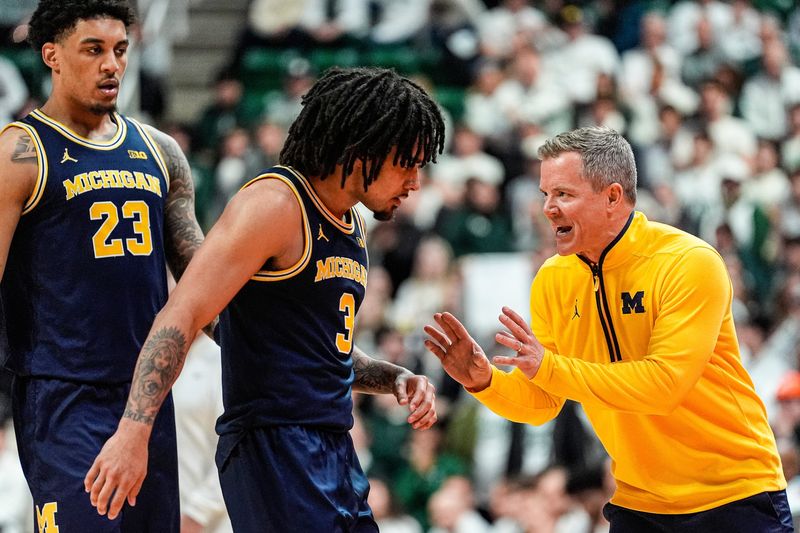
He is seemingly unflappable on the sidelines, his boyish face expressionless, his neatly cropped hair devoid of sweat. With his arms crossed and his jaw set, he could be a civil engineer overseeing a bridge build, or a chairman of the board staring out his penthouse window.
So it might stun you to learn that the day Michigan basketball coach Dusty May got his first head coaching job in college basketball, he cried.

Not out of joy. Quite the opposite. He thought he’d made a terrible mistake. He’d signed a contract with Florida Atlantic before getting a true look at its facilities or the existing team (“I’m a terrible businessman” he confesses) and once he did, he panicked.
“I remember it like yesterday,” May says. “I went back to the hotel and realized it was too big of a job. There’s no way I was going to build it. I thought I’d just committed career suicide.”
May had, to that point, been the ultimate staff member. The guy who’s never late, who works 120 hours a week, who finds no task too small, no request too unreasonable.
Such dedication let him rise from a student manager for Bobby Knight at Indiana to assistant coaching gigs at Eastern Michigan, Murray State, UAB, Louisiana Tech and Florida.
“I was incredibly happy as an assistant at Florida. I thought we had a Final Four team coming back. Then to go into that (new situation) and feel like the world is collapsing around you because of what you didn’t know.”
He was 41. In charge. And over his head.
So what turned him around?
“My wife. She gave me the tough love she always has. She said, ‘You’re not backing out of it now. You gave your word. So let’s get after it.’
“I started making recruiting calls about five minutes later.”
You look at what Dusty May has accomplished since that moment in 2018, taking FAU — a glorified commuter school in posh Boca Raton, Florida — all the way to a Final Four and a 35-win season, then landing with Michigan and turning an 8-24 team under Juwan Howard into a 27-10 record and a Sweet 16 spot in the NCAA Tournament in May’s first year, followed by this year’s Big Ten regular-season title, a 1-seed in the NCAAs and — so far — a 33-3 record heading into another Sweet 16 matchup against 4-seed Alabama, and you emerge from that hurricane of accomplishments with a single question:
How does he do it?
It’s simple.
He listens.
Lessons from Bobby Knight
Coaching, at many levels, can be a performative art. Especially in college basketball, where the players come and go so quickly that teams are identified coach-first. They are “Mike Krzyzewski’s Duke Blue Devils,” or “Rick Pitino’s St. John’s Red Storm.”
It’s easy, in such an environment, to become an audience to your own legend. Putting on a show. May, now 48, no doubt witnessed that working for Knight, who ultimately became so consumed by his own Patton-like persona that he overplayed it and got fired.
Like so many small-town kids in Indiana — he was raised in Greene County, about 30 miles from Bloomington — May grew up dreaming of playing for Knight. But when he peaked at 5 feet 10, he shifted his dreams from suiting up for the legend to studying him.
So much so that May walked away from his Division II college team at Oakland City University after one semester to became an unpaid student manager at Indiana. Playing ball was a joy, but coaching, he believed, was his calling.
“What did your friends say,” he is asked, “when you gave up playing to be a student manager? You were only 18. Didn’t they think it was cooler for your social life to be an athlete?”
“Well,” he says, chuckling, “it was Indiana, I was a small-town guy, and Bobby Knight was like a god. So that was cool enough.”
May learned a ton at Indiana, doing everything from breaking down tape to recording games, keeping statistics and mixing with players during drills.
But mostly what May learned is that working for Bobby Knight didn’t make him Bobby Knight.
“I tried to be a mini-version of coach Knight when I started coaching at 19. And I realized after one summer that that wasn’t the best way for me.
“I remember coaching an AAU game in Lexington, Kentucky, and we’d gotten up early and driven four hours, and I was a college student, I didn’t have money, so we had to fundraise for the gas money and the typical stuff.
“We’re playing poorly at halftime, and I’m literally screaming at them, ‘Why did we do this? We spent this much on gas money! Why did we get up and do this? I did this! I did that!’
“And then I realized, they don’t really care that you had to raise the gas money. I needed to separate myself out and find a way for them to be the best they could be. And it wasn’t through screaming and intimidation.
“I didn’t enjoy it. They didn’t enjoy it.”
And so, he went the other way. instead of yelling, he focused on listening. And like Robert Frost’s road less-traveled, that has made all the difference.
A cultivator, not a commander
Consider the challenge facing May when he took over the Michigan job. The program was in the dumper. Only three players were returning. NIL money and the lighting-quick transfer portal — things that didn’t exist when May started at FAU — were now determining factors in building a roster. And May was not exactly a magnetic household name, despite his Cinderella successes at FAU.
But one thing May had done his whole career was cultivate relationships. Someone who used to work with him. Someone he befriended or met at a clinic. Heck, during his interview for the U-M job, May reminded athletic director Warde Manuel that Warde’s wife was the realtor who sold Dusty his first house in Ypsilanti in 2005.
That type of personal networking helped May bring transfer Vlad Goldin with him from FAU, despite many other schools chasing after the talented center. And forward Danny Wolf, upon leaving Yale, had some connections to U-M that May parlayed into his transfer to Ann Arbor.
Those two became star pillars of May’s surprisingly successful inaugural run, as did transfers such as Roddy Gayle Jr. and Tre Donaldson, whom May circled in on and quickly closed.
“In the first year,” May admits, “it was probably more the brand of Michigan that brought them in than me.”
By the second year, that had flipped. Word got out about how May’s teams played, how tight they were, how May was more a cultivator than a commander.
Plus, May and his staff were very clear about the type of player they were looking for. If you want to be “the man” at a program, stack your numbers, build your brand, parlay your stats into an NBA lottery spot, “then you shouldn’t come here,” he says.
That no doubt turned away some. But it attracted others.
“Believe it or not,” May says, “I think there are a lot more players that want to play like that than most people realize.”
In search of vulnerability
Still, selling a team concept in an ego-driven sports world isn’t easy. May has managed to do it. Take Yaxel Lendeborg, who was considered the No. 1 transfer prospect in college basketball last year. He reportedly turned down an NIL deal in the $7 million-$9 million range from Kentucky to play for Michigan (at about half that amount.)
And no, it’s not the same as getting a player for free. We’re still talking millions. But any time an athlete takes less money, there’s a reason.
The reason in Ann Arbor is now the coach. Not just how he talks, but how he reacts when players talk.
“I’ve studied some of the best educators outside of sports,” May says, “and I feel like when these guys are in a very stressful moment in a game, each situation needs something different. It might just be a hand on the shoulder to get them to relax and refocus, or it might need to be a sharp word to get them motivated or ticked off at me.
“Reading the situation and trying to figure out what makes each guy the best, being fair but being demanding without trying to bully them, that’s what I want to achieve.”
May offers the example of a new player during a film session last year who kept answering May’s questions with what he thought the coach wanted to hear. May kept stopping him and saying, ‘’No, just tell me what you saw on this play, not what you think I want. I’m not trying to critique what you’ve done. I’m trying to understand how you see the game. Be brutally honest with what you saw and what you were thinking.
“I’m trying to get them to be very vulnerable with who they are and where they are. Then I can help them.”
How many times do you hear “vulnerability” as a prime objective? Maybe in a therapist’s office. Rarely on a basketball court.
Big stakes, better performance
But May’s ears and patience have molded Michigan into a powerful unit now, one favored by many to make the Final Four and even to win it all. May, the married father of three sons, is well-liked in Ann Arbor. He’s already had his contract reworked. He steers an even-keeled ship, values dignity and communication and gets along with the media. His players marvel at his ability to jump in and work out with them, on the court or in the weight room.
But in only his second year, it’s the system he’s developing that offers the biggest promise. Remember, this is a wholly different group than last year. Aday Mara is a transfer from UCLA. Morez Johnson Jr. transferred from Illinois. Lendeborg came from UAB. Trey McKenney was recruited out of high school in Michigan.
All four received Big Ten honors this season. We haven’t even mentioned Elliot Cadeau, Nimari Burnett or Gayle.
It’s the type of roster that can play a lot of different ways — smother you on defense, play over your heads with big men, drill you with fast play and high percentage shooting.
But to May, the best weapon is attitude.
“This team has a very businesslike approach. We didn’t celebrate when we made the Sweet 16 this year. That was up to the players. They just felt like that was another step towards our ultimate goal.”
In that way, they are mimicking their coach. That calm façade on the sidelines? That hard stare, but emotionless look?
It’s deliberate.
“If I get too emotional over a call or effort, then I can’t see what I need to be looking at next. I can’t anticipate what they’re doing. I don’t feel like I can make the right suggestions to our guys, because I’m thinking with too much emotion.”
And therein lies the secret sauce of what Dusty May has done in less than two full seasons. Take the emotional air out of where it doesn’t belong (ego, player rivalries, anger over foul calls) and put it into where it does (listening, analyzing, advancing.)
“We’re attacking this week just like we have the others,” he says of the Midwest regional semifinals and final opening Friday. “It’s not the NCAA Tournament, it’s a small tournament in Chicago against Alabama and then either Tennessee or Iowa State, and we have to be prepared to play good basketball.”
“But, I will say this about our guys.” He pauses. “The bigger the stakes, the better they perform.”
Going back to that panicked day in his hotel room — and seeing where May is today — you can say the same about him.
Contact Mitch Albom: malbom@freepress.com. Check out the latest updates on his charities, books and events at MitchAlbom.com. Follow @mitchalbom on x.com.
This article originally appeared on Detroit Free Press: In Dusty May, Michigan basketball has coach who listens as much as he teaches
Reporting by Mitch Albom, Detroit Free Press / Detroit Free Press
USA TODAY Network via Reuters Connect