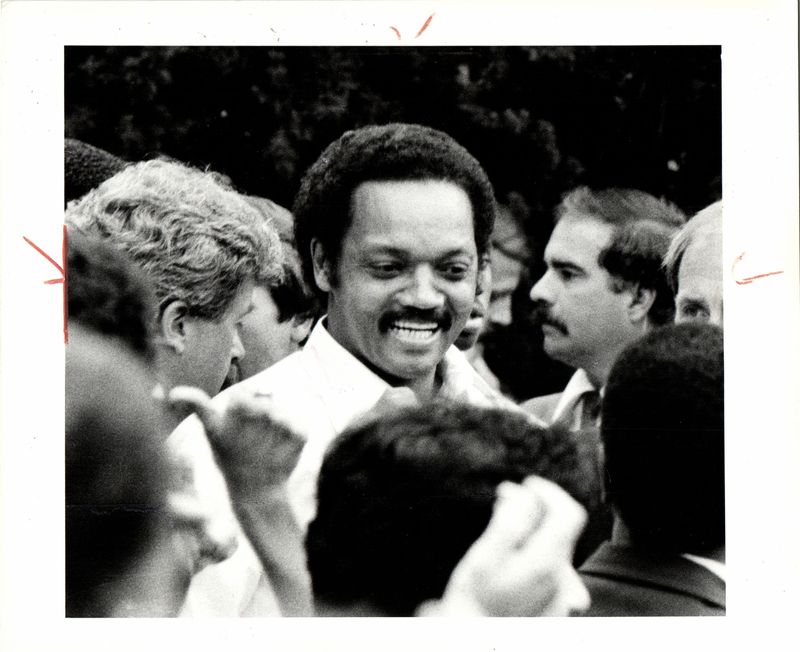
I spent a month touring Australia by bus in 1988, all by myself, the same year Jesse Jackson was campaigning for president for the second time.
I managed to cover quite a bit of territory during that visit, but one of my most memorable stops was at a tiny — and I do mean tiny — one-stoplight town of several hundred residents named Auburn, located in the middle of nowhere in South Australia. I had planned to only spend one night at the bed and breakfast, which was located in a bar owned by an extremely welcoming married couple, the Shepleys, who had been referred to me by a friend in Ann Arbor, where I was working as a reporter at the Ann Arbor News. I wound up spending three nights instead.

Had the time of my life, that is, after the residents recovered from the initial shock of meeting an actual Black American. My exploits in that one town were enough to fill a book, and who knows? Maybe one day.
But I do want to share one small recollection from that trip, because it relates to Jesse Jackson’s impact, not just in the United States, but globally — even in a tiny Australian town halfway around the world.
No one in Auburn that I met had ever met a Black man from America, and they certainly had never even been exposed to the possibility that a Black American male like Jesse Jackson, running for president of the United States, could exist in the real world.
When I arrived in Auburn, it was dark, and I was a bit nervous. Especially when the bus driver told me that this was my stop, because all I saw was the dirt road we had been traveling on. But he assured me it was Auburn, so I got off the bus, holding my one bag as it drove away in a cloud of dust. I looked down the road, and noticed a light coming from a small convenience store. When I entered, the young kid working behind the counter looked like he couldn’t quite believe what he was seeing. I tried to calm him down by asking if there was a phone booth nearby. He pointed, and I said thanks. I entered the booth and dialed the Shepleys. Chris Shepley answered, and asked where I was.
“Turn around,” he said.
I turned around.
“Do you see the lights flashing on the porch? That’s us. Come on up.”
Turns out, Auburn only had that one phone booth, as well as one stoplight. So that is how small a town Auburn was.
As I said, I have a lot of fond memories of my time spent in that town. But the day that sticks out most for me is the day that Jesse Jackson won the Michigan Democratic Primary. A March 27, 1988, article written in the Los Angeles Times described Jackson’s upset victory:
“LANSING, Mich — In a stunning victory that gave a major boost to his presidential candidacy, the Rev. Jesse Jackson overwhelmed Massachusetts Gov. Michael S. Dukakis Saturday in the Michigan Democratic presidential caucuses.
Running strongly in white and black areas, Jackson got nearly twice as many popular votes as Dukakis, and also appeared to be winning considerably more delegates than Dukakis, based on the popular vote in the 18 congressional districts.
With 85% of the vote in, Jackson had 101,037 votes or 54% of the total, to 53,041 votes or 28% for Dukakis.”
But this wasn’t just news in the United States. This was actually front-page news in Auburn, South Australia.
Unfortunately, I didn’t keep a copy of that local newspaper, but the story was also on the television news behind the bar. And everyone in that bar was watching this news with near disbelief, but in a good way. I remember several of my new best friends kept looking back and forth between me and the unbelievable news breaking on the television screen.
I was never prouder to be a Michigan resident than I was at that moment.
Throughout my visit, the one thing I learned about Australians is that they can be very direct. If they like you, you’ll know it. And if they don’t, well, it’s not hard to figure that out either. Fortunately, I passed the test in Auburn, which meant that the locals had a ton of questions about Black people that they assumed I could answer for the entire race.
Most of their questions stemmed from the numerous misrepresentations they had been consuming about Black people, courtesy of what was being fed to them on their television sets. I will never forget how disappointed and amazed they were that I was so pathetic at the game of darts because they just assumed that, you know, as a Black person who is related to African people, well, surely I knew how to throw a spear. Even a small one.
Not a joke.
I also remember watching a television show that characterized young Black males as stereotypical gangsters and flamboyant criminals. The man sitting next to me at the bar asked if that was how Black people were in America. Serious question, no offense intended. Just wanted to know. So I told him that, sure, there were some Black males in America like that, but that this group hardly represented Black males as a whole. It was a sickening, gross distortion of who we were.
So when Jesse Jackson miraculously won the Michigan primary? Oh yeah. The line of questioning changed dramatically. Because now they were witnessing, for the very first time, a powerful, bold, exceptionally well-spoken Black American man who was campaigning to be president of the most powerful nation on Earth — and he had just defeated the leading white candidate in a major American state. My state. Now, for the first time, they began to realize that maybe they had been lied to, or at least not been given the full story about who Black Americans really were. Because this Jesse Jackson guy was for real. He was right there on the news, bigger than life.
Jesse Louis Jackson Sr. died on Feb. 17, 2026, at the age of 84, after living a remarkably meaningful life that defied all boundaries that attempted to constrain him. It is definitely true that he was as controversial as he was impactful — it would be dishonest to claim otherwise — but it is also true that Jesse Jackson’s life was the definition of a miracle. No one who came into the world with the challenges that were thrust upon him practically from the day he was born should ever have been able to become who he became. It shouldn’t have been possible.
It was considered impossible to everyone except Jesse. Did he have a massive ego? Sure. How could he have survived without it? How could a Black kid born to a high school mother and raised poor and struggling in South Carolina dare to run for president of the United States? Twice? What made such a man think he had the qualifications to successfully secure the release of Navy Lt. Robert Goodman from captivity in Syria in 1984 (the year he waged his first presidential campaign)? And then to successfully negotiate the release of dozens of hostages from various Western nations held hostage by Saddam Hussein six years later in 1990? And then to secure the release of three U.S. Army soldiers in 1999? And to accomplish and achieve more than I can possibly recount.
And, in the process, to change the world. As I saw in Auburn, Australia; back in Detroit, Michigan; and on election night 2008, when a Black man finally became president of the United States.
I’ll leave it to others to remind us all of Jesse Jackson’s faults. But on this day, I choose to honor him.
Free Press contributing columnist Keith A. Owens is a local writer and co-founder of Detroit Stories Quarterly and the We Are Speaking Substack newsletter and podcast. Submit a letter to the editor at freep.com/letters, and we may publish it online and in print.
This article originally appeared on Detroit Free Press: I rolled into Australia days before Jesse Jackson’s surprising win | Opinion
Reporting by Keith A. Owens, Contributing columnist / Detroit Free Press
USA TODAY Network via Reuters Connect