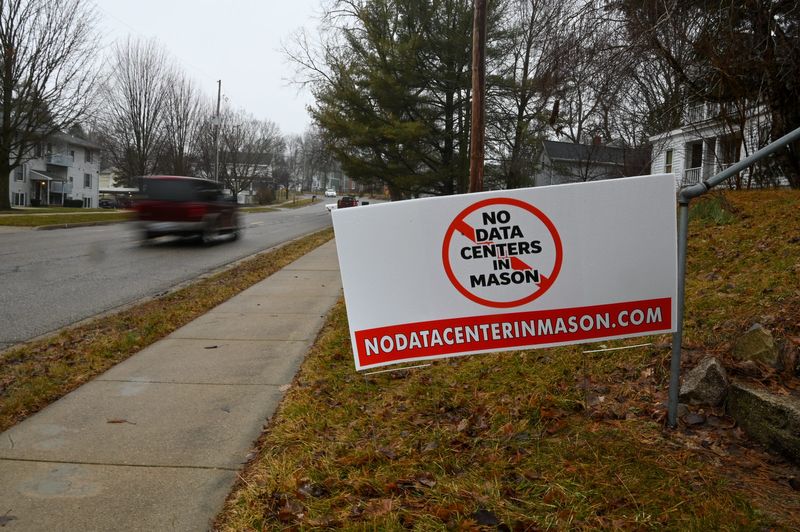
MASON — Amid clear interest from a hyperscale data center developer, city officials have suspended a controversial ordinance that laid down stronger rules for such facilities because enough citizens signed petitions to suspend it.
Councilmembers formally received the 755 valid signatures, more than the 600 required to put the ordinance up for a referendum vote, at their March 2 session. That action suspended the ordinance approved by council 5-2 in February to create a new Technology Innovation (M-3) zoning district in preparation of any data center proposals.

City officials had argued the new zoning rules were a proactive tactic to address any future data center proposals and to provide an environment for large-scale technology uses.
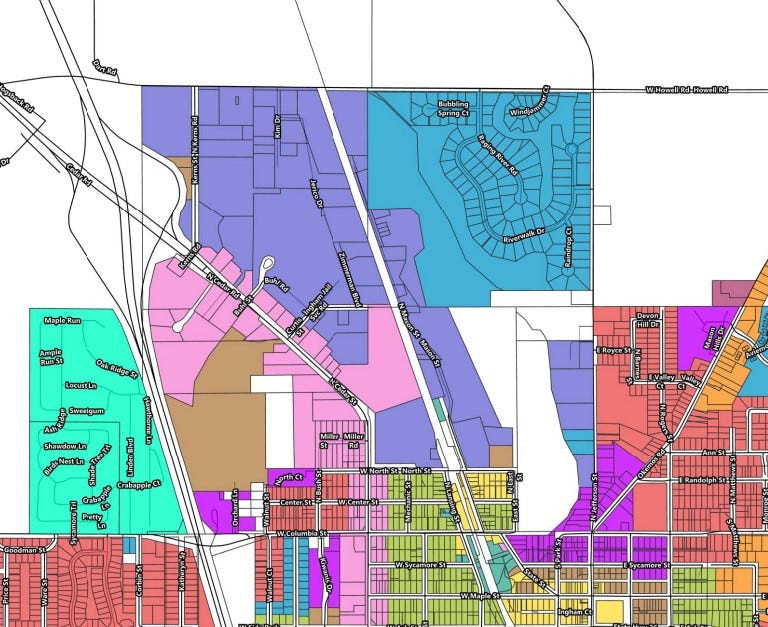
They added they wanted more stringent standards for data centers that under current rules could locate in areas of the city already zoned for general manufacturing, or M-2. That M-2 zoned property, according to the city’s zoning map, is on the outskirts of town — mainly in the northwest corner, north of Cedar Street, and on the south end.
Councilmembers are seeking a legal opinion before deciding whether to take the next step of repealing the ordinance that set noise, screening and other standards for data centers or letting voters decide on a repeal in August. Council could decide at its March 16 meeting.
Mason Mayor Russell Whipple said the city had not yet designated an M-3 district.
Attorney Alan Greene of Dykema Gossett PLLC in Bloomfield Hills reached out to the city on Feb. 11 asking Elizabeth Hude, Mason’s community development director, what the referendum could mean for his client, which is “evaluating sites for a potential hyperscale data center development within or near the City of Mason.” He declined to name his client.
Hyperscale data centers are large operations, on the scale of an automotive manufacturing plant and in many cases larger. For example, a developer gained approval in Oakland County’s Lyon Township for a six-building, 1.8 million square foot hyperscale data center on 172 acres.
Greene said his client’s project would be drawing primary power from Consumers Energy’s “grid” in sufficient quantities to provide full operational capacity on a 24/7/365 basis. Also, he said, hyperscale data centers utilize standby emergency generators to provide “backup” power in the event of an emergency that would need periodic testing.
“Specifically, my client formally requests written interpretation/confirmation from the City regarding (i) whether a hyperscale data center is a permitted use (by right) within the City’s existing M-2 (General Manufacturing) zoning district and, if so (ii) how certain ordinance provisions would be applied to a Data Center project. We are seeking this guidance to inform feasibility, site planning, and early design assumptions before approaching the City with a specific parcel and concept plan.”
Greene did not indicate that a location within the city has been chosen.
Greene did not respond to phone and email requests for comment. Hude deferred to City Manager Deborah Stuart, who also did not respond to phone and email requests.
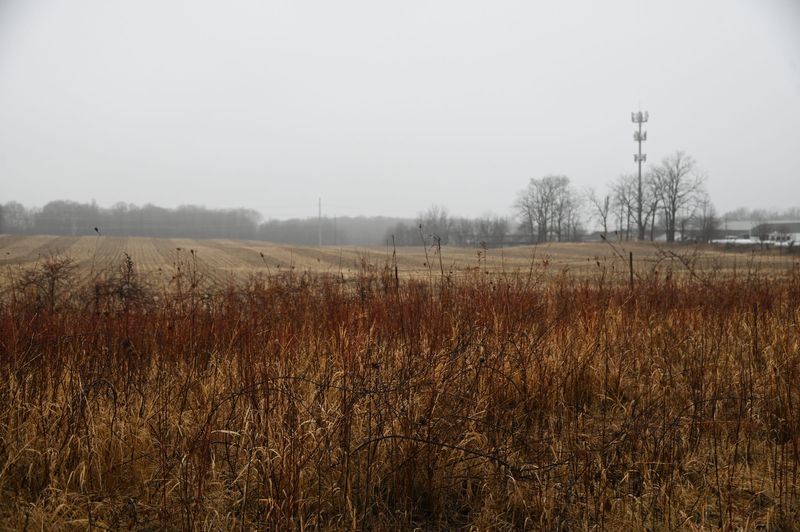
Meanwhile, Cathy Baird, of Vevay Township, is part of the Mason Data Center Facts group that organized the petition drive. She said there are rumors a developer wants to build a data center roughly between U.S. 127 and College, Columbia and Howell roads, an area that includes Vevay Township.
She was critical of the new M-3 zoning rules.
“It was a doormat waiting for a data center to come in, (and) it gave them no legal right to deny it,” Baird said of Mason’s M-3 ordinance. “We want it to go to the voters. That’s why we did the referendum. If we didn’t put that on a referendum, we would be a data center in another week.”
Baird said her group is upset because the M-3 ordinance would allow a data center “use by right.” In her interpretation, that means, as long as the proposed development met the city’s definition of a data center, it would have to be legally approved. She wants a “special use” provision that would allow more scrutiny and a legal denial if the project didn’t meet special use criteria.
Whipple has said he’s found it confusing and frustrating that the majority of the critics seem to be from outside the city. Baird agrees that roughly half are from Mason and a large portion are from adjacent Vevay Township, but said her son lives in the city and the township has a right to fear annexation in the case of data center proposals.
Whipple said the suspended district would have laid down more stringent standards than the M-2 industrial park requirements that a proposal will be subject to for now.
Under current M-2 zoning rules, the lighting rule for data centers includes the requirements that “no more than 1 foot candle of light shall cross a lot line 5 feet above the ground on a residentially used lot” and light would have to be directed downward as much as possible. Permitted noise levels would average 50 and 55 decibels at residential property lines and front setbacks would be up to 60 feet.
Under the new M-3 ordinance that has been suspended, stricter protections would include “dark sky” elements, such as limiting the height of lights and light level, noise levels of 55 decibels at residential property lines and front setbacks of up to 200 feet.
“But the law is the law,” Whipple said of the signatures. “The unfortunate thing is it doesn’t stop a data center from presenting a proposal to the city. It doesn’t stop the city from considering that.”
The state has been dealing with a quick succession of data center proposals, and Whipple said he learned Mason Data Center Facts was considering a petition drive around the same time councilmembers were reviewing whether to approve the M-3 district, which it did on Feb. 2.
“The referendum on the M-3 ordinance succeeded not because the residents didn’t want an ordinance, but because the one adopted was not sufficient,” Aurelius Township resident Megan Short told council on March 2. “Most importantly, the ordinance allows hyperscale data centers as a use by right. That removes meaningful discretion over whether a project is appropriately sited.
“That is the most critical flaw in the ordinance. It’s literally what we mean when we say, ‘This ordinance was a data center welcome mat.'”
Contact editor Susan Vela at svela@lsj.com or 248-873-7044. Follow her on Twitter @susanvela.
.
This article originally appeared on Lansing State Journal: Hyperscale data center eyes Mason as residents push back on new zoning rules
Reporting by Susan Vela, Lansing State Journal / Lansing State Journal
USA TODAY Network via Reuters Connect