

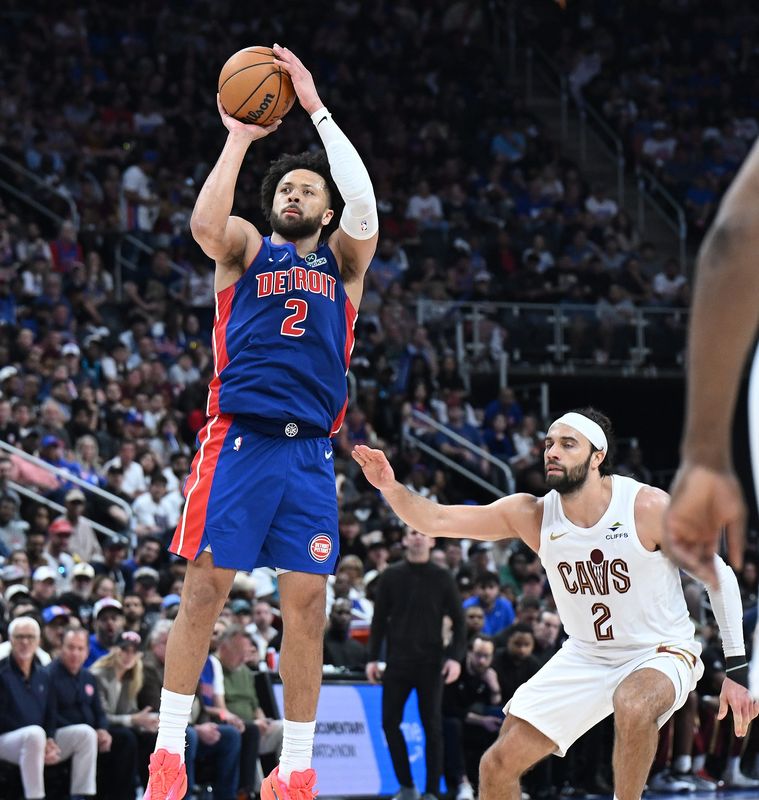
Detroit — The lasting image of Cade Cunningham for the 2025-26 season came at the 5:51 mark of the fourth quarter in the Detroit Pistons’ Game 7 defeat to the Cleveland Cavaliers on May 17.
Coach J.B. Bickerstaff substituted Cunningham for Ron Holland II during the final five minutes. Before walking to the bench, fans inside Little Caesars Arena greeted Cunningham with a standing ovation. They expressed their admiration for the All-NBA guard, honoring the player who has been at the forefront of the franchise’s return to prominence over the past two seasons. The love was particularly evident during the MVP-worthy leap he made while leading the Pistons to a 60-win season.

“Obviously, a disappointing series. Fell short of doing enough of the right things to win the series, but we were the number one seed for a reason,” Cunningham said after the loss. “We won a lot of games this year. We played great basketball all year long and really established our identity … one we hadn’t had for a long time. All those things are positives and things that we’ll take into the offseason and come back next year and grow from.”
Amid the applause, however, it was also a testament to the appreciation of watching Cunningham battle through the postseason, having recovered from a collapsed lung and working his way back into shape during the most intense part of the season.
“I thought Cade was an absolute warrior,” said Trajan Langdon, president of basketball operations. “I haven’t gone through a collapsed lung, especially with cracked ribs at the same time. For him to do what he did, we were all appreciative. What he did was not easy.”
Cunningham sustained a collapsed lung on March 17 during a game against the Washington Wizards. The injury caused him to miss 11 games. His recovery required him to remain inactive, which led to deconditioning a month before the start of the postseason.
Similar to his 13-point Game 7 performance against the Cavaliers, there were moments when Cunningham seemed far from the player who had been a brief frontrunner for league MVP honors during the regular season. Before the playoffs began, Cunningham revealed he was not at 100% health. Despite the issues he faced, Cunningham still put in one of the most impressive individual runs of the playoffs.
With the New York Knicks winning the Larry O’Brien Trophy on Saturday night, the 2026 postseason concluded, and Cunningham ranked among the league’s most prominent players.
“He was put in a really difficult position coming back from not being able to do much for 14 days, and at that time of the year, everyone is in elite shape. He was trying to get back to where he was,” Langdon said. “Before, I thought he was in incredible shape and ready to explode in the postseason. But what happened to him in Washington set him back, and I know it frustrated him. He did not get a chance to be his best self.”
While leading the Pistons to the second round of the playoffs, Cunningham averaged 28.1 points per game. It marked the second-highest postseason scoring average, trailing only Finals MVP Jalen Brunson, who led the league with 28.4 points per game.
With 394 points, Cunningham was the only player to rank in the top 10 in total points in the playoffs without advancing to the conference finals. He also tied Brunson and Paolo Banchero for the highest-scoring game of the postseason, with 45 points. Across 14 games, he also averaged 7.5 assists, ranking fourth.
However, Cunningham’s turnovers were the only drawback of his individual performance. Among teams that advanced to the second round or further, he led the league in turnovers, averaging 5.6 per game. He placed third in total turnovers with 79, trailing only James Harden (84) and Stephon Castle (80).
Cunningham faced challenges with ball security during the Pistons’ run to the Eastern Conference semifinals. It was one of several areas he aimed to improve during the offseason in hopes of returning better for next season.
“He will learn from the 14 games we played in the postseason,” Langdon said. “He is going to look at everything and realize that he has to become more efficient — all of our guys do. The more efficient we are, the fewer mistakes we make as a team. We are all going to look in the mirror and say, ‘How do we get better?'”
Although Cunningham’s postseason performance was strong individually, the All-Star guard was somber upon realizing the Pistons had fallen short of their championship aspirations. Similar to the Pistons’ first-round elimination last season, Cunningham is using the team’s and his personal shortcomings as motivation to continue improving, with hopes of making another leap next season.
He hopes the time spent building on this year’s success will lead him not only to guide the Pistons to the conference finals, but also to be the catalyst in Detroit winning a title as the last team standing next June.
“My game feels sharp right now, but I’m building on where I’m at and continuing to add to it and become the best player I can be,” Cunningham said. “All those things are at the forefront of my mind, and I have time to work on those things, so I’m just focused on how I can get better now.”
Coty.Davis@detroitnews.com
@cotydavis_24
This article originally appeared on The Detroit News: How Pistons’ Cade Cunningham stacked up stastically in NBA Playoffs
Reporting by Coty M. Davis, The Detroit News / The Detroit News
USA TODAY Network via Reuters Connect
By Coty M. Davis, The Detroit News | USA TODAY Network
