General Motors has entered into collaboration discussions with Lockheed Martin to provide strategic support and potentially munitions parts as part of a Department of War initiative to “triple or quadruple” weapons production over the next several years.
GM Defense, headquartered in Washington, D.C., and defense contractor Lockheed, based in Bethesda, Maryland, leaders said on a June 16 media call that it is too soon to know if any GM manufacturing plants could be tapped to help build munitions or what the future projects may cost either company.

The discussions were disclosed as Reuters reported that President Donald Trump this month invoked the Defense Production Act ― which allows the government to reach voluntary agreements for industry to aid national defense in times of potential crisis ― to help respond to “limited production capacity, fragile supply chains, long-lead dependencies and related production bottlenecks” in weapons and munitions supplies.
Trump, according to Reuters, sent a memo to the Department of War on June 11 giving the Pentagon authority to seek out agreements with business and industry.
While the discussions revealed June 16 did not mention the Defense Production Act specifically or industry voluntarily offering aid to weapons production, on the media call with GM Defense and Lockheed, officials said ongoing conflicts such as the war with Iran and supplies diverted to Ukraine are depleting the U.S. weapons stockpile. Ford, too, has been looking into defense-related projects.
Lockheed is one of the world’s biggest defense contractors and constructs F-35 jet fighters, Thaad missiles and Black Hawk helicopters among other products.
Frank St. John, Lockheed’s COO, told reporters that the need for rapid production growth led to the contract with GM Defense. While the defense company had already scaled munitions production over the past three years, St. John said discussions with the Department of War over the past 12 months led to several “nontraditional” ways of scaling defense manufacturing.
“They recognized the complementary capabilities that we had, and it was an easy decision to move forward once the suggestion was made,” St. John said.
Lockheed has already committed $9 billion is capital and infrastructure investment in 20 different facilities across its manufacturing footprint to close the deficit, he added.
The Wall Street Journal first reported a possible collaboration the evening before, citing “people familiar with the matter,” noting that an agreement had not been finalized and may be subject to change.
The focus is on munitions but not exclusively, according to St. John. More details will be determined over the next couple of weeks, though leaders said the collaboration would benefit both companies.
While leaders would not address what specific products the collaboration would yield, the early conversations are focused on GM’s high-rate manufacturing and supply chain, according to Bruce Brown, vice president of strategy from GM Defense.
GM Defense, the automaker’s military subsidiary formed in 2017, has contracts with the U.S. Army, the U.S. Department of State, the U.S. Secret Service, NASA ― through the Lunar Outpost subcontract ― as well as the Government of Canada.
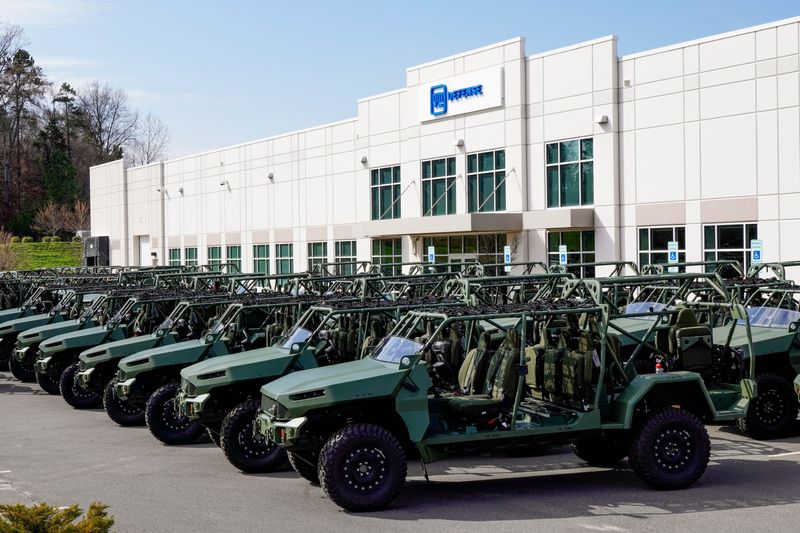
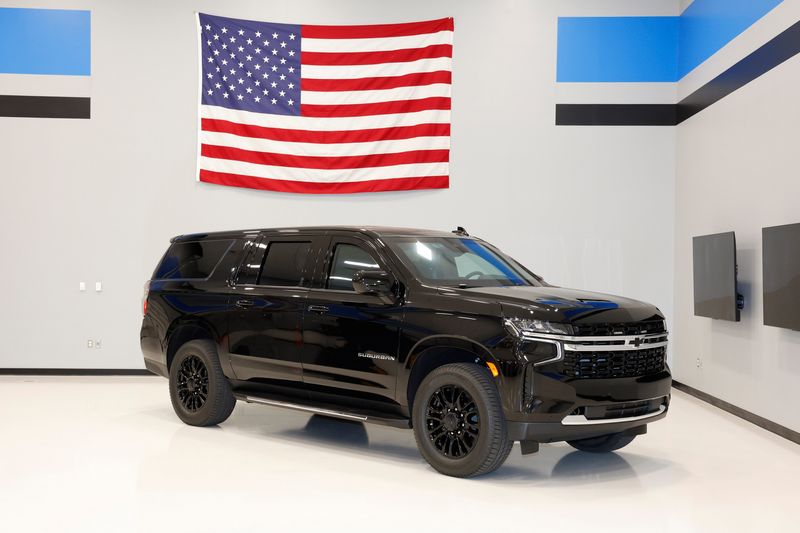
GM Defense produces vehicles like the Suburban Shield, a factory-built armored Chevrolet Suburban built on GM’s heavy-duty pickup platform, and the unarmored Infantry Squad Vehicle (ISV), a nine-passenger troop carrier built on Chevrolet Colorado ZR2 architecture.
In the United States, GM plans to invest $9 billion in its manufacturing footprint and $7 billion in research and development across 2026. The company does not break out investments exclusive to its defense business, though spokesman Jim Cain noted that the business line aims to be as cost-effective as possible.
To that end, part of what makes production of defense vehicles like the ISV so economical is that it relies almost entirely on GM’s existing production platform. Though GM Defense has made modifications for suspension, structure, and load‑carrying capacity to the vehicle, about 90% of its parts come from commercial components.
GM said in a statement that its initial multiyear U.S. Army order of about 1,200 vehicles has expanded ― the Army now plans to procure more than 10,000 ISVs.
GM Defense has manufacturing locations in Concord, North Carolina, and additional laboratories and test facilities in Warren and Milford, Michigan.
Jackie Charniga covers General Motors for the Free Press. Reach her at jcharniga@freepress.com. Staff writers Jamie LaReau and Todd Spangler and Reuters contributed to this story
This story has been updated with additional context and information
This article originally appeared on Detroit Free Press: GM, Lockheed in talks to collaborate as US scales weapons stockpile
Reporting by Jackie Charniga, Detroit Free Press / Detroit Free Press
USA TODAY Network via Reuters Connect
By Jackie Charniga, Detroit Free Press | USA TODAY Network