

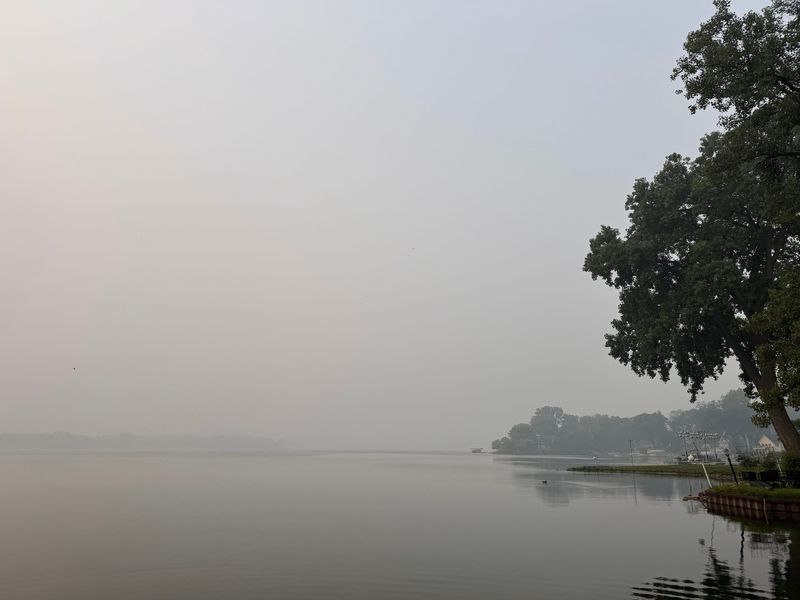
A view of Whitmore Lake as smoke from wildfires in Canada and Minnesota take over southeast Michigan.
Home » News » Local News » Michigan » How long will wildfire smoke last in Michigan? Air quality alert extended
Michigan

How long will wildfire smoke last in Michigan? Air quality alert extended

A statewide air quality alert in Michigan has been extended through Friday, July 17, as officials expect Canadian wildfire smoke to linger at least another day before moving out of the Great Lakes region.

Smoke from active wildfires in Ontario, Canada, and northern Minnesota has enveloped most of Michigan’s Upper and Lower peninsulas. AirNow’s air quality index says the air is hazardous to breathe because of high levels of fine particulate matter (“PM2.5”).

Video Thumbnail

Thunderstorms are possible on Friday afternoon and evening, July 17, and Saturday afternoon, July 18, as a cold front moves through, which could help push the smoke out, Grand Rapids NWS senior meteorologist Nathan Jeruzal. Storms are also possible in northern Minnesota and Canada, which could help extinguish wildfires and reduce the billowing smoke being carried south and east.

“Our best model for smoke only predicts out to 48 hours,” Michigan Department of Environment, Great Lakes, and Energy said in its MiAir forecast. “That model is currently showing improvements on Saturday (July 18), but it is likely that smoke will linger and recirculate for a while. The National Weather Service mentions the possibility of rain on Saturday (July 18), which would help. The Friday forecast will shed more light on that.”

Michigan residents should still expect a hazy day on Friday, July 17, until the change in wind direction and rain move in to clear the air.

The smoke that moved into Michigan this week is considered to be worst observed in years.

“Observed smoke concentrations are unprecedented and far exceed the smoke events of 2023 and 2025. This can be blamed on the nearness of the fires (north of the Minnesota arrowhead region) and the shear number and size of fires in that area. A front dropped through the region on Wednesday (July 15) trapping and dragging that smoke southward to complete the picture,” according to EGLE.

While Michigan continues to experience smoke and haze, residents are urged to limit their outdoor time as much as possible, keep windows closed, run central air conditioning with MERV-13 or higher rated filters and avoid any wood burning.

For those who have to head outdoors, monitor for symptoms, including wheezing, coughing, chest tightness, dizziness, or burning in nose, throat and eyes.

Here’s more on current conditions in Michigan:

How bad is the air quality in Michigan right now? Statewide air quality map

The map below displays the current air quality at monitoring sites in the U.S., Canada and Mexico. Air monitoring sites are color-coded based on the pollutant (ozone or particulate matter) with the highest value. Particles that are less than 10 micrometers and 2.5 micrometers in diameter are called PM10 and PM2.5, respectively.

An AQI of 50 or below means the current air quality is good. The shaded areas of the map show the approximate boundaries where air quality is available and listed as anything other than good. The information is updated hourly.

What does ‘PM2.5’ mean on the air quality index?

On the AQI, particulate matter readings, labeled “PM2.5,” range from 0-301 or higher, and measure the fine particulate matter in the air, such as smoke, dust, soot or dirt.

The “2.5” figure means particles are 2.5 micrometers in diameter or smaller, according to the EPA — that is 30 times smaller than the average human hair, which is about 70 micrometers in diameter.

Air quality index: who belongs to a ‘sensitive group’?

“Sensitive groups” identify people who may be more at risk for breathing in polluted air than others.

According to the EPA, people who have respiratory problems (like asthma), heart or lung disease, diabetes, are a senior or child, or of a lower socioeconomic status are all considered within a sensitive group.

In addition, outdoor workers and pregnant people are within the sensitive groups based on Michigan’s Health and Human Services Department.

How can I stay updated on air quality in Michigan?

Michigan residents can check current conditions through EGLE’s MiAir Quality Index Dashboard. The interactive map provides AQI scores for cities across the state.

Residents can also use AirNow, a part of the U.S. Air Quality Index, and check local conditions by searching their ZIP Code or city. AccuWeather also has an AQI feature that lists the current pollutants in the air.

In addition, Michigan’s HHS Department has a Facebook and X account. The department allows residents to subscribe to alerts through the EnviroFlash system.

Contact Sarah Moore @ smoore@lsj.com

This article originally appeared on Detroit Free Press: How long will wildfire smoke last in Michigan? Air quality alert extended

Reporting by Sarah Moore, USA TODAY NETWORK / Detroit Free Press

USA TODAY Network via Reuters Connect
Image

By Sarah Moore, USA TODAY NETWORK | USA TODAY Network

Related posts

Leave a Comment

A view of Whitmore Lake as smoke from wildfires in Canada and Minnesota take over southeast Michigan.
Home » News » Local News » Michigan » How long will wildfire smoke last in Michigan? Air quality alert extended
Michigan

How long will wildfire smoke last in Michigan? Air quality alert extended

A statewide air quality alert in Michigan has been extended through Friday, July 17, as officials expect Canadian wildfire smoke to linger at least another day before moving out of the Great Lakes region.

Smoke from active wildfires in Ontario, Canada, and northern Minnesota has enveloped most of Michigan’s Upper and Lower peninsulas. AirNow’s air quality index says the air is hazardous to breathe because of high levels of fine particulate matter (“PM2.5”).

Video Thumbnail

Thunderstorms are possible on Friday afternoon and evening, July 17, and Saturday afternoon, July 18, as a cold front moves through, which could help push the smoke out, Grand Rapids NWS senior meteorologist Nathan Jeruzal. Storms are also possible in northern Minnesota and Canada, which could help extinguish wildfires and reduce the billowing smoke being carried south and east.

“Our best model for smoke only predicts out to 48 hours,” Michigan Department of Environment, Great Lakes, and Energy said in its MiAir forecast. “That model is currently showing improvements on Saturday (July 18), but it is likely that smoke will linger and recirculate for a while. The National Weather Service mentions the possibility of rain on Saturday (July 18), which would help. The Friday forecast will shed more light on that.”

Michigan residents should still expect a hazy day on Friday, July 17, until the change in wind direction and rain move in to clear the air.

The smoke that moved into Michigan this week is considered to be worst observed in years.

“Observed smoke concentrations are unprecedented and far exceed the smoke events of 2023 and 2025. This can be blamed on the nearness of the fires (north of the Minnesota arrowhead region) and the shear number and size of fires in that area. A front dropped through the region on Wednesday (July 15) trapping and dragging that smoke southward to complete the picture,” according to EGLE.

While Michigan continues to experience smoke and haze, residents are urged to limit their outdoor time as much as possible, keep windows closed, run central air conditioning with MERV-13 or higher rated filters and avoid any wood burning.

For those who have to head outdoors, monitor for symptoms, including wheezing, coughing, chest tightness, dizziness, or burning in nose, throat and eyes.

Here’s more on current conditions in Michigan:

How bad is the air quality in Michigan right now? Statewide air quality map

The map below displays the current air quality at monitoring sites in the U.S., Canada and Mexico. Air monitoring sites are color-coded based on the pollutant (ozone or particulate matter) with the highest value. Particles that are less than 10 micrometers and 2.5 micrometers in diameter are called PM10 and PM2.5, respectively.

An AQI of 50 or below means the current air quality is good. The shaded areas of the map show the approximate boundaries where air quality is available and listed as anything other than good. The information is updated hourly.

What does ‘PM2.5’ mean on the air quality index?

On the AQI, particulate matter readings, labeled “PM2.5,” range from 0-301 or higher, and measure the fine particulate matter in the air, such as smoke, dust, soot or dirt.

The “2.5” figure means particles are 2.5 micrometers in diameter or smaller, according to the EPA — that is 30 times smaller than the average human hair, which is about 70 micrometers in diameter.

Air quality index: who belongs to a ‘sensitive group’?

“Sensitive groups” identify people who may be more at risk for breathing in polluted air than others.

According to the EPA, people who have respiratory problems (like asthma), heart or lung disease, diabetes, are a senior or child, or of a lower socioeconomic status are all considered within a sensitive group.

In addition, outdoor workers and pregnant people are within the sensitive groups based on Michigan’s Health and Human Services Department.

How can I stay updated on air quality in Michigan?

Michigan residents can check current conditions through EGLE’s MiAir Quality Index Dashboard. The interactive map provides AQI scores for cities across the state.

Residents can also use AirNow, a part of the U.S. Air Quality Index, and check local conditions by searching their ZIP Code or city. AccuWeather also has an AQI feature that lists the current pollutants in the air.

In addition, Michigan’s HHS Department has a Facebook and X account. The department allows residents to subscribe to alerts through the EnviroFlash system.

Contact Sarah Moore @ smoore@lsj.com

This article originally appeared on Detroit Free Press: How long will wildfire smoke last in Michigan? Air quality alert extended

Reporting by Sarah Moore, USA TODAY NETWORK / Detroit Free Press

USA TODAY Network via Reuters Connect

Image

By Sarah Moore, USA TODAY NETWORK | USA TODAY Network

Related posts

Leave a Comment