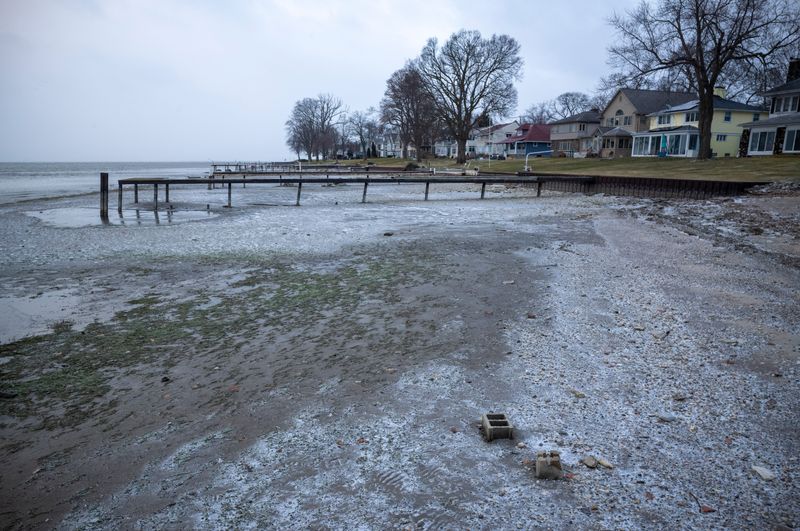
Detroit — Great Lakes water levels are expected to run several inches to a foot below average during the 2026 boating season, a shift that Lake Carriers’ Association officials say could lessen shipping loads even while cruise lines are forecasting a record season.
Lakes Huron and Michigan are running roughly a foot below their long‑term average heading into 2026, with forecasts keeping both below average into late summer, according to the U.S. Army Corps of Engineers’ Monthly Bulletin of Lake Levels released Wednesday. Lake Erie is also projected to stay several inches low through the core of the boating season.

Corps hydrologists attribute the pattern to weaker water supplies — the balance of precipitation, runoff and evaporation over the lakes — and caution that mariners should be ready for more exposed bottoms and tighter clearances in some harbors and channels, even while the lakes remain above record lows.
Freighters adjust as Great Lakes water levels fall
U.S.-flagged Great Lakes freighters carried 71.3 million tons of cargo in 2025, an 8.9% decrease from a year ago, according to the Lake Carriers’ Association. It was also 8.1% below the fleet’s 5-year average, it reported.
Association officials say most of that decline reflects weaker demand across key commodities, but they also flag water levels and dredging as constraints that operators will have to watch more closely this year.
In an association newsletter, they warn that “except for salt shipments, which increased by 4.1 percent, all commodity shipments decreased in 2025,” and note that lower water and deferred maintenance on some channels can force vessels to load lighter than they otherwise would.
“We’re going to continue to see the water levels drop,” said Eric Peace, vice president of the Lake Carriers Association, in an interview with Maritime Reporter TV. “So dredging will continue to be an issue for us, and then with dredging we deal with environmental impacts.”
Looking ahead to this season, the carrier’s association that represents 13 companies sailing 43 U.S.-flagged ships, has told members that if lake levels remain below average into late summer, ships will need to “watch drafts and loading windows more closely in several key channels” to avoid groundings and that this “could limit how deeply we can load on certain runs” even if customer demand firms up.
Cruise ship traffic surges despite lower lake levels
Cruise operators paint a very different picture for 2026. Cruise the Great Lakes said “the economic impact of cruising on the Great Lakes is expected to exceed $300 million (US) in 2026, a 25% increase from 2025,” driven by more passengers, more port calls and higher shoreside spending. The group projects nearly 175,000 passenger visits across more than 800 port calls by 10 cruise ships operated by seven lines, and calls 2026 “a record-breaking season” for the region.
“We forecast this upcoming season to be even stronger than 2025, both in terms of passenger numbers, destinations visited, and economic impact, which underscores the appeal of cruising in the Great Lakes,” said Sally Davis Berry, tourism director for the Green Bay-based Cruise the Great Lakes.
Cruise officials acknowledge that lower water can complicate dockings at some shallow ports, but say most vessels already operate with conservative drafts and flexible itineraries, giving them the ability to adjust schedules or substitute nearby ports if particular piers get too shallow.
Lakes Michigan, Huron and Erie run below long‑term averages
The Corps’ February 2026 bulletin shows that lakes Michigan, Huron and Erie are projected to track below their long‑term average levels through the first half of the year, with Michigan and Huron running roughly a foot low and Erie several inches low. Both remain well above record lows and far below the record highs seen in the late 2010s.
Lake Superior, which received 155% of the normal precipitation for its watershed in February, is expected to remain at or near last year’s levels this summer, but still three to four inches below its long-term average. Precipitation remains the largest impact on Great Lakes water levels, which also fluctuate based on evaporation and inflows and outflows of water. They also have seasonal fluctuations.
The bulletin describes recent conditions as a period of reduced water supplies and notes that this deficit is enough to expose shoals and reduce safe operating drafts in constrained harbors and connecting channels. Harbor and port officials along the St. Clair–Detroit–Erie corridor say they are reviewing soundings, buoys and dredging priorities earlier than usual in 2026 to keep both commercial and cruise traffic moving.
Ports and harbors brace for shallow channels in 2026
Port authorities and local officials say the combination of below‑average water levels and a mixed freight outlook is increasing pressure to fund dredging and modernize docks that serve both bulk freighters and visiting cruise ships.
The Lake Carriers Association emphasizes that nearly all U.S. laker cargoes move on federally maintained channels and warns that “deferred maintenance and lower water levels work together to reduce system efficiency,” by limiting drafts in critical bottlenecks and forcing some vessels to leave cargo behind when depths fall short of charted norms.
The lower lakes follow a period of record and near-record highs, which caused massive erosion throughout the Great Lakes, including the loss of homes into Lake Michigan.
For communities banking on cruise calls, Cruise the Great Lakes argues that the “record-breaking $300 million economic impact” it is forecasting for 2026 should strengthen the case for investments that keep piers accessible even in a lower‑water year.
This article originally appeared on The Detroit News: Great Lakes water levels decline, squeezing freighters as cruises boom
Reporting by Gary Miles, The Detroit News / The Detroit News
USA TODAY Network via Reuters Connect