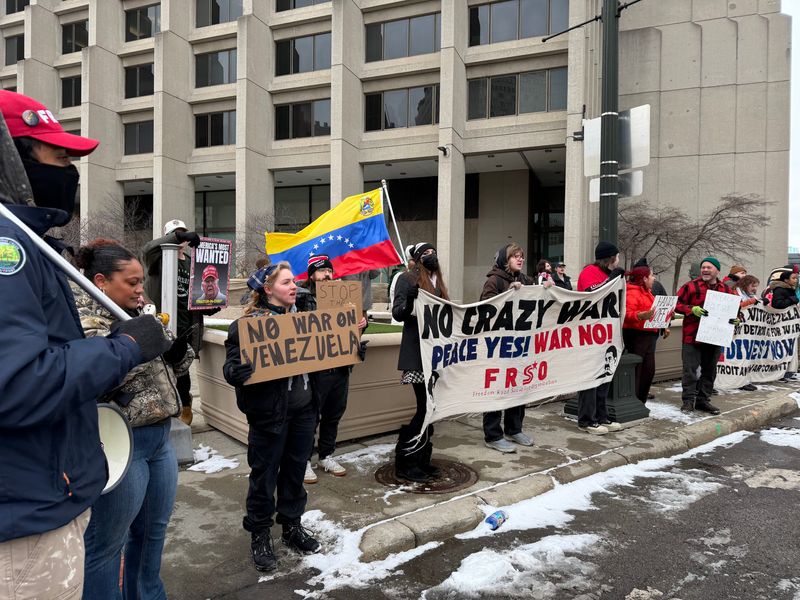
A video of a protester in Grand Rapids being arrested after speaking with a local news station is going viral and sparking questions about First Amendment rights.
Protester Jessica Plichta was arrested for failure to obey a lawful order from police, according to Grand Rapids news station WZZM, which interviewed the 22-year-old and had cameras still rolling when she was approached and arrested by police.

“The group refused lawful orders to move this free speech event to the sidewalk and instead began blocking intersections until the march ended,” according to a statement from the Grand Rapids Police Department to the Free Press on Jan. 6.
Whether a person wants to protest U.S. intervention in Venezuela or rally in support of it, the U.S. Constitution promises the right to free speech. States and municipalities can make laws about permits, noise levels and other aspects of protest that restrict but still allow the freedom for safety or other reasons.
Though the U.S. Constitution guarantees rights, that doesn’t always mean the police will respect them or that a court will uphold them if they’re violated, according to the National Lawyers Guild’s “Know Your Rights — a guide for protesters.”
“When you are protesting or having any interaction with law enforcement, asserting your rights does not usually mean that the police will respect your rights or change how they are treating you. However, by using your rights … you can make it harder for police to use your own statements or anything found on you during a search as evidence against you during a trial.”
Where do I have the right to protest?
Public property. No permit is necessary to march on public sidewalks, as long as car and pedestrian traffic is not obstructed, according to the ACLU of Michigan. Police may ask demonstrators without a permit to move to the side of a sidewalk to let people pass or for other safety reasons.
According to the ACLU, the rights of protesters and organizers are strongest in “traditional public forums,” such as streets, sidewalks and parks. People have the right to speak out in front of government buildings as long as they are not blocking access or interfering with operations.
The rules for speech on private property are determined by the property owner.
Counter-protesters also have the right to be present and voice displeasure within the vicinity of a different group, although they do not have a right to physically disrupt an event or drown out the speakers they are protesting, according to the ACLU.
Some Michigan cities, including Detroit, Ann Arbor and Grand Rapids, require large gatherings that have the potential to obstruct traffic to obtain a permit with up to 70 days’ notice.
What should I do if I am stopped by police?
The National Lawyers Guild recommends trying to end law enforcement interaction as quickly as possible, as well as stating your rights out loud when asked questions.
“If a cop is speaking to you on the street, ask: ‘Am I free to go?’ If they say yes, you should leave, if you can do that safely, according to the NLG.
“If the cop says anything other than yes, follow up with: ‘Am I being detained?’ If they say anything other than yes, then say that you do not want to talk further and leave immediately,” according to NLG’s Know Your Rights guide.
If a police officer asks a question, a protester does not have to answer and can let the officer know they will remain silent and want to speak to a lawyer.
Statements you make to people who are not police can be held against you, according to the NLG.
In Michigan, police cannot ask you to provide your name or other identity information unless you have been detained on reasonable suspicion that you have committed a crime. This right is not the same in every state.
Police are allowed to pat down the outside of your clothing without consent, but they need your permission or a warrant to search beyond that, according to NLG’s guide. To decline a search, the guide recommends using the standard legal phrasing, “I do not consent.”
What if I get arrested?
Michigan’s ACLU recommends asking for a lawyer immediately, remaining silent and not signing or agreeing to anything without a lawyer.
If a defendant hasn’t hired a lawyer, they can ask for a court-appointed public defender if they can’t afford it, according to Michigan Legal Help from the Michigan Supreme Court and Michigan State Bar Association.
If you are arrested, you will be searched as part of the arrest process, according to NLG.
Police officers may lie to you about having evidence, deals to drop charges, overstating penalties for crimes, the timeline of your detention, and whether they are recording, according to the guide.
Lying to a government agent is sometimes a criminal offence, while remaining silent until speaking to a lawyer is not, according to the NLG.
Can I take photos and videos?
When in a public space, people have the right to photograph anything in plain view, including federal buildings and police, according to Michigan’s ACLU.
On private property, property owners may set their own rules.
Police may not confiscate or demand to view photos or videos without a warrant. They may not delete data under any circumstances, according to the ACLU.
Police may order citizens to stop recording if they are “truly interfering with legitimate law enforcement operations, but video recording from a safe distance is not interfering,” according to the ACLU.
What are my rights if police shut down a protest?
According to Michigan’s ACLU, police may not disperse a protest unless there is “clear danger of a riot, disorder, interference with traffic, or other immediate threat to public safety.”
“Protesters must receive a clear and detailed notice of a dispersal order, including how much time they have to disperse, consequences for failing to disperse, and what exit route they can follow before they may be arrested or charged with any crime,” according to the ACLU.
Officers must give “reasonable opportunity to comply, including sufficient time and a clear exit path,” according to the ACLU.
What should I do if I think my rights have been violated?
The ACLU of Michigan recommends getting contact information of witnesses, taking photos of injuries, and writing down everything you can remember, including officers’ names, badge and patrol car numbers.
With this information, you can file a written complaint to a civilian complaint board, police department or agency, according to the ACLU.
Contact Natalie Davies at ndavies@freepress.com.
This article originally appeared on Detroit Free Press: Grand Rapids protester arrested after TV interview. What are rights to protest?
Reporting by Natalie Davies, Detroit Free Press / Detroit Free Press
USA TODAY Network via Reuters Connect