The birth of a new General Motors Co. car still begins with a sketch. But after that, the Detroit automaker is leaning into artificial intelligence to supercharge development.
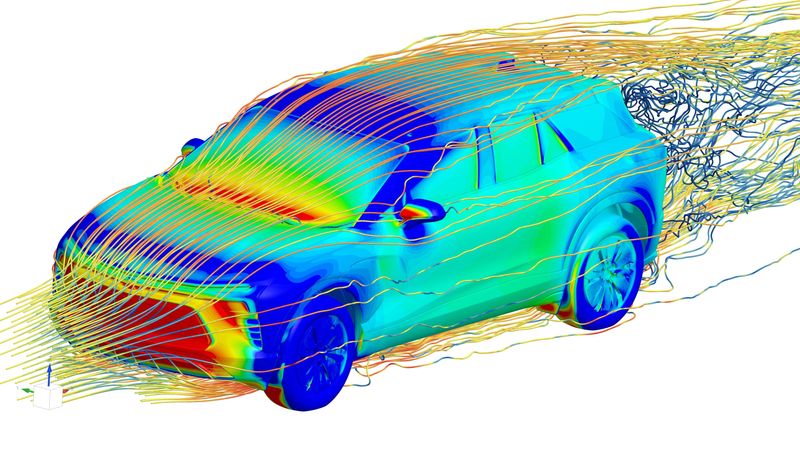
What once took months of work to turn a concept vehicle sketch into a realistic animation now takes days, and checking aerodynamics no longer requires sculpting clay model after clay model. AI saves time, GM design leaders said, and analysts caution U.S. automakers have little time to spare as they hurry to keep up with lightning-fast production speeds in China.

“We’ve found that it’s coming so fast that if we don’t have a shared philosophy and strategy for how to leverage AI, that we’ll simply be inundated by the coming wave and be left behind,” said Bryan Styles, GM’s director of design innovations and technology.
GM rivals Ford Motor Co. and Stellantis NV have been increasingly incorporating AI, too.
Stellantis in April announced a partnership with Microsoft Corp. to implement AI in sales, customer care and operations. Examples include tools that improve product development and validation, help predict maintenance needs, and deploy new digital features in vehicles faster.
Ford dealers use a streaming service-like platform for AI-fueled training on product, competitors, service repairs, sales and more. And Ford Pro, the automaker’s commercial vehicle unit, also recently launched an AI chatbot for users of its fleet telematics system to be able to find information faster, identify maintenance needs faster sooner, and offer cost-saving ideas.
“It’s an arms race,” said Dan Ives, an analyst at investment firm Wedbush Securities Inc. “It’s going to be a differentiating factor for the Big Three, especially with the global competition.”
Clay models and virtual wind tunnels
Starting with a designer sketch, GM now employs user-interface design programming to make 3D renderings and advertisement-esque animations to pitch concept models. The short videos “have become the standard way we communicate in the design studio,” exterior vehicle designer Dan Shapiro said.
“Years ago, to kind of frame this, going from a sketch to a really photorealistic 3D animation like this would have taken multiple teams — including design, sculpting and visualization — several months to do.
“Now by using AI tools, a video like this can be done by a single designer in less than a day,” Shapiro added. “So that enables us to work a lot quicker, explore a lot more ideas and ultimately come up with better designs.”
Once a design concept is finalized, designers sculpt models that are passed on to engineers for drag and aerodynamic analysis, said Scott Parrish, a lab manager at GM Research and Development.
“If it doesn’t meet the prescribed targets, it goes back to sculpting or design, and they tweak the design, and it goes back and forth,” Parrish said. “And these are those handoffs that cost us a lot of time and money.”
GM is now developing in-house tools to make that process almost completely digital.
“Imagine a digital sculptor sitting next to an aerodynamicist and exercising these models to get instant results,” said Rene Strauss, who heads GM’s virtual engineering program. “This would have previously taken something like two weeks, and for us to be able to have that immediate feedback right now is so valuable to our process.”
Added Shapiro: “Our designers, sculptors and digital modelers still shape every millimeter of the surface. But this gives us a huge head start to begin clay model refinements, rapid prototyping execution and even early aerodynamic analysis.”
AI and jobs
Criticism over the use of AI in industry is mainly focused on potential job losses as algorithms and robots begin to outstrip human abilities in both design and manufacturing, a concern cited by the United Auto Workers, among others.
Styles said the goal at the Detroit automaker is to “augment and accelerate, versus replace” workers — an aim likely to be tested by automakers and in other industries as AI tools become more widely used in myriad applications.
Industry experts described AI as a productivity multiplier. “That means that each individual autoworker is producing more output,” PNC Bank senior economist Gus Faucher said on a Detroit PBS panel last month. “And yes, that causes job losses, and that’s been a problem for the Detroit area.
“But it also means higher living standards over time as we have more productive workers,” he added. “And so I think AI is going to be like that.”
The UAW declined to comment further on the increasing use of AI in early vehicle design. But union President Shawn Fain and other labor advocates are pressing U.S. lawmakers for protections to ensure AI does not lead to job losses.
“Greedy corporate power brokers today want us to believe that killing millions of jobs in the name of AI will be a good thing,” Fain said during a rally with U.S. Sen. Bernie Sanders last month. “The working class knows better.”
Exactly how AI will shape jobs is playing out in real time, Ives said.
“The jury’s still out in terms of if it’s going to be a huge negative impact or potentially positive to employment,” Ives said. “It all depends on robotics and how quickly it could help from a manufacturing perspective. It’s an opportunity, but it’s also a potential risk for autoworkers.”
sballentine@detroitnews.com
This article originally appeared on The Detroit News: GM is using AI to design vehicles. Here’s what that means
Reporting by Summer Ballentine, The Detroit News / The Detroit News
USA TODAY Network via Reuters Connect