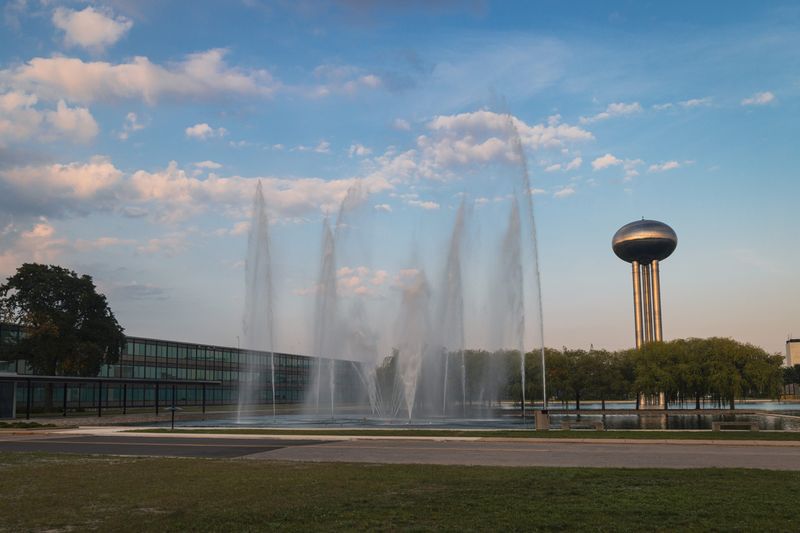
Seventy years after the opening of the General Motors Technical Center in Metro Detroit, company President Mark Reuss says GM’s “nerve center” plays an even greater role at the automaker now.
Roughly 25,000 people are currently employed there — the most of any white-collar GM site despite a series of layoffs — as part of an intentional decision by leadership to encourage speed and collaboration in design, Reuss said in an interview with The Detroit News.

“It’s the first time that we’ve really had the most of the company concentrated in one place,” he said. “Remember when we had divisions? They were in Lansing. They were in Flint. They were in Pontiac. Everything now is on-site, which is really important from a speed and innovation standpoint.”
The 710-acre campus in Warren is more than twice the size it was when it opened in May 1956. The site, designated a National Historic Landmark in 2015, has been so influential that GM took inspiration from the Tech Center when designing its new corporate headquarters at Hudson’s Detroit.
“The company has gone through a lot of different reorganizations over many, many years, as you would expect to remain competitive,” said Reuss, who began his GM career as an intern in 1983. “But I think it always has been the nerve center of innovation for us, and I think it still is today, even more so maybe than when I started.”
Hailed as “where tomorrow meets today,” “where the future is created” and “the Versailles of industry,” the Tech Center’s reputation has been focused on innovation since its inception, said Warren Browne, an auto supplier consultant and former GM executive who worked at the carmaker for 40 years.
“The Tech Center was about the future, and still to this day it’s about the future rather than anything that has to do with today,” Browne said. “If you wanted to know about what was going to happen at General Motors two or three years down the road, you went out to the Tech Center.”
The site is the birthplace of 20th-century inventions ranging from seatbelts to mechanical hearts. Today, GM tests self-driving cars on roughly 38 miles of road on campus, and researchers there study new battery chemistries to power electric vehicles.
“The cell chemistries that are being developed there in R&D are small cell forms that we can actually take across the railroad tracks on the campus and validate, and then we can learn how to construct them in our new manufacturing facility for cells,” Reuss said.
The Tech Center’s former cafeteria has since been remodeled as Cadillac House, where wealthy buyers custom-design the handmade Cadillac Celestiq they will drive. Making the ultra-luxury vehicle requires additive manufacturing on campus, Reuss said, another advantage in speed of design.
The closeness of craftsmen, designers and engineers at the Tech Center allows the company to go from “math data design into physical properties extremely quickly,” he said.
“That’s a huge competitive advantage,” Reuss said.
The Tech Center’s origins
Before the Tech Center, “everything was designed or put together” at the GM Building off Grand Boulevard in Detroit, said automotive historian Robert Tate with the Motor Cities National Heritage Area.
The Tech Center was former Chairman Alfred P. Sloan’s brainchild, said Tate, who worked in GM’s archives in the 2000s. He said pressure from rivals such as the flashy 1940s Studebakers pushed GM to dig deeper into design to remain competitive.
“We invented car design,” Reuss said. “We invented the clay model. Those types of things are big, and it started with the color studios and then has blossomed into a real competitive advantage in terms of going to market with different brands and different designs.”
Construction began in 1945, Tate said, and finished in 1955. President Dwight Eisenhower spoke via a closed-circuit television during the opening ceremony May 16, 1956, according to the historian.
Famed architect Eliel Saarinen drew up initial plans for the project and after his death in 1950, son Eero Saarinen, whose designs include the Gateway Arch in St. Louis, created the final design of the campus, which features an aluminum-clad design dome used to mimic natural light for checking the look of vehicles during development.
The finished Tech Center site originally spanned more than 300 acres, according to Tate. Some of GM’s most popular models were born at the Tech Center, where engineers and designers were, and are, surrounded by iconic sculptures and classic midcentury modern furniture.
“General Motors dominated the industry when it came to design in 1960s with the Pontiac GTO, with the Cadillacs and things like that because of their design features,” Tate said.
sballentine@detroitnews.com
This article originally appeared on The Detroit News: General Motors’ Tech Center still future-focused after 70 years
Reporting by Summer Ballentine, The Detroit News / The Detroit News
USA TODAY Network via Reuters Connect