Video footage of an 18-year-old shot by Detroit police during the June 22 Ford Fireworks shows the teen with his back to an officer running away before he falls to the ground in a parking lot.
His attorney said the video doesn’t show anything in his hand or him pointing anything at police.

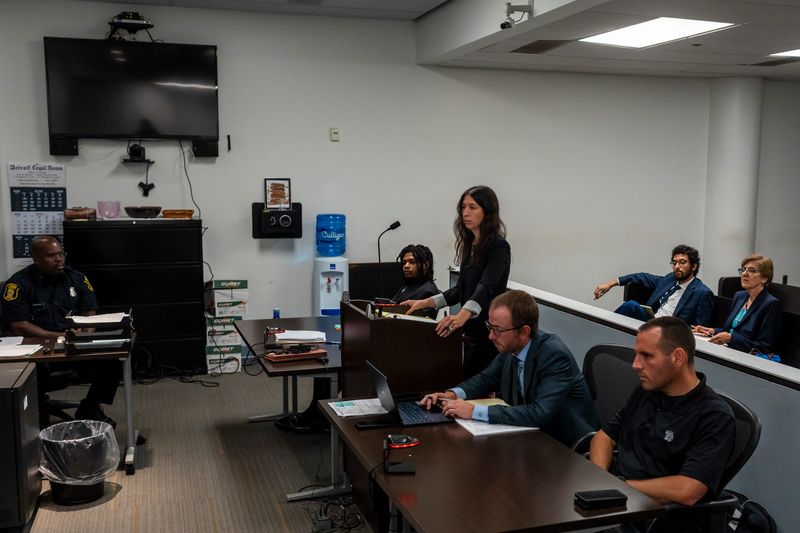
The first public glimpse of the video was played Friday, July 31, in 36th District Court as a part of a preliminary exam for Alonzo Lee-Perkins. The 18-year-old is charged with carrying a concealed weapon, felony firearm and resisting police.
In the weeks since Lee-Perkins was shot, protesters have taken to the streets demanding the officer’s name and the footage. And the case has been at the center of an escalating conflict between Detroit police’s largest union and the city’s civilian police oversight board.
David Gonzales, the officer who pulled the trigger, avoided questions during the court hearing by invoking his Fifth Amendment right against self-incrimination.
The surveillance footage shown Friday was from the parking lot in Cadillac Square where Lee-Perkins was shot around 6:30 p.m.
Police have said they tried to stop Lee-Perkins on suspicion of carrying a gun after he walked away from a group where another arrest was underway, that his hands were positioned in a way that suggested he was armed, and that the officer fired mid-chase fearing for his safety and the public’s. A gun was recovered.
Police kept the teen handcuffed to his hospital bed for five days without charges, family members previously told the Free Press — past the 72-hour limit the law allows — before prosecutors charged him June 28. Lee-Perkins grandmother said he was shot in the back, buttocks, and back of the shoulder. He’s out on bond.
Allison Kriger, Lee-Perkins’ attorney, argued in court Friday that the police stop and chase was unlawful from the start. A “hunch” that her client was holding a gun isn’t enough reasonable suspicion, and it isn’t probable cause. She said the video shows her client did not have anything in his hand or point a gun at officers.
While no body camera footage from Detroit police played in court Friday, Kriger said she has it. She said it captures Gonzales calling Lee-Perkins a “b—-” and threatening to shoot him as he chased Lee-Perkins.
Assistant Prosecutor Matthew Makepeace played body camera footage from a Michigan State police officer of an interview with Lee-Perkins in the hospital, where he admitted to having a gun holstered on his waistband.
Lee-Perkins grandmother told the Free Press he took a gun to the fireworks because he’d previously been shot in the neck and feared for his safety.
Gonzales’ partner, Joseph Wafer, did testify Friday and was questioned by Kriger on whether he saw the teenager with a firearm. Wafer was driving in the car with Gonzales when they saw another unit making an arrest in Cadillac Square and went to the scene to assist.
Wafer said Lee-Perkins was wearing black pants and a black hoodie and appeared to be holding something near his front waistband and that he believed it was a firearm. Wafer said he never saw what the teen was holding and said he could have been holding a phone or wallet in the hoodie’s front pocket.
The incident began, according to Wafer, when the teen walked past their squad car and Gonzales told him to stop, but instead Lee-Perkins fled. Gonzales got out of the car and chased him, Wafer followed suit, he said.
“Did you see a firearm, when you viewed him with your own eyes?,” Allison Kriger, Lee-Perkins’s attorney, asked Wafer.
He said he didn’t.
“So what you are indicating is that you didn’t see his hands grabbing on to anything, right?” Kriger continued.
“I didn’t see the actual object,” Wafer responded.
While she was questioning Wafer, she asked him if he heard anything said by Gonzales, who was running in front of him during the chase. He said he didn’t — only three gunshots. Wafer also said Gonzales and Lee-Perkins turned into a parking lot, so he didn’t witness the shooting.
36th District Judge Chastity Youngblood ruled that the prosecution had enough evidence against Lee-Perkins for the case to go trial.
Prosecutors say they’re still reviewing Gonzales actions. A spokesperson for the Detroit Police Department declined comment Friday.
A Free Press investigation in 2025 found 20% of Detroit police shootings over the past decade grew out of nonviolent stops — often for suspected gun possession — that escalated into foot chases.
Police shooting escalates battle between cop union, oversight board
Controversy over the shooting has been growing.
Board of Police Commissioners watched body camera footage of the Lee-Perkins shooting in closed session Thursday after several delays amid the legal battle between the city and the union. The city’s legal team told them not to talk publicly about the video.
The union and the board have been on opposite sides of a broader war over police transparency:
The Detroit Police Officers Association sued the city in November over an ordinance requiring faster public release of body camera footage, arguing the rules fail to protect officers’ images and identities, and won a temporary injunction that has halted the release of such footage altogether. The last police shooting video published on the department’s YouTube channel went up Dec. 14.
Also, Ron Thomas, vice president of the DPOA, sent a letter on July 10 to Chief Todd Bettison alleging that commissioners Victoria Camille and Darious Morris obstructed justice when they visited Lee-Perkins in the hospital.
Both commissioners say their visits came after Lee-Perkins had been officially released from Detroit police custody.
“It appears that two members of the BOPC went to interview the subject of the shooting and have made statements to the media suggesting that they do not believe the officer’s account. These statements serve to interfere with both the open criminal and the open IA investigations,” Thomas alleged in the letter.
“Commissioners Camille and Morris have inserted themselves and interfered with an active criminal investigation, and potentially committed obstruction of justice.”
When a Free Press reporter asked Thomas whether his letter might be seen as retaliation against the commissioners:
“For them to interview him with ties to the police department is obstruction of justice. No one can interfere with an investigation. They went under the guise of a ‘well-being check’ to a hospital,” Thomas responded. In his letter to Bettison he emphasized that the BOPC “is not an arm of the DPD,” and that its commissioners “are not officials of the department.”
Camille has spent weeks blasting a union-won injunction that has halted the public release of police shooting footage since January, arguing that commissioners can’t hold police accountable if even those tasked with oversight can’t see video of the most critical incidents.
In Thomas’s July 10th letter, he argued that showing the footage to the board would be a violation of the union’s collective bargaining agreement and the injunction.
Andrea Sahouri covers criminal justice for the Detroit Free Press. Contact her at asahouri@freepress.com.
This article originally appeared on Detroit Free Press: First glimpse of Detroit police shooting at fireworks shown in court
Reporting by Andrea May Sahouri, Detroit Free Press / Detroit Free Press
USA TODAY Network via Reuters Connect
By Andrea May Sahouri, Detroit Free Press | USA TODAY Network