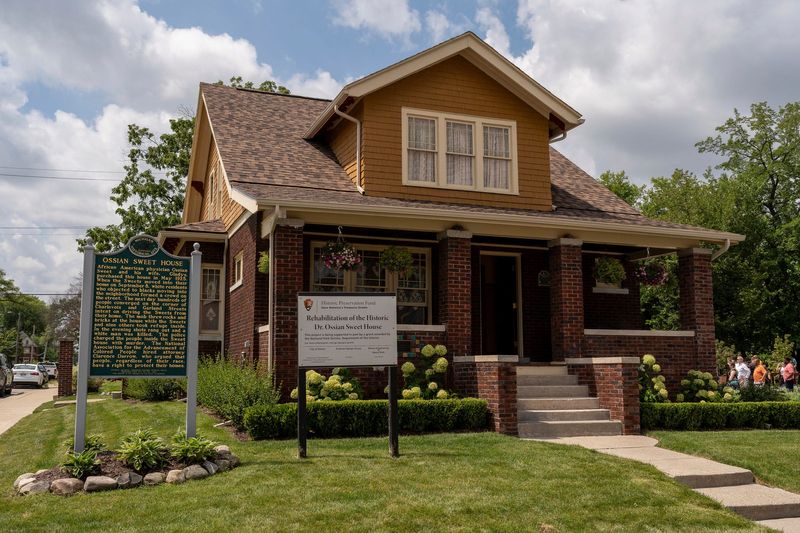
One hundred years ago, prominent Black physician Dr. Ossian Sweet moved into a home in a majority-white neighborhood on Detroit’s east side, and soon faced racism in the form of an angry mob. But now, the historic home faces something beautiful and meaningful: the city’s newest park.
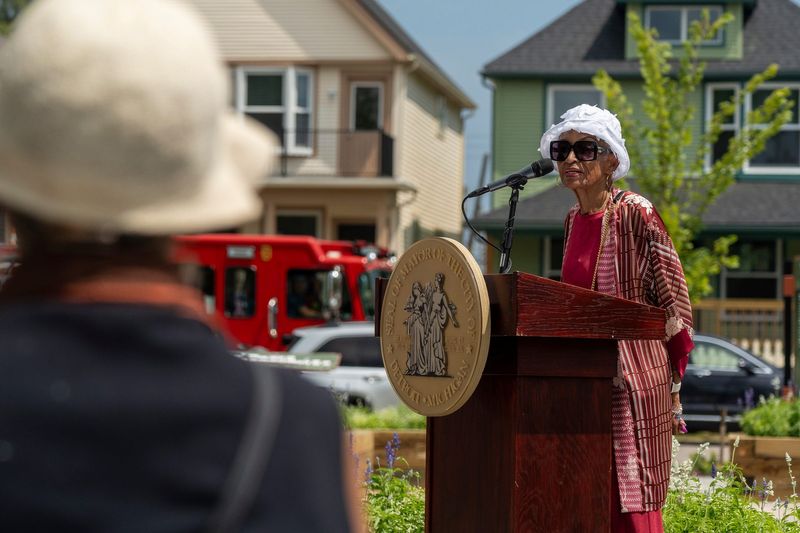
On Wednesday, Aug. 13, Detroit Mayor Mike Duggan, family members and the community gathered nearby to unveil the Dr. Ossian Sweet Memorial Park, honoring his legacy.

Sweet’s family moved into the home at 2905 Garland St. in September 1925 and soon faced a racial incident that would eventually lead to the dismantling of discriminatory housing policies. The family defended themselves against an angry mob of hundreds of people who surrounded the house, throwing rocks and threatening the family, Duggan said. The Sweet family defended themselves by firing shots and killing one of the agitators, which led to a murder trial.
While in law school, Duggan studied the case. Later, he became the Wayne County prosecutor and said the fact that the prosecutor’s office had prosecuted the Sweet family in the 1920s, “to me, was one of the great injustices of the office. I pushed, in those years, to have the historic marker … that marker was not placed there (at the house) until the early 2000s, when we pushed for it. We were not keeping alive, as far as I was concerned, the memory of what happened.
“Of course, the police didn’t arrest any of the people of the mob. They arrested all the members of the family,” Duggan said. “Ultimately, after a hung jury, in the second case, Dr. Ossian Sweet’s brother Henry was acquitted by an all-white jury, who concluded that every person has a right to defend their home. They changed the history of neighborhoods across the city, and really, across the country.”
Defense attorney Clarence Darrow, brought in by the NAACP to defend the family, used the trial to tackle the issue of an individual’s right to defend their home, along with the nation’s discriminatory housing polices, attracting the national spotlight to Detroit, Duggan said. Now, the family of Daniel Baxter, Detroit’s elections department’s chief of operations, owns the home through his organization, the Ossian H. Sweet Foundation.
Baxter was 10 years old when he began learning about the history of his home. His mother had a collection of newspaper articles about the Sweet family, which fascinated Baxter at a young age.
“I went back into the kitchen to my mother and I said, ‘Ma, did that really happen?’ She said, ‘Yes baby, it sure did.’ I said, ‘Well mama, one day, one day, I’m going to do something to make sure that everybody in the world knows what happened on the corner of Garland and Charlevoix,'” Baxter said.
The city spent $1 million of the American Rescue Plan Act money to renovate the lots next to Sweet’s home on Garland Street. Detroit’s general services department’s landscape design unit aimed to tell the historic accounts of the deadly night through “symbolic designs and interpretive signage,” according to the city. The planter boxes represent the foundations of neighboring homes when the Sweets moved in back in 1925, and the wood-style pavers are intended to evoke “a feeling of stepping into a home.”
Jackie Spotts, Sweet’s niece, thanked Duggan for bringing the project to fruition. Spotts grew up with Sweet’s mother, who looked after her “because my mother was here during the time helping them during the trial. At this time, she contracted tuberculosis but she didn’t know it at the time. After she had me and my brother, she passed away. So I was reared by the same woman who reared him,” Spotts said.
“Dr. Sweet fought each and every day that he could for civil rights. He never stopped,” Spotts said, describing him as an organizer. “New Year’s Day, you knew to go to the ballpark because he was going to read out the (Emancipation Proclamation). And he got the people to come hear him do this every year and talk about the importance of voting in politics, and he got them there, because he fed them.”
The park also features memorial trees to honor the 11 people — Sweet; his wife, Gladys; his brothers, and several friends — in the home when the incident occurred.
Two elm trees at the entrance of the park represent Sweet and his wife, according to the city, and a large legacy oak tree represents their daughter Iva Sweet, who was months old when the event took place and died at 2, from tuberculosis.
The city is also renovating three vacant homes across the street from the Sweet Home, as well as one at the opposite end of the park, to match the style of 1925 and extend the landscape honoring Sweet’s family.
The home underwent a restoration project to open as a public museum and is also listed on the National Register of Historic Places and is a registered Michigan State Historical Site.
And for decades before the park was in place, the Sweets’ story made its mark on the community.
The Rev. James Curenton, the senior pastor of Mayflower Congregational Church of Christ in Detroit’s Bagley Community, says the Dr. Ossian Sweet Memorial Park represents a classroom that has the power to educate and even steer the future of the community in a positive way.
“There are white suburban kids that have never heard the stories about violence being inflicted upon Black people in Detroit,” said Curenton, who also serves as a board chairman for Evangelical Homes of Michigan and MOSES, a community-organizing nonprofit that serves Detroit residents. “However, there also are Black youths right here in Detroit that haven’t learned about this history either because we haven’t done a good job of telling these stories.
“Scripture says: ‘You will know the truth, and the truth will set you free.’ So, this park has an important role to play in the healing of our city because real change and reconciliation cannot take place without knowledge of the truth. Therefore, at a time when efforts are being made to shut down the study of our history, I’m hoping that the park will educate our entire region and amplify the truth in a way that resets the narrative and prevents us from making some of the mistakes of the past.”
Like Curenton, 91-year-old Dr. William Jackson believes in the power of history, and during the late evening of Aug, 12, just hours before the official opening of the Dr. Ossian Sweet Memorial Park, Jackson pointed to a part of Sweet’s legacy that is connected to another proud tradition.
“For our community, it’s very valuable to receive lessons about Dr. Ossian Sweet because his life is a reminder that medical doctors in Detroit have historically functioned in all capacities of life,” said Jackson, who serves as board secretary for the Detroit Medical Society, which has waged a “scientific, medical, social, civic, economic, physical and spiritual battle” for equal opportunity and equal access to health care in Detroit since 1917. “Medical doctors not only serve their patients, we also are citizens. And Dr. Sweet exercised and defended his rights in a way that helped us to move forward as a community and as a nation.”
Dana Afana is the Detroit city hall reporter for the Free Press. Contact: dafana@freepress.com. Follow her: @DanaAfana.
Scott Talley is a native Detroiter, a proud product of Detroit Public Schools and a lifelong lover of Detroit culture in its diverse forms. In his second tour with the Free Press, which he grew up reading as a child, he is excited and humbled to cover the city’s neighborhoods and the many interesting people who define its various communities. Contact him at stalley@freepress.com or follow him on Twitter @STalleyfreep. Read more of Scott’s stories at www.freep.com/mosaic/detroit-is/. Please help us grow great community-focused journalism by becoming a subscriber.
This article originally appeared on Detroit Free Press: Detroit unveils Ossian Sweet Memorial Park to honor family’s legacy
Reporting by Dana Afana and Scott Talley, Detroit Free Press / Detroit Free Press
USA TODAY Network via Reuters Connect