

A Detroit music mogul, once described in a sealed federal search warrant as one of the largest heroin dealers in the Midwest who used his rap label to launder drug money, is in fresh trouble along with his wife after being accused of heading a nationwide drug ring linked to Mexico’s Sinaloa Cartel.
BMB Records owner Brian “Peanut” Brown, 57, sold an estimated 100 kilograms of heroin, fentanyl and methamphetamines every month between October 2020 and March 2024, according to the government. The alleged drug conspiracy headed by Brown operated out of hubs in Detroit, Los Angeles, Atlanta, Ohio, Tennessee and Kentucky, prosecutors allege.

Prosecutors also said Brown laundered more than $3 million and blew money stashed in 23 bank accounts on a lavish lifestyle. That included homes in Michigan, California and Georgia, cars and motorcycles, while Brown dispatched drug couriers from the West Coast to Detroit and beyond.
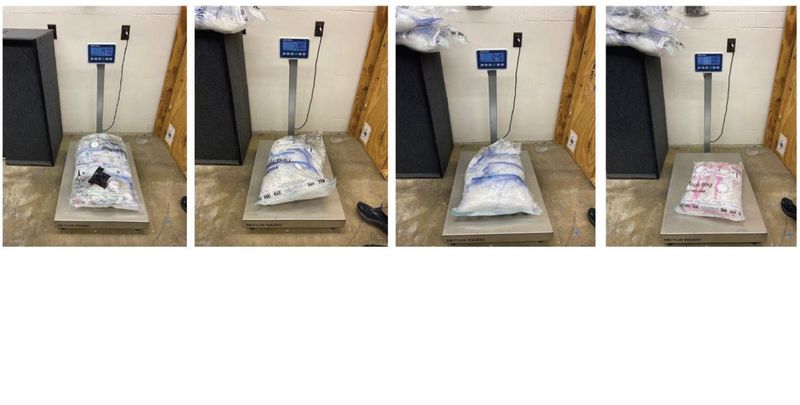
Federal court records, audio recordings and pictures of pillow-sized bags of meth help illustrate an expansive drug investigation involving million-dollar locales, incriminating text messages and one Detroit music mogul. Prosecutors portray Brown as an incorrigible felon helping to fuel the nation’s overdose epidemic while masquerading as a successful “hood hero.”
During the ongoing bond fight, Assistant U.S. Attorney Caitlin Casey said Brown’s “public persona as an upstanding businessman or even as a ‘reformed drug dealer’ is a total sham.”
“(Brown) cannot claim to be a man of charity and integrity on the one hand while dealing fentanyl, heroin and methamphetamines with the other,” Casey told a federal magistrate judge.
Brown, who has been behind bars since December 2024, has sought release on bond since June 2025, with his most recent request taking place June 18 in a sealed federal courtroom in Detroit. U.S. District Judge Denise Page Hood did not rule on the request immediately and instead sent Brown back to jail in Bay City, where he is being held while awaiting trial.
A continuation of the hearing is scheduled for July 1.
Brown, dressed in an orange Bay County jail uniform, sat during the bond hearing as his lawyer, Allison Kriger, pushed for the music mogul’s release. She has argued that concerns about Brown fleeing or posing a danger to the community could be mitigated by home confinement and other conditions.
Brown’s legal team emphasized that the case does not involve firearms, explosives, destructive devices or other dangerous weapons. And Brown did not flee during the investigation despite U.S. Drug Enforcement Administration Agents raiding a stash house in West Bloomfield or after prosecutors say he watched investigators seize cocaine from an alleged co-conspirator in September 2023.
“If that’s true … you would think he would have fled at that moment. He would have gotten out of Dodge and said ‘Uh, oh, they’re onto me,'” said Mark Kriger, Brown’s co-counsel, during an earlier court hearing. “Did he flee after that search warrant was executed? He did not.”
Case holds high stakes for Spirit of Detroit award winner
The case carries high stakes for Brown. His rap sheet spans decades, includes convictions in a drug case in 2001 and a 12-year prison stint, followed by what prosecutors called a return to the drug world and a conviction for a federal gun crime in 2019.
Brown was indicted, again, in a drug-conspiracy case unsealed May 7. If convicted, he faces at least 15 years in federal prison and up to life.
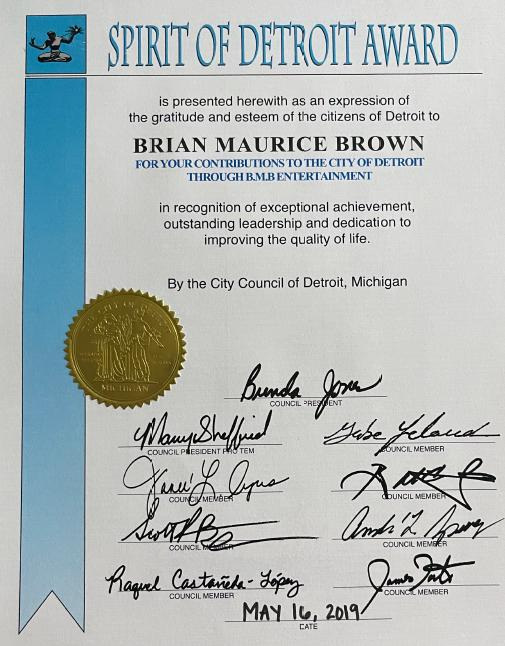
In their bid for bond, Brown’s lawyers noted “his reputation for honesty, integrity, and peacefulness,” which led the Detroit City Council to give him a Spirit of Detroit award in 2019.
The award is signed by future-Mayor Mary Sheffield and two council members who became convicted criminals: Gabe Leland and Andre Spivey.
“… Mr. Brown has demonstrably … strong ties to the community, strong family relationships, friendships, and relationships with upstanding members of the community, and a legitimate, long-standing business,” his lawyers wrote in arguing for bond.
Brown’s most prominent business is BMB Records. Investigators have said Brown laundered drug money through an independent rap label that has featured a stable of entertainers, including Ray J, a singer and actor who starred in a pornographic video with Kim Kardashian; rapper Bre-Z, who starred on the hit Fox drama “Empire”; and Charli Baltimore, a platinum blonde perhaps best known for dating the late rapper The Notorious B.I.G. in the 1990s.
The roster also has included rapper Kash Doll, real name Arkeisha Knight. She signed with BMB after the label paid for her $15,000 breast-enhancement surgery, according to court records.
Brown pursued her for his rap label because he has a penchant for “big boobs and butts,” Knight alleged in a lawsuit.
Brian Brown lingers in jail while co-defendant wife takes a cruse
Aside from the rap label, Brown has a long track record of being a successful businessman and is a family man with strong ties to the region, his lawyers said.
The defense lawyers proposed that Brown could live with his elderly mother-in-law while on bond under home confinement in Ypsilanti or at his home in Georgia. The home has interior and exterior cameras and “the ability to monitor Brian at all times,” his lawyers argued, while he lives with his wife and children.
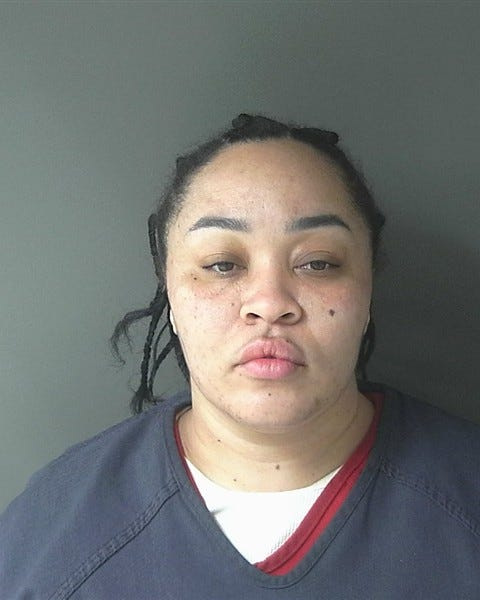
Wife Akia Brown was released on bond in December 2024.
The indictment and prospect of spending 20 years in federal prison have not slowed her outwardly luxurious lifestyle. With her husband jailed indefinitely and after receiving a court-appointed lawyer, Akia Brown posted photos online of her posing next to a Mercedes-Benz in her garage and modeling an outfit outside her 5,288-square-foot, $875,000 home near Atlanta.
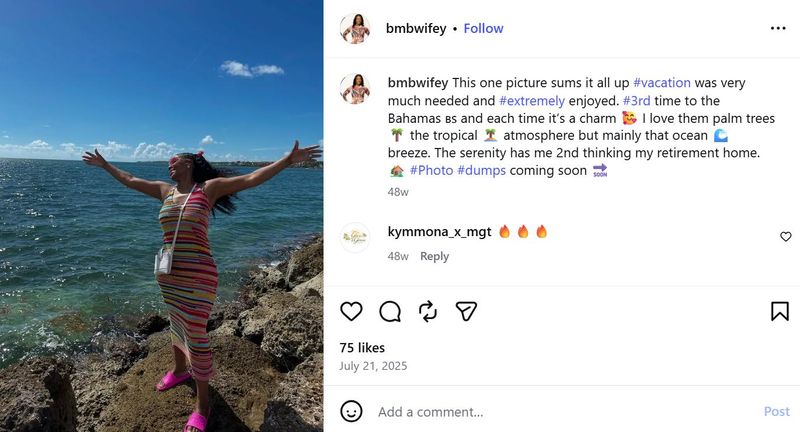
In July, she received court permission to fly from Atlanta to Miami for a cruise to the Bahamas, according to an itinerary filed in federal court.
Akia Brown, aka @bmbwifey, later posted videos and photos from the ship, the shore and the sea for her 13,600 Instagram followers. Last week, she was in the Detroit federal courtroom as Brown fought for bond.
Akia Brown’s lawyer, Patrick Nyenhuis, did not respond to a message seeking comment.
Two members of the alleged drug ring charged alongside Brown when the first round of criminal charges was filed two years ago have pleaded guilty. That includes a woman caught with 3 kilograms of cocaine after leaving a West Bloomfield Township condo that doubled as the drug ring’s stash house, and a courier caught with more than 3 kilos of cocaine and fentanyl outside the same condo.
In May 2022, a Drug Enforcement Administration informant told investigators that Brown was continuing to traffic drugs and was working directly with Mexico’s Sinaloa Cartel, prosecutors argued in the fight to keep Brown in jail.
A tip leads to surveillance of purported stash houses
That tip prompted DEA agents to start physically and electronically surveilling Brown and others. They identified stash houses in Detroit and West Bloomfield used to store drugs and money and, crucially, obtained Brown’s cellphone number.
The spying would soon pay off.
In September 2023, investigators watched Brown leave the West Bloomfield stash house and place a black bag in the back of a Chevrolet Traverse. Driver Dominque Glenn, who has since pleaded guilty, left, but investigators soon stopped her for a traffic violation and searched the SUV.
“Inside, investigators located a trap compartment containing three vacuum-sealed bricks that tested positive for more than three kilograms of cocaine,” prosecutors wrote.
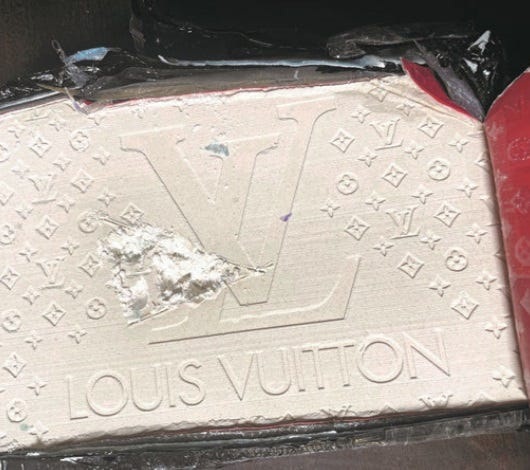
Investigators also searched Brown’s cloud storage and allegedly found a photo of a kilogram of drugs stamped with the Louis Vuitton logo.
He would soon be linked to another massive Midwest drug bust.
In December 2023, three women were arrested after investigators said they flew from Los Angeles to Indianapolis with 50 kilograms of meth hidden in their luggage.
The bust was the culmination of an investigation that started two months earlier, in October. That is when an informant told DEA investigators that a woman, Latasha Weatherspoon, traveled every week or so from Los Angeles to Indianapolis to coordinate delivery of fentanyl and methamphetamine, according to court records.
Weatherspoon, 39, recruited other couriers to haul the drugs in their checked luggage, the source said.
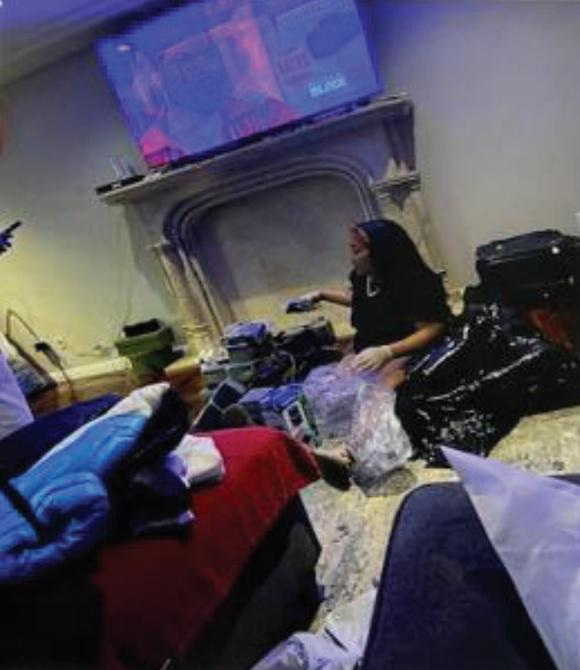
After the bust, investigators searched one of the women’s phones and found a photo of Weatherspoon sitting on the floor of a home wearing gloves and surrounded by packages and vacuum-sealed bags.
The bags “were identical to the ones found containing the methamphetamine inside the four pieces of luggage found during the traffic stop on December 19, 2023,” DEA Special Agent Sean Yauger wrote in a complaint filed in federal court in Indiana.
Investigators also found a video from Dec. 18 — the night of the Indiana flight — showing large Ziploc bags filled with suspected meth.
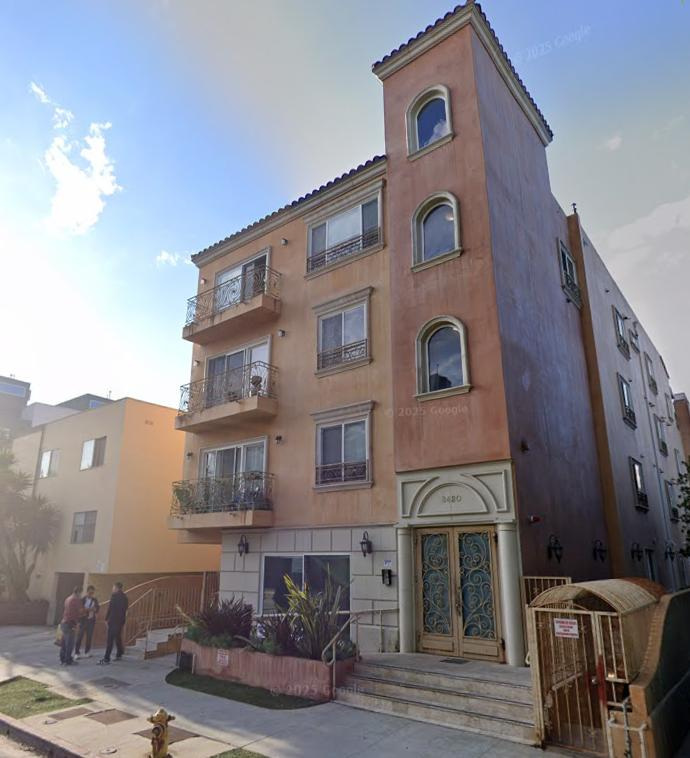
Investigators searched the women’s phones and found evidence Brown had hired them to package and fly the meth for distribution in the Midwest, the prosecutors wrote. And metadata from saved photos showed the drugs were packaged in a luxury building filled with $1 million condominiums near Beverly Hills, California.
Investigators later learned Brown leased one unit inside the building, and his phone location data showed Brown near the building as the drugs were being packaged for the trip to Indiana, according to the government.
Weatherspoon and one other woman have pleaded guilty to possession with intent to distribute controlled substances and are awaiting sentencing in federal court in Indiana.
Prosecutors describe profits generated by alleged drug ring
The alleged drug ring generated big profits.
From 2020 to 2024, Brown and his wife had 23 business and personal bank accounts and used accounts belonging to others to launder more than $3 million in drug money, prosecutors allege.
“Brown had coconspirators deposit drug proceeds into his account and their own accounts,” the DEA agent wrote.
Internal Revenue Service agents also discovered that cash deposits were commingled with legitimate money, but the deposits were distinguishable from the legitimate income generated by Brown’s music business and his wife’s real estate ventures, according to the government.
“As quickly as the money went in, the money went out,” Casey, the assistant U.S. attorney, said during Brown’s bond hearing last year.
“Brown is no run-of-the-mill drug dealer,” Casey added. “He is far more. He was operating at the top level of a drug-trafficking enterprise pushing poison into our communities for decades.”
rsnell@detroitnews.com
This article originally appeared on The Detroit News: Detroit rap mogul Brian Brown gets in fresh trouble with feds
Reporting by Robert Snell, The Detroit News / The Detroit News
USA TODAY Network via Reuters Connect


By Robert Snell, The Detroit News | USA TODAY Network
