The City of Detroit failed to translate multiple announcements about recent emergency situations, including hazardous smoke and extreme heat, according to a statewide immigrant rights group, and city officials have vowed to make comprehensive improvements.
The failure violated a year-old ordinance requiring city departments to translate public service announcements during such moments, said Christine Sauvé, policy, engagement and communications manager for the Michigan Immigrant Rights Center (MIRC), and potentially left thousands of Detroiters for whom English is not their first language without vital information.

“We’re at a point where there needs to be some course correction,” said Sauvé, who raised the alarm on how Detroit translates important resources.
The omission points to a broader issue: the city falling short of ensuring residents with limited English have the same resources as other Detroiters — a concern echoed by another advocate who works with immigrant community groups and the Detroit City Council member who sponsored the ordinance amendment last year to ramp up language access.
John Roach, Mayor Mary Sheffield’s spokesperson, said she’s “deeply committed” to ensuring all Detroiters have access to important information. The back-to-back and quick changing heat and air quality emergencies “highlighted a process improvement opportunity” instead of “any individual or departmental failure,” he said in a statement.
In her first seven months, Sheffield tapped new leadership in the three city departments — Civil Rights, Inclusion and Opportunity (CRIO); Office of Immigrant Affairs, and Media Services — that work closely on language access, he said.
“They have been directed to jointly develop a comprehensive plan to not just meet ordinance requirements but to exceed them to provide better communication to all residents with limited English proficiency,” he said. That process began at least two months ago.
This plan is meant to address challenges and strengthen the city’s language access program (LAP). A contractor for that program, LanguageLine, will be meeting with CRIO to evaluate the existing process and ways to improve. The department is also expected to hire an additional staffer dedicated to the language access program, he said.
What was translated?
Fourteen percent of Detroit’s population, five years old and above, speak a language other than English at home. Eight percent speak Spanish. The city identified the following languages as important to translate: Spanish, Bengali, Arabic and French.
Translated posts appeared to be sporadic on the city’s social pages in recent weeks, according to a review by the Free Press and BridgeDetroit.
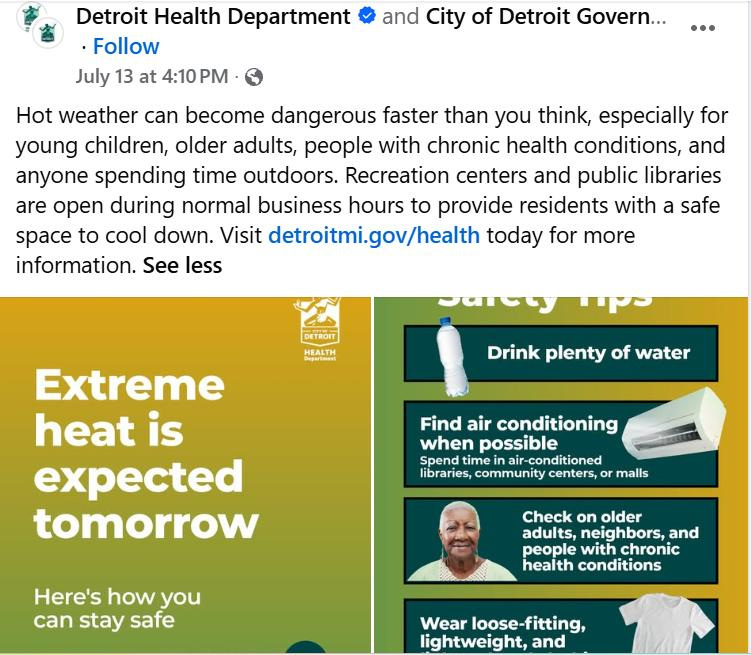
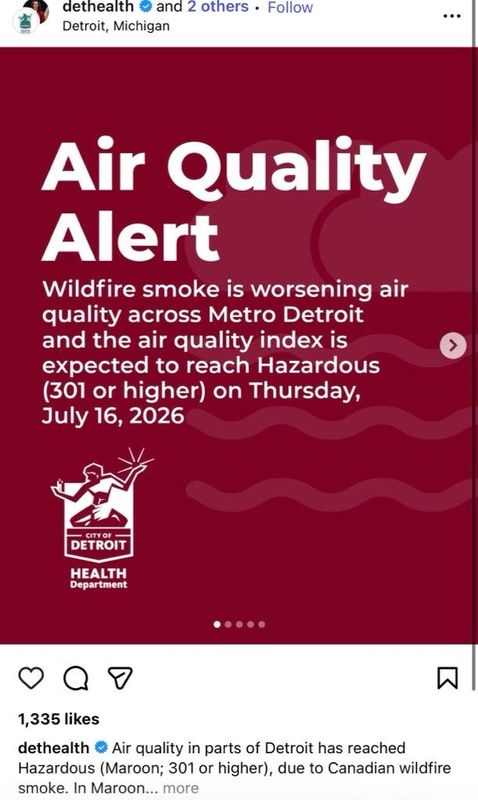
Since June 30, posts on the city of Detroit’s main Facebook and Instagram — which has more than 300,000 combined followers — showed infographics and videos about the extreme heat, air quality alerts and where to get free masks during unhealthy air conditions in English only.
Posts about replacement SNAP benefits during power outages were jointly published on the city’s main and health department Instagram pages in English, Spanish, Arabic and Bengali.
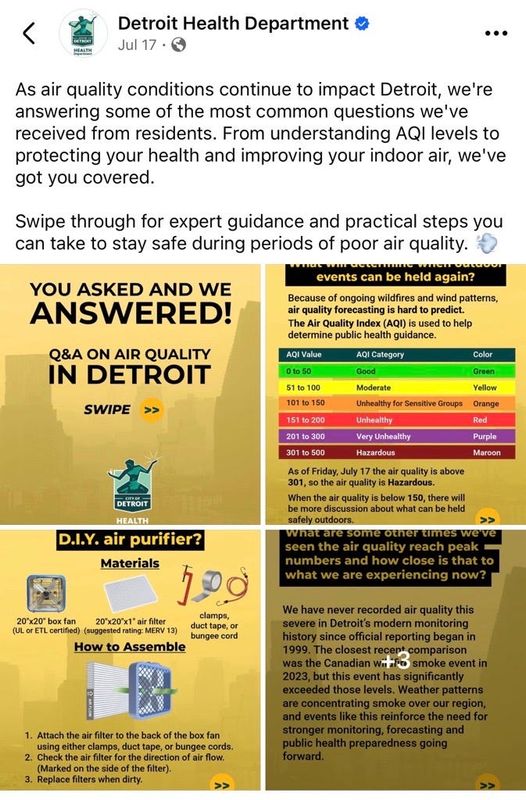
Meanwhile, on its own social channels, the city’s health department did publicize graphics about the cyclosporiasis outbreak (in English and Spanish) and cooling spots (in English and Spanish as well), but several posts about extreme heat and updating residents about the air quality — including when levels were hazardous — available resources and an FAQ were in English across both Instagram and Facebook. Both department-specific pages have about 32,000 followers combined.
Emergency content isn’t consistently translated or shared widely, Sauvé said. Language access is “complex and dynamic,” but Detroit has had a program for years and with the ordinance, “we would expect to see a higher level of performance by now,” she added.
In the coming weeks, the city is expected to kick off a multi-language and interdepartmental communication strategy when it responds to crises.
“CRIO did complete translations that were requested for both the heat and air quality emergencies,” said department director Jade Mathis in a statement. “A significant part of the comprehensive plan the mayor has requested will address the need for rapid development and coordinated deployment of multi-lingual public messaging that speak to urgent public health and safety matters.”
For heat wave communications, CRIO received a request from the health department on July 13 and translations were completed and returned on July 15 in Spanish, Arabic and Bengali, according to the city. As for air quality communications, CRIO received a request from the health department for the mayor’s office on July 16 and translations were done that same day in Spanish, Arabic and Bengali.
“In the case of the heat and air quality emergencies, the conditions of the emergencies changed significantly between the submission and receipt of the alert information. This rendered the request obsolete,” Roach said. “As a result, we will be shifting to a rapid response strategy that includes faster timelines, and importantly, message templates that are pre-translated and easily modified to guarantee timely and equitable message delivery.”
He highlighted balancing speed and accuracy of translated messages as conditions change.
Detroit’s alert system allows users to choose their language. On the city’s health department website and main page residents can toggle between English, Spanish, Bengali, Arabic or request translation. But that’s not enough since it doesn’t apply to all resources, such as the health education library, Sauvé said.
About 8% of Detroit’s population are foreign-born, including immigrants, migrants and naturalized U.S. citizens, according to the U.S. Census Bureau. Detroit is home to pockets of immigrant communities from Mexico, Central America, Yemen and Bangladesh and West Africa.
Council Member Gabriela Santiago-Romero, a vocal advocate for immigrant rights who sponsored the ordinance, said the administration has more work to do.
“Immigrants in Detroit already feel like they’re not cared for, like they’re not important, and obviously if we’re not communicating with them, they completely feel as if they’re not even a part of the city,” she said. “Quite frankly, if you can’t even communicate with immigrants, I don’t see how they can believe that we’re going to also take care of them. For me, it’s a very basic thing that we’re not doing, so I completely understand why they feel as if the city’s not prioritizing them.”
What the ordinance says
Last May, the Detroit City Council approved an ordinance to provide translation and interpretation services for limited English speakers. It requires departments to submit language access plans and for the city’s human rights department to create a citywide language access plan, including training, interpreters and translation services.
Notably, during emergencies, departments should translate warnings and public service announcements, the ordinance says.
“We passed an ordinance. We put money in the budget for it to be enforced. We keep asking for flyers to be translated every single day, and it hasn’t been enforced. Desperately, we need the administration to be able to communicate with everyone,” Santiago-Romero said.
She said she’s aware of the concerns MIRC — which helped draft and advocate for the ordinance — has raised and is trying to ensure the administration is enforcing it. The ordinance was meant to eliminate “systemic language barriers for over 7,000 limited English proficient households” and enshrine language access as a civil rights protection, according to a new city compliance report published June 29.
Santiago-Romero’s office in mid-July sent out a newsletter about the air quality translated in English, Arabic and Spanish. She said she regularly gets flyers that aren’t translated and she immediately emails the administration and asks for a translation. It takes a few days, she said, but it gets done.
“I’m not the one responsible for translating documents,” she said. “I passed the law for this to happen, and it hasn’t happened, and every single day I have to tell them to translate a document. … They need to be held responsible to communicate with the public.”
The ordinance amendment — meant to be a “floor” to ensure basic services — was 10 years in the making, said Sauvé.
The ordinance requires a compliance report one year after it is implemented and, after that, by the end of each fiscal year. According to the administration’s understanding of the law, Mathis said the city’s Human Rights Department collected data through the end of the last fiscal year, which was June 30, and spent the beginning of this fiscal year compiling and verifying information.
The report — covering July 1, 2025 to June 30, 2026 — offers a glimpse at how Detroit is providing “equitable language access services” across departments. The city completed 193 document translations, 825 interpreter requests and 4,920 on-demand interpretation calls. The city spent $362,275 in language access services in the previous fiscal year.
Goals for the coming year include ensuring all departments implement the ordinance, ramping up signs and ways to inform residents about language services, working with community partners and making sure employees can access training and request services in one place.
The city will also be hiring someone within the next 30 days — with a portion of the $200,000 Santiago-Romero secured in the latest budget — to support the language access program, Mathis said.
“I hope the publishing of this report, while late, is a sign the City is recommiting to implementing and enforcing the ordinance and ensuring all Detroiters have access to essential services in a language they can understand,” Sauvé said.
‘An equal playing field’
Yelena Ramautar, a community advocate and immigrant who works with Caribbean and African groups, said Detroit can’t be a welcoming city in platitudes only.
“What are the actionable things that you do, to show people they feel welcome?” she said. Language is a part of that.
Ramautar said the city can work with community groups to reach immigrant populations, especially languages that are not as widely spoken, such as West African Wolof.
“We just want to be able to be at the table,” she said. “We are here to be of assistance.”
Many immigrants work on the frontlines in construction and restaurants, Sauvé said, and they “desperately” needed information and resources, for cooling centers and free masks, to protect themselves and their families.
“It’s really about trying to create an equal playing field where everyone gets the same resources, tools and opportunities in the city and that we’re not leaving some communities behind,” Sauvé said.
MIRC’s Detroit clients hadn’t heard about some of the warnings and the organization had to share information, she said. Detroit can learn from other cities. She pointed to recent air quality posts from Chicago.
“Municipalities have a duty to uphold the Title VI Civil Rights protections that include language access,” said Elinor Jordan, of the Michigan Poverty Law Program, which advocated for statewide language access alongside MIRC.
As a public benefits attorney, she said, she sees “a clear role” for municipalities to share information about important health and safety programs, such as SNAP and Medicaid.
“I hope the City of Detroit and other municipalities are working to get these updates out to their residents in multiple languages so that no one is left out of critical services,” Jordan said in an email.
Reach reporter Nushrat Rahman at nrahman@freepress.com.
This article originally appeared on Detroit Free Press: Detroit promised language access. Recent emergencies exposed gaps.
Reporting by Nushrat Rahman, Detroit Free Press / Detroit Free Press
USA TODAY Network via Reuters Connect
By Nushrat Rahman, Detroit Free Press | USA TODAY Network