

“This was our Covid project,” Ed Fish explains with a laugh of the two-story one-time factory he and his wife, Bess, bought in 2020 and now call home. Located in the Detroit neighborhood known as Milwaukee Junction – named because of the nearby railroad, he points out – it is just off Grand Boulevard and in the shadow of the Piquette plant, not far from iconic Fisher building.
Originally home to the Peerless Weighing Machine Company, the 12,000-square -foot building was built in 1925 and manufactured the coin-operated penny scale machines once found in drug stores and on American streets. “We think it was the second building built here,” Fish says of the structure, which now has a historic designation. Gold leafing on the building’s front windows that read “Have You Weighed Yourself Today?” was replicated during the renovation and is a nod to that history.

The building, however, sat empty for “years and years” with little interest until the couple, who were looking for a project, discovered it. “It was too small for community development but it couldn’t be knocked down because of the historic designation,” Ed explains. It was, however, just the right size project for the creative pair, both Detroit natives who had spent years in Silicon Valley and Washington D.C. but were itching to come home and be a part of Detroit’s downtown revival.
They had considered other Eastern Market, Island View and Gratiot locations before ultimately deciding on Milwaukee Junction. “There was a lot going on,” Ed, a former lawyer turned tech entrepreneur and banker, says. “We felt like it was a really interesting neighborhood. We could walk anywhere and we liked that we weren’t displacing anyone. We figured that if we were going to move back after 38 years, we wanted to be where the action is and be a part of what is going on in the city.” Bess, a former lawyer and current glass artist, agrees. “We’ve always been creative and innovative people. That’s what we like and this area is a beautiful little pocket.”
Team peerless
When they purchased the building, there was nothing but whitewashed walls, 16-foot-high windows and a floor, Ed explains. “It was industrial space. Over time, artists may have lived in it but we could see that the bones were great.” Their plan was to restore the building, sandblasting off the paint to uncover the original brick and carving the second floor into a 6,000-square-foot loft-style home with four bedrooms and 3 ½ baths for them and adding seven rentable apartments of various size on the first floor.
They put together a team to restore it that included architect Derek Slupka, general contractor Kermit Ball and designers Lauren Guidry and Susie Kapadia of GHK Design Collaborative in Birmingham. Work started while they were still living in D.C. “The team with Kermit Ball and GHK made this possible,” Ed says. The challenge for the design team, explains Guidry, was to take very unique industrial spaces and make them feel like a home. “We wanted to maintain the character and industrial elements while making it into livable space,” adds Kapadia. “It was a challenge, but a very fun one.”
Challenge met
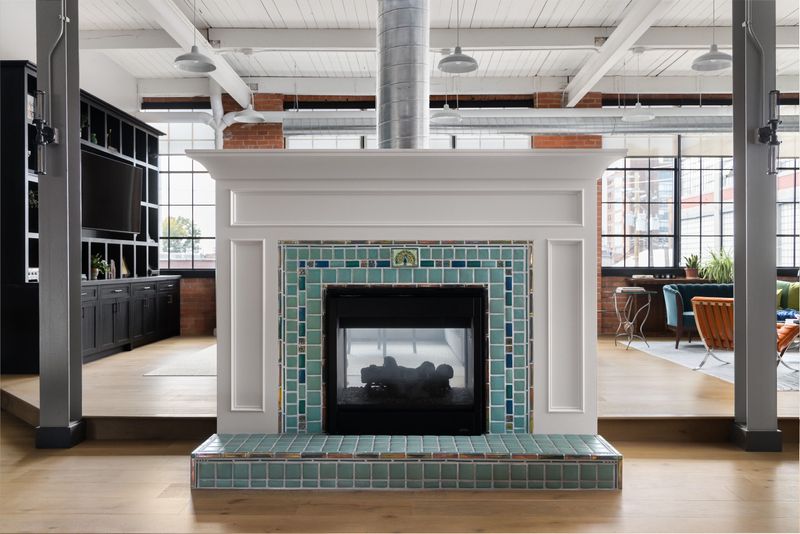
The team accomplished that by carving the large open space into separate “rooms.” They raised the living room area, added large built-ins for the television and books, and divided it from the nearby dining area with a two-sided fireplace adorned with Pewabic tile. A peacock tile — a nod to Bess’s maiden name—has a place of honor in the fireplace; fish motifs throughout the home are reference to Ed’s family moniker.
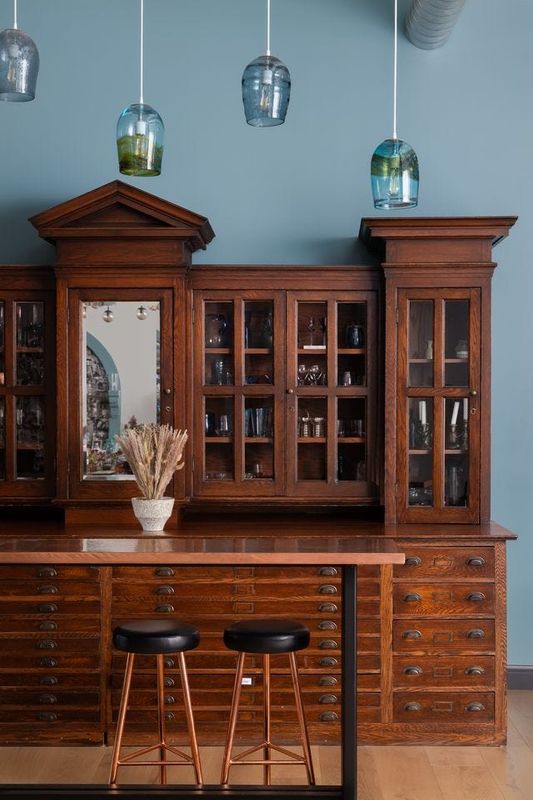
Detroit plays a starring role throughout. “We wanted to incorporate a lot of local design and artisans,” says Kapadia. “It was all part of their vision.” They also incorporated elements of the city’s past in salvaged architectural pieces such as a large wooden linen press, once part of the sacristy at Poletown’s St. Stanislaus, now used as a bar and dining area storage. A custom window in the living room over Bess’s inherited family piano features rainbow-colored glass inset pieces that Bess hand-picked, some from Detroit schools, others from 18th-century France. Ed’s office near the entrance includes doors made from the frames saved from the building’s original windows. The door to the laundry was purchased from Detroit Throwbacks and once adorned a city school. “They’re very pro-Detroit,” Guidry says of the pair. “The home feels like a living piece of art.”
Other features are more personal. Detroit Wallpaper transformed an eye-catching collage of family photos into a custom wallpaper that now fills an arch near the dining area. Bess made the hand-blown glass pendants over the kitchen’s 10-foot island, a space perfect for entertaining and family gatherings. Sea glass that Bess has collected through the years provided the inspiration and palette for the guest space, affectionately known as “the mermaid bath.”
Living their dream
The couple moved in just before Thanksgiving in 2024. The home quickly became a gathering place for the artists and other creatives, hosting fundraisers and record releases. Ed calls the space “artist-friendly… there’s a community here, and we are lucky to be a small part of that.”
While it’s perfect for larger groups, the couple also finds the home ideal when it’s just the two of them. Ed loves to sit in the kitchen nook and drink his coffee. Bess is fond of the rocking chair in the primary bedroom, and enjoys quiet nights looking out at the nearby Fisher Building, which “glows copper at night,” she says. “I sit in the chair that I rocked all my babies in, next to my dad’s favorite side table, looking at the lights of the Fisher building, and think this is pretty perfect.” Another popular perch is the unexpected swing, which hangs not far from the kitchen. “Everyone who comes here gets on the swing, says Bess, including Ed’s friends and his 89-year-old mother.
Coming home has been everything they hoped it would be. The loft is perfect for them, but also has enough room to accommodate their five children and grandchildren for holidays and other visits. “We’re stewards of this wonderful building and want to be contributors to the city and the neighborhood,” Ed explains. There’s a lot of homecoming in this place. We’re very happy to be here.”
This article originally appeared on The Detroit News: Detroit couple turns historic factory into dream home
Reporting by Khristi Zimmeth, Special to The Detroit News / The Detroit News
USA TODAY Network via Reuters Connect
By Khristi Zimmeth, Special to The Detroit News | USA TODAY Network
