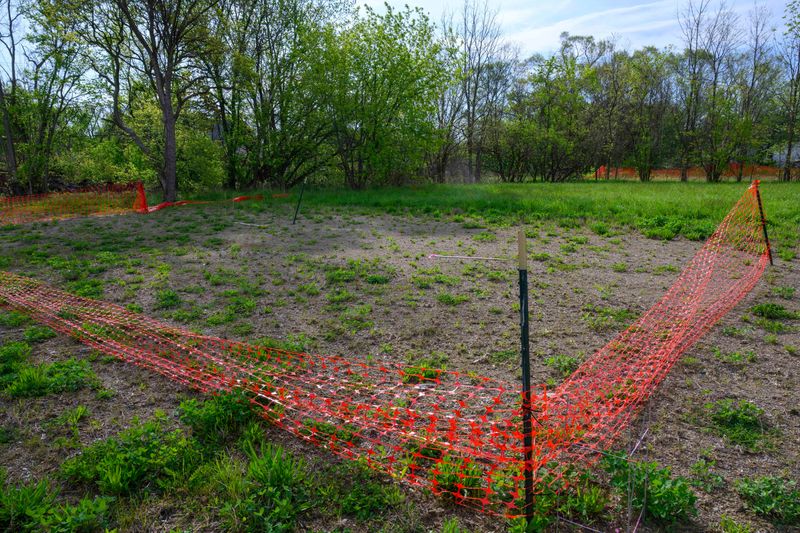
Detroit — The Detroit City Council on Tuesday paused a plan to pay an outside firm $3.5 million to investigate hundreds of former demolition sites throughout the city that may now be filled with contaminated dirt, saying they want more information.
The council delayed a request by Mayor Mary Sheffield’s administration to pay the firm Mannik & Smith $3.5 million to perform “environmental due diligence,” as described in council documents, at 650 sites for potential toxic backfill. That backfill was put there by private contractors to refill the gaping holes of demolished homes.

Several council members said they wanted more information about whether taxpayers will be on the hook for the $3.5 million, as well as more information from the city about the growing controversy around the contaminated sites.
The $3.5 million is needed to pay for testing of the fill material at sites identified as potentially having soil contamination issues, city officials said.
“We are, quite frankly, fixing a problem that we did not create, and I am asking that we (the city) be paid for having to fix this issue,” said Councilwoman Gabriela Santiago-Romero.
The cost will continue to grow, as “multiple contracts to address this issue,” of testing and then potentially replacing toxic backfill appear to be coming soon, said Councilman Denzel McCampbell. He sits in a council committee that receives the contract requests before they reach full council.
“We will be seeing soon, contracts to remediate and remove dirt and put new dirt into one property,” McCampbell said. “I know we should be working quickly. But we have not had a full conversation of where things are, and also, what does it mean for this to be solved, and what steps will be taken in that way?”
Council requested the city’s law department provide some of those answers.
Getting some of the millions back from one of the private contractors involved in the ongoing investigation over the dirt controversy will be challenging, City Attorney Graham Anderson told the council on Tuesday.
That’s because the contractor Gayanga Co., a Detroit-based demolition contractor now under investigation, said it closed last week and is already facing litigation, and the city will also take legal action, Anderson said.
“This is a matter we plan on pursuing in litigation,” Anderson said. “We hope to be able to have this as part of our total damages and cost recovery.”
The demolitions were part of of the city’s unprecedented half-billion dollar campaign to raze 27,000 empty blighted homes over 12 years.
In one of his final press conferences as mayor in December, Mike Duggan announced separate investigations had begun to determine how many demolition sites may contain contaminated dirt that is used to fill the holes left behind after razing a home. The dirt may have come from the redevelopment site of the former Northland Shopping Center, according to city officials
Duggan said that replacing the fill material at 400 sites would be about $8 million and that a $15 million fund had been set aside to cover those costs and any additional sites that could be added.
The city has set up two websites, one that shows a map or sites that have had backfill replaced or need to be replaced. Another site posts the results of analysis for each site tested.
Demolition contractor suspended
In September, Detroit-based Gayanga and owner Brian McKinney were temporarily suspended from doing work after allegedly using “contaminated dirt” to backfill the sites of 33 demolished homes, according to the city’s Office of Inspector General. In November, the city suspended Milford Township excavation firm Iron Horse of Michigan after elevated contaminant levels were found in the soil at multiple sites where the firm had supplied backfill.
The effort to identify how many Detroit home demolition sites may contain toxic dirt has grown in size and cost from that original press conference.
Initially, the number of sites to be tested for toxic dirt was around 420, and the overall cost to test and potentially refill the dirt was around $8 million, city officials said last year. The number of sites being tested for contaminated dirt has now grown to 650 locations, city officials said recently.
Detroit officials said they “handed off” the criminal investigation to the local office of the Federal Bureau of Investigation late last year.
Brian McKinney, the owner of Gayanga and co-founder, said the company has “officially closed its doors.”
“Gayanga was founded to create opportunity for Black workers in Detroit — to build careers, provide living wages, and create stability for families in our community. For eight years, we fought to do exactly that,” McKinney said in an emailed statement. Gayanga is also Black-owned.
“Over the past year, we remained largely silent while navigating an intense public and legal process. Beyond the temporary OIG suspension of Gayanga Co. and myself, much was discussed publicly about my personal relationship with Mary Sheffield, and I understand it became a tactic during last year’s mayoral race. I have already acknowledged the pain my affair caused while I was married, and it is not something I am proud of. Out of respect for my ex-wife and my family, I will not discuss private details further.”
McKinney contends that Duggan acknowledged in the December press conference that over 309 Gayanga properties had already been tested and verified as clean.
Gayanga files lawsuit
Gayanga filed a lawsuit in Wayne County Circuit Court last week that contends city officials presented a limited number of data “that created the misleading impression” that Gayanga was responsible for “widespread contamination,” according to the lawsuit. City officials presented to media and public that Gayanga was associated with contamination at over 80% of 40 tested properties last year.
The city didn’t reply to a request for comment Tuesday about the lawsuit.
Gayanga is also being sued. Last week, a group representing laborer unions filed a federal lawsuit against the firm for about $24,000 in unpaid benefit contributions, along with interest to the union workers. The suit was filed in the U.S. District Court in Detroit.
The plaintiffs are the Michigan Laborers’ Health Care Fund, Michigan Laborers’ Pension Fund, Michigan Laborers’ Vacation Fund, LIUNA Training Fund of Michigan, the Michigan Laborers’ Employers’ Cooperation and Education Trust Fund, and the Michigan Laborers’ Annuity Fund.
laguilar@detroitnews.com
This article originally appeared on The Detroit News: Detroit council delays contract to find toxic dirt at home demo sites
Reporting by Louis Aguilar, The Detroit News / The Detroit News
USA TODAY Network via Reuters Connect