Detroit Three automakers built their businesses on the backs of the working class: Ford Motor Co. with the everyman’s Model T, General Motors with the all-American Chevrolet and Stellantis with blue-collar Dodge and Ram trucks.
Yet, in recent years, the companies have increasingly shifted from building and selling affordable small cars and sedans to focus their production on moneymaking big SUVs and pickups, and, in the case of Stellantis, pricey muscle cars with rocket engines, too.

These vehicles can easily carry an average manufacturer’s suggested retail price (MSRP) of $65,000 or more — in fact it can be much more. Consider a GMC Yukon SUV: Its average MSRP in the second quarter this year was $92,658, according to Cox Automotive data.
The publicly owned companies can’t be totally faulted. They have bills to pay and must make money for shareholders. But these prices are hardly attainable for a working-class person — the workers who built automakers’ businesses and who are key customers, too.
According to the U.S. Bureau of Labor Statistics, the typical full-time American worker earned a weekly wage of $1,251 in the second quarter of 2026, which is a median annual salary of $65,052.
Yet, just last month, the automakers pointed to continued consumer demand for their pricey vehicles as reasons to project wider full-year profit growth. In other words, wealthy buyers keep coming to showrooms and are keeping the automakers in Detroit — and across the industry — well fed, dulling the urgency for automakers to invest in making lower-profit-margin vehicles priced at $30,000 or less.
“New cars are more the domain of the affluent than pre-pandemic,” David Whiston, autos analyst at Morningstar, told the Detroit Free Press. “It’s concerning only for the ‘what if’ aspect of what if there’s a surge in unemployment and the stock market tanks at the same time.”
Beyond such hypothetical perils, there are deep complexities as to why the average new car prices for U.S. carmakers’ vehicles top the industry average. All three carmakers have acknowledged the need to offer a portfolio with more affordable options. But part of the blame goes to the consumer.
“Base models still exist,” wrote Erin Keating, Cox Automotive executive analyst, in a column. “Automakers continue to build them, and they are available on dealer lots. But many consumers are choosing better-equipped trims and vehicles with more advanced features. At the same time, more affluent households are accounting for a larger share of new-vehicle demand, and those buyers often gravitate toward higher-priced models.”
By the numbers
The industry-wide average MSRP for a new car in the second quarter was $51,306. Here are some average MSRPs for new vehicles for the second quarter, according to Cox Automotive data:
Edmunds.com ran the numbers as well, but used the average transaction price rather than average MSRP. The MSRP is what is listed on the window sticker. The average transaction price is what the buyer actually paid for the vehicle after all discounts and trade-in values were factored in.
In the second quarter, the industry average transaction price was $48,949, according to Edmunds. Here are how the automaker’s average transaction prices compared with the industry average:
Edmunds’ data showed that Detroit automakers’ average transaction prices a decade ago in the same quarter were $16,000 to $23,000 less than today. The Asian brands ranged from $10,000 to $15,000 less in 2016.
More money, but more car?
You may be thinking that everything was cheaper a decade ago and inflation should be factored in, but Ivan Drury, Edmunds’ director of Insights, explains it this way: “We never provide inflation adjustments for any of those historical data points because autos are part of the basket of goods that power the (Consumer Price Index). This creates a circular issue, and people will always want to dig up a window sticker to argue about historical prices. On the opposite end, if we deflate today’s prices to 2016 it also nulls out a lot of the shock and awe for today’s prices.”
But Cox’s Keating is careful to note that the higher prices today do deliver more product than what consumers got a decade ago and she does factor for inflation.
“The Honda CR-V, a consistent consumer benchmark, helps show the point,” Keating wrote in her column. “Over the past decade, the average transaction price for a CR-V has increased by roughly $11,000, from around $28,000 in 2016 to about $39,000 today. That sounds like a big increase. Adjusted for inflation, however, the difference nearly disappears. In real terms, the price is essentially where it was 10 years ago.”
A 2016 Honda CR-V LX did not offer the host of features that come on the 2026 model. For example, the 2026 model includes a more powerful engine compared with the 2016 model, a touch screen display, wireless Apple CarPlay and Android Auto, automatic emergency braking, adaptive cruise control, lane keeping, push-button start, automatic climate control and more — all of which were not on the 2016 model.
“The narrative that new vehicles have become unaffordable simply because sticker prices average near $50,000 misses the point,” Keating said. “Today’s vehicles are more advanced, more capable and more content-rich than those sold a decade ago. In real terms, many have held their value remarkably well.”
Detroit risks losing first-time buyers
Still, as the U.S. automakers gradually ended production over the past decade of small cars and lower priced sedans in lieu of the bigger, more profit-rich SUVs and trucks that consumers desired, more expensive vehicles now dominate their total sales. The profits on big trucks can only be estimated, but in a 2023 report by Reuters, it noted that GM’s average per-vehicle earnings before interest and taxes on all of its trucks and SUVs in 2022 was $10,678, as calculated by Benchmark auto analyst Michael Ward, based on GM’s SEC filings. Meanwhile, its estimated that profits on small cars can be as low as 1% of the MSRP, according to CarDealer Magazine.
In the second quarter of 2016, about a third of Ford’s sales were made up of vehicles priced below $30,000. In the second quarter this year, only 3.5% of Ford’s sales comprised vehicles priced at $30,000 or less, Edmunds data showed.
On the opposite extreme, vehicles priced above $70,000 made up less than 1% of Ford’s sales a decade ago and today they comprise 19%, according to Edmunds data. The data showed similar percentages for Stellantis vehicle sales compositions.
At GM there is still a somewhat wide offering of vehicles priced below $30,000. In the second quarter of 2016, 35% of GM sales consisted of cars priced below $30,000 and today those vehicles make up about 16% of GM’s sales, Edmunds data showed.
Still, on the high end, GM is selling more of the pricer products like the others. In the second quarter 2016, 3.6% of GM’s sales were of vehicles priced above $70,000. In the second quarter this year, those vehicles make up 23% — nearly a quarter of GM’s total sales.
The data signals to Drury a sign that the Detroit Three risk leaving behind the base that built them.
“While the Detroit Three have each carved out distinct paths in their hunt for profitability, Ford leaning into trucks, GM capitalizing on SUVs, and Stellantis bankrolling emotional engineering, their collective focus on the bottom line is beginning to alienate the entry-level buyer,” Drury said. “This shift away from affordability is discouraging both the first-time shopper and the loyalist waiting for a reason to return to the showroom after a decade-long drought from new car shopping.”
Detroit automakers try to go lower
Ford does recognize the need for more affordable products. It has been a rallying cry for Executive Chair Bill Ford and CEO Jim Farley.
“Affordability is a big issue,” Bill Ford told the media on the sidelines of this year’s Detroit Auto Show on Jan. 13. “It’s one we talk about a lot internally and we actually have a lot of plans to address that … some of which we haven’t announced yet, but will shortly because I do think that’s really important.”
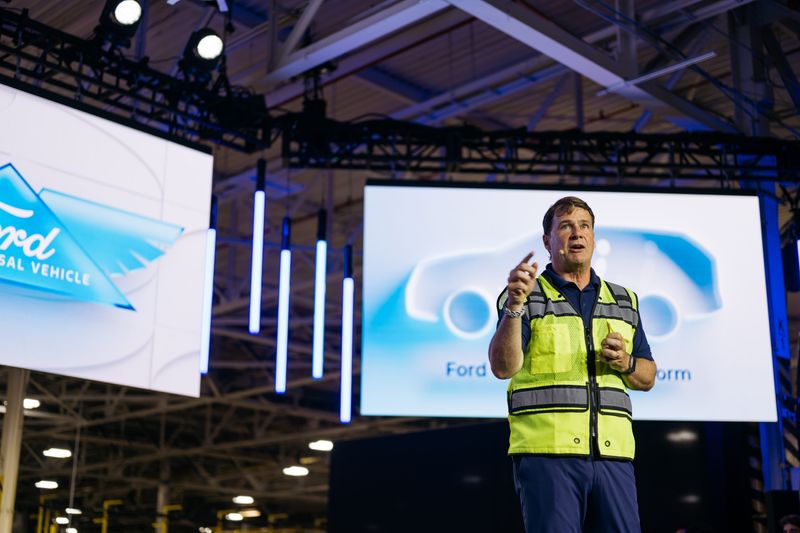
In August 2025, Farley promised a new lineup of affordable electric vehicles to be built at its Louisville Assembly Plant in Kentucky based off of Ford’s new Universal Electric Vehicle platform. The first will be a midsize pickup called Ford Fathom. Ford announced on Aug. 6 that the Fathom will start at $29,945, when it goes on sale in 2027.
GM CEO Mary Barra has long stated her belief that EV adoption will not take off until there are more EVs available around the $30,000 price point. The redesigned 2027 Chevrolet Bolt EV starts at $28,995 and the starting price of the Chevrolet Equinox EV is $34,995. GM offers the Chevrolet Trax, Equinox, and Buick Envista starting below $30,000.
Stellantis CEO Antonio Filosa earlier this year noted the industry’s high pricing when he launched a strategic turnaround plan centered on lower price points. In May, Filosa said the automaker will launch nine vehicles priced at less than $40,000 by 2030 in North America, including two under $30,000.
But the Detroit automakers truly face a challenge when figuring out pricing, Drury said. The companies attempted lower-priced vehicles in the past and found the cars they offered to be only equal to competitors, or, in some cases, behind competitors on features, value or fuel economy, he said. So the U.S. car companies canceled such entry-level products, as the proliferation of SUVs and more expensive trucks allowed them to shine in mostly uncontested market segments.
“Today’s market for new cars is a challenge for automakers as they received mixed signals,” Drury said. “Ford’s Maverick was too successful and has seen a $10,000 price increase since inception. Bronco Sport with a $35,900 average transaction price has a similar market share to Bronco at $55,800. No one sells as many sizes and variety with pickups as Ford and the quickest selling one, at 50 days to turn, is $60,000.”
Likewise, Drury noted that GM has the Buick Envista and Chevrolet Trax catering to the entry-level buyer. The 2026 Trax starts at $21,700 and the Envista at $29,500. But for twice the price GM sells over twice as many Silverado 1500 and Sierra 1500 full-size pickups. Cox Automotive data showed the average MSRP for the Silverado and Sierra in the second quarter was $68,968.
U.S. automakers also face high costs between paying for material goods, auto parts, manufacturing and higher wages than some foreign competitors. While Asian carmakers can make lower-priced vehicles at their U.S. plants, such as Toyota’s Corolla made in Mississippi and Honda’s Civic made in Indiana, when the current business model emphasizes “bigger is better,” it is hard to get Detroit carmakers’ engineers to devise creative solutions to control costs to compete, Drury said.
Still one ‘super’ affordable car
Both Drury and Keating also agree that it is difficult to fault companies for following the profit, too, when most buyers bypass base trims for loaded models. For most 2025 model year transactions across the industry, the average base MSRP of $38,046 soared to $50,007 once options, higher trims and destination fees were tallied, Drury noted.
For U.S. automakers it is “make hay while the sun shines,” Drury said, but at some point the wealthy buyers will run their course and the new group of buyers that don’t have an existing trade-in with positive equity or double-digit down payments will be forced to look elsewhere if Detroit’s carmakers do not have enough offerings at the lower price point.
So while it is tempting to cater to the buyers with the deepest pockets, Drury said, there is “a risk in forgetting the brand’s roots.”
“The same individual signing for a $70,000 SUV today was likely once a consumer just hoping to get approved for a $20,000 car loan,” Drury said. “By abandoning their status as full-line manufacturers, these (automakers) might be securing short-term gains at the expense of lifelong brand loyalty, potentially closing the door on the next generation of cradle to grave customers.”
Still, there is one “super affordable” new car out there — besides the Trax, Keating said. The 2026 Hyundai Venue starts at $22,150, which is equal to $15,878 in 2016 dollars.
Jamie L. LaReau is the senior autos writer for USA TODAY Co. who covers Ford Motor Co. for the Detroit Free Press. Contact Jamie at jlareau@freepress.com. Follow her on Twitter @jlareauan. To sign up for our autos newsletter. Become a subscriber.
This article originally appeared on Detroit Free Press: Detroit 3 automakers’ average car prices top the industry. Here’s why
Reporting by Jamie L. LaReau, Detroit Free Press / Detroit Free Press
USA TODAY Network via Reuters Connect
By Jamie L. LaReau, Detroit Free Press | USA TODAY Network