Ann Arbor — If this liberal enclave is a bubble, people on the outside rarely scrutinize what’s happening within it.
During this year’s mayoral election, however, outsiders are poking the bubble left and right.

A governor and two U.S. senators have weighed in with endorsements. Money from interest groups is making it one of the most expensive races in city history. Unions have joined the fray, splitting their support between the two candidates.
Why do nonresidents care about a primary involving a part-time mayor whose power is no greater than the other ten members of the Ann Arbor City Council?
Because one of the candidates, Yousef Rabhi, is a democratic socialist and his victory, along with other progressive wins, could become an issue at the top of the ticket this fall, political strategists said.
Rabhi is running against Mayor Chris Taylor, who has been in office for a dozen years.
Republicans could use the ascension of Rabhi in their quest to paint Democrats as radical, said Myra Johnson, a Democratic political consultant from Ann Arbor.
“It’s a proxy,” she said. “If Yousef wins, the Republican Party will be pointing to him, ‘We told you. They’re communists.’”
Ann Arbor is just a skirmish, but there’s a much larger war being fought between moderates and progressives for the soul of the Democratic Party, she said.
If ever a place was ripe for the liberal groundswell bubbling through the party, it’s what some people call the People’s Republic of Ann Arbor.
Wherever the left is heading, this college town usually gets there first.
The city council passed a fair housing ordinance in 1963, decriminalized marijuana in 1972 and supported same-sex marriage in 2004. In December, it removed neighborhood watch signs on the grounds they promote exclusion.
A hometown protester vs. the ‘quiet’ liberal
Rabhi, 38, is an adopted son of Ann Arbor.
He was born in Ypsilanti but grew up in Ann Arbor and graduated from the University of Michigan. In a city with a protest-rich history, he was right at home.
His grandparents were activists who fought in the Algerian revolution, he said. As a child, he marched in downtown Ann Arbor during demonstrations against the wars in Iraq and Afghanistan.
“I welcome disagreement. There should be disagreement,” he said. “The whole reason that I wanted to run is to put power back in the hands of the people in this community.”
Rabhi was still attending UM when he ran for the Washtenaw County Board of Commissioners in 2010. He won and has held public office ever since: six years as a commissioner, six as a state representative and three more on the commission.
But he hasn’t given up the bullhorn.
He was a lone wolf on both governing bodies, pulling further left than his comrades, he said. He took forceful positions and didn’t like to compromise.
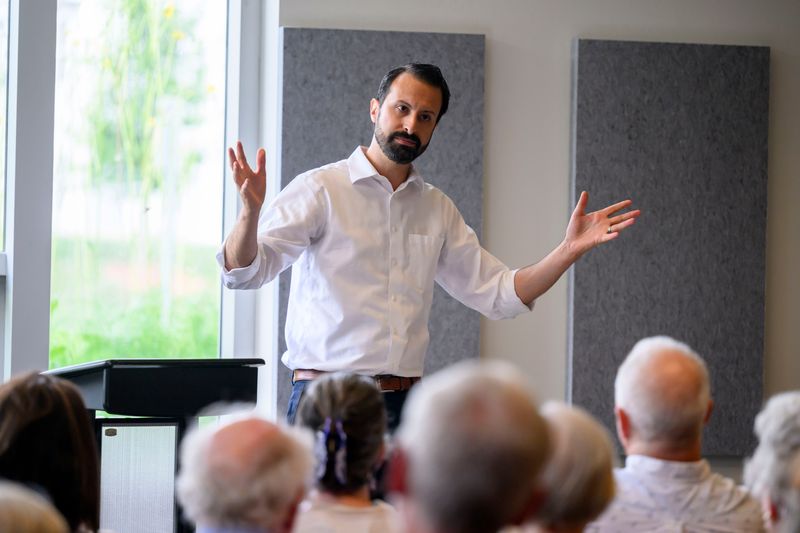
During debates in the mayoral race, he talked fast and emphatically, the words gushing out. His responses to questions used every second of his allotted time.
Taylor isn’t a democratic socialist but is no slouch ideologically. His liberal bona fides are long and deep, according to a review of his record.
As mayor, he led campaigns that opposed ICE, supported solar power and reduced carbon pollution. He helped create low-income housing that runs on clean energy.
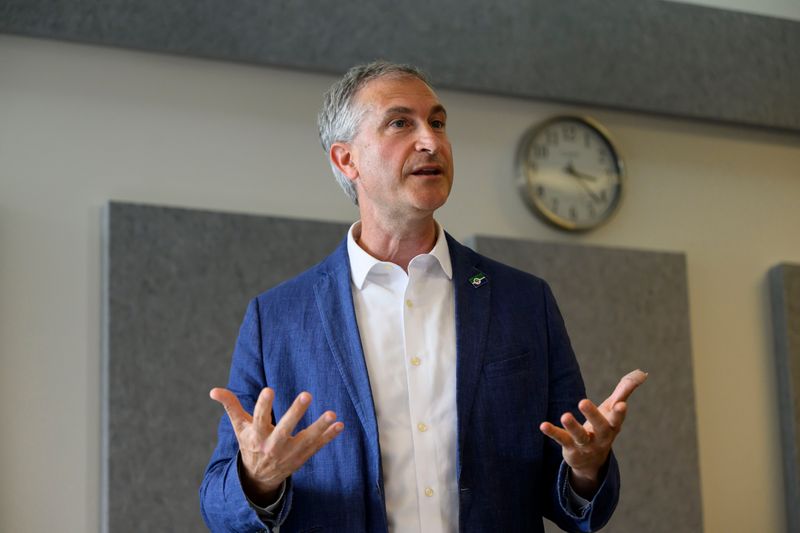
If Rabhi is a lone voice braying in the wilderness, Taylor tries to cobble together consensus on the council, he said. He’s an estate planning lawyer with a soft voice and reserved manner.
“I’m not a fancy lawyer. I’m not an angry lawyer,” he said. “I’m a quiet person. That’s what we need.”
Big-name politicians try to influence Ann Arbor mayor’s race
The campaign for mayor has been robust with testy exchanges between candidates, big crowds at debates, flowing political donations and thousands of campaign signs covering the city.
Rabhi was endorsed by U.S. Sen. Bernie Sanders, the democratic socialist from Vermont, while Taylor is supported by two centrist in-state Democrats, Gov. Gretchen Whitmer and U.S. Sen. Elissa Slotkin.
Rabhi has received $214,000 in campaign contributions, compared with $176,000 for Taylor, according to their latest campaign finance reports filed with the county. The $390,000 total dwarfs the $122,000 raised in the 2022 race.
Also spending money is Michigan Deserves Better, a Lansing nonprofit organization that doesn’t disclose its donors. The group, which has criticized progressive candidates in Democratic primaries, has distributed mailers against Rabhi.
More so than past years, the chatter at the bustling ethnic restaurants and artisanal coffee shops in downtown Ann Arbor wiggles its way to the mayor’s race.
Benjamin Michael, 46, a chief technical officer for a digital marketer, said the candidates want the same thing, but Taylor favors a more methodical approach.
“They’re both advocating the same thing,” he said. “They want the same goals but have a different way to achieve them.”
Housing affordability, growth a flashpoint in Rabhi’s campaign to unseat Taylor
Rabhi is supported by an unusual combination of progressives and growth opponents.
The anti-development crowd is upset with the mayor for championing a new comprehensive land use plan that expands housing throughout the city. It reversed decades of restrictions by allowing duplexes and triplexes in neighborhoods once limited to single-family homes.
Taylor said a bigger supply of housing could drive down the skyrocketing cost of rent. The average price in the city is $2,000 a month.
On other issues, Rabhi said the city is moving in the right direction but needs to pick up the pace. He said the city remains too expensive, that only upper-class people can afford to live there.
Mentioning FDR’s New Deal, he wants to expand the government’s role in residents’ lives.
He said the city could create affordable housing by building it on public land. The government would invest in co-ops and land trusts, and maintain the city-owned housing, he said.
“If we want affordable housing, we have to build affordable housing,” he said. “Our community has really gone in the wrong direction because what we need now is affordable housing for the workers today.”
Rabhi also wants to replace DTE Energy Co. with a city utility powered by renewable energy. A group, Ann Arbor for Public Power, is collecting signatures to put the measure on the November ballot.
The city utility and housing would be financed through revenue bonds, which are repaid by project earnings, he said.
Some residents, however, are skeptical about Rabhi’s plans.
Alex Lowe, a software developer, was looking forward to having an alternative to Taylor, whom he believes hasn’t done enough as mayor. But Lowe was disappointed with Rabhi despite the fact that he, like Rabhi, is a democratic socialist.
Lowe, 36, believes Rabhi is more focused on ideological fights than getting things done. He said he’s voting for Taylor, who he believes is more progressive than Rabhi.
“The mayor is more concerned about outcomes than ideology,” he said. “He’s willing to work with the system.”
Ann Arbor mayor pumps brakes on push to abolish DTE Energy
Taylor said the city is already taking steps to address the lack of affordable housing.
In 2020, voters approved a 20-year millage to build lower-cost homes. Taylor, who helped draft the levy, said the city will add 1,200 units in five years, which is double the number it built during its first 200 years.
As for DTE, Taylor said it was a cancer that pulls profits out of the community. But replacing it would be a money pit, he said.
Getting rid of the utility would be a multiple-step process with some stages costing hundreds of millions of dollars, he said. The steps include litigation, condemnation and acquisition.
“We have to deal with reality,” he said. “This action would require a decade of multi-million dollar litigation before it even got started.”
As for renewable energy, Taylor led an effort that allows residents to supplement their service from DTE with green power.
The Sustainable Energy Utility, approved by voters in 2024, is installing solar panels and solar battery backup systems in 100 homes this year and 1,000 next year, according to the city.
Still, some voters felt Taylor should be doing more to help residents deal with the expense of living in the city.
Erick White is a retired U-M professor of Asian religious anthropology who rode a bike to one of the candidates’ forums. After the debate was over, he said he didn’t hear the mayor propose any new solutions to the city’s problems.
“He’s not solving the problems enough,” he said. “I want to know how he’s going to make more affordable homes after the 1,200 units.”
White, 61, said the mayor’s solutions were limited to tweaking the market, while Rabhi wants to go beyond that and take more drastic action.
Taylor pushes back against ideological ‘fantasy’
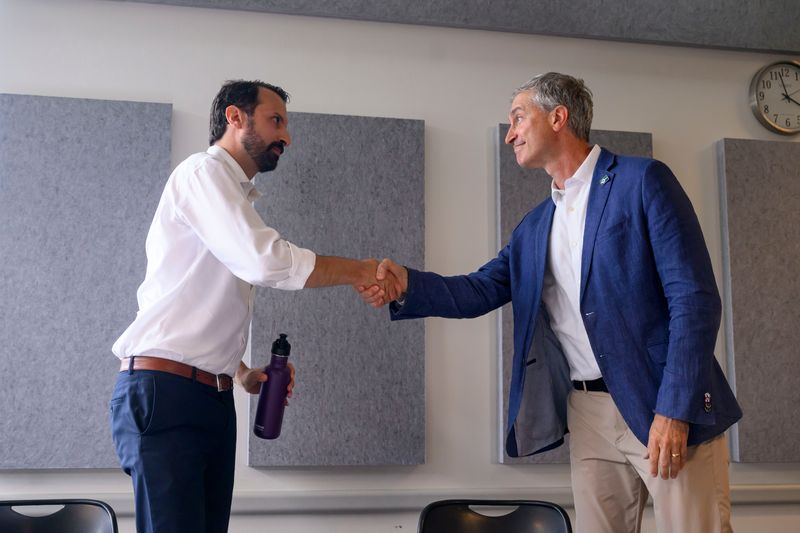
The final debate in the mayor’s race was held on July 19 at the Traverwood Library, near UM’s North Campus.
During construction of the library, horses were used to remove the cleared trees, not because it occurred a long time ago (it was built in 2008) but because Ann Arbor likes to do things in an environmentally friendly way.
The community room of the library overflowed with 80 people. The mostly elderly crowd applauded heartily after some of the responses by both candidates.
Taylor, wearing a jacket, smiled easily as he stuck to his talking points, sometimes pausing after making a point. Rabhi, in a dress shirt, was more exuberant as he barreled through his responses.
Rabhi compared Ann Arbor to a country club, saying a person needed a membership to live in the gilded community.
“This isn’t the community that I grew up in,” he said. “We’re pricing people out. Frankly, 1,200 (affordable) units is not enough. We need to do way better than that.”
Taylor said Rabhi’s solutions for problems were light on specifics.
Describing himself as progressive several times, Taylor said he has come up with ways to improve residents’ lives while Rabhi is trying to win ideological arguments.
“This is not fantasy,” Taylor said about his accomplishments. “This is not pie in the sky. It’s real world.”
fdonnelly@detroitnews.com
(313) 223-4186
@prima_donnelly
This article originally appeared on The Detroit News: Democratic socialist tests how progressive Ann Arbor wants to be
Reporting by Francis X. Donnelly, The Detroit News / The Detroit News
USA TODAY Network via Reuters Connect
By Francis X. Donnelly, The Detroit News | USA TODAY Network