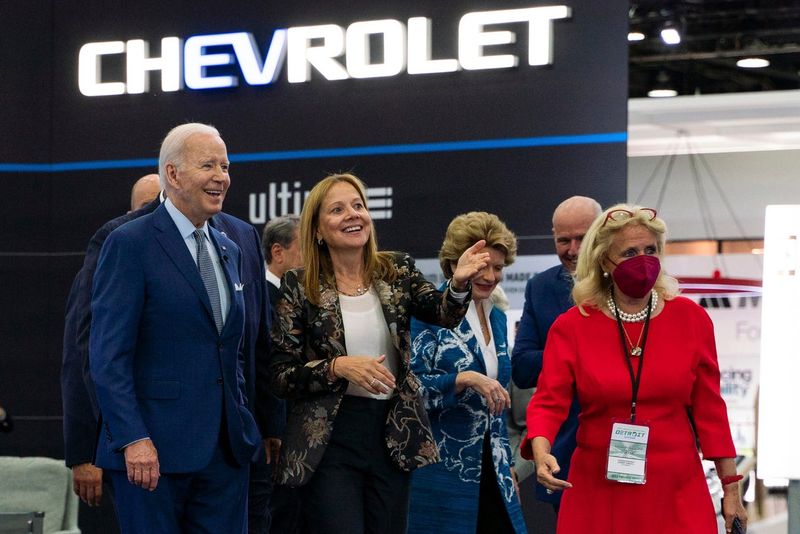
General Motors CEO Mary Barra and Ford Motor CEO Jim Farley were both approached — separately — by senior defense officials in the Trump administration who are seeking the automakers’ help to increase the nation’s supply of military equipment.
The Pentagon wants to use the automakers’ workforce and factory capacity to help it produce more weapons and other equipment as the war in Ukraine has depleted inventory, and now the war on Iran is also taking a toll.

To be clear, the automakers would likely not make weapons, but rather produce the structural components to be subcontracted to a weapon manufacturer. The car companies have an expertise in stamping, casting, forging and working with plastics and other composites. But no details have been defined given there has only been exploratory talks at this point.
The Wall Street Journal was first to report that there were discussions, but a source familiar with the situation confirmed to the Detroit Free Press some context and that the meetings had taken place, as early as last year, well before the war with Iran began. The person asked not to be identified because they are not authorized to share the information publicly.
Ford spokesman Dave Tovar declined to comment for this story.
GM spokesman Jim Cain emailed this comment: “For more than 100 years, GM has supported America’s security, safety, and those who protect our nation. While that commitment continues, we do not comment on speculation.”
A spokesperson for the White House did not immediately respond to a request for comment.
Automakers’ history making military equipment
It makes sense that the government would tap both GM and Ford for help. When the nation entered the second world war, the Detroit Three automakers played a part in manufacturing war materials as part of the so-called Arsenal of Democracy. Ford designed the Jeep and built 282,000 of them. In 1941, it built the Willow Run plant, a factory near Ypsilanti, Michigan, that could mass produce the B-24 Liberator bombers.
Ford’s Rouge assembly complex, where it now builds its top-selling F-150 pickup, opened in 1918 and Ford started helping the World War I effort by building tractors, submarine chaser boats and airplane engines for the military. It started car production in 1927.
GM converted more than 100 plants during World War II to manufacture trucks, planes, machine guns, propellers and ammunition. Chrysler (now Stellantis) also converted factories to make military equipment for that war.
In 2017, GM formed subsidiary GM Defense to apply its vehicle technology to military equipment and win lucrative government contracts with the U.S. and foreign governments. In 2020, it won its first contract, worth $214.3 million, to build the Infantry Squad Vehicle (ISV) for the U.S. Army. It has won other contracts since then such as in 2021. GM Defense won a $36.4 million contract from the State Department to develop large support utility commercial vehicles for the department’s Diplomatic Security Service, which is the federal law enforcement and security arm of the department.
A matter of national security
The military weapons are complex to produce, making it difficult for the primary contractors to keep up with demand when there are now two wars the country is supply military tools for: Ukraine and Iran.
The full-scale Russian invasion of Ukraine began in February 2022. The Iran war, dubbed by the Trump administration as “Operation Epic Fury,” began on Feb. 28 with surprise airstrikes by the United States and Israel. The countries say the war is to halt Iranian nuclear, military and leadership infrastructure.
The U.S. Defense Department has been trying to figure out a way to get better tools into the hands of soldiers at a lower cost for many years now and has looked to non-military companies, such as GM and Ford, for help breaking up supply chain bottle necks to increase production of weapons and other equipment.
The WSJ reported that the defense officials framed the request for help as a matter of national security. The Defense Department “is committed to rapidly expanding the defense industrial base by leveraging all available commercial solutions and technologies to ensure our warfighters maintain a decisive advantage,” a Pentagon official said to the WSJ.
The Pentagon officials initiated the talks with Barra and Farley because the automakers have specialty labs and the manufacturing scale to help replenish the dwindling stockpiles of munitions. Both automakers have proven an ability to shift production away from cars such as when they made lifesaving ventilators during the height of the COVID pandemic six years ago.
It is unclear as to how deeply GM and Ford are considering the request, but according to the Wall Street Journal, Wisconsin-based Oshkosh has been in talks with the Pentagon since November after Defense Secretary Pete Hegseth called for companies to boost production, Logan Jones, chief growth officer for the company’s transport segment, told the Journal.
Oshkosh builds tactical troop carriers for the Army and U.S. allies, but most of the company’s $10.5 billion revenue is nondefense, the WSJ said.
“We’ve been out looking at capabilities that we think fit their needs, just proactively,” Jones said in the WSJ. “We’ve heard it loud and clear that this is important.”
Jamie L. LaReau is the senior autos writer for USA TODAY Co. who covers Ford Motor Co. for the Detroit Free Press. Contact Jamie at jlareau@freepress.com. Follow her on Twitter @jlareauan. To sign up for our autos newsletter. Become a subscriber.
This article originally appeared on Detroit Free Press: Defense officials reportedly asked GM and Ford for help with munitions
Reporting by Jamie L. LaReau, Detroit Free Press / Detroit Free Press
USA TODAY Network via Reuters Connect