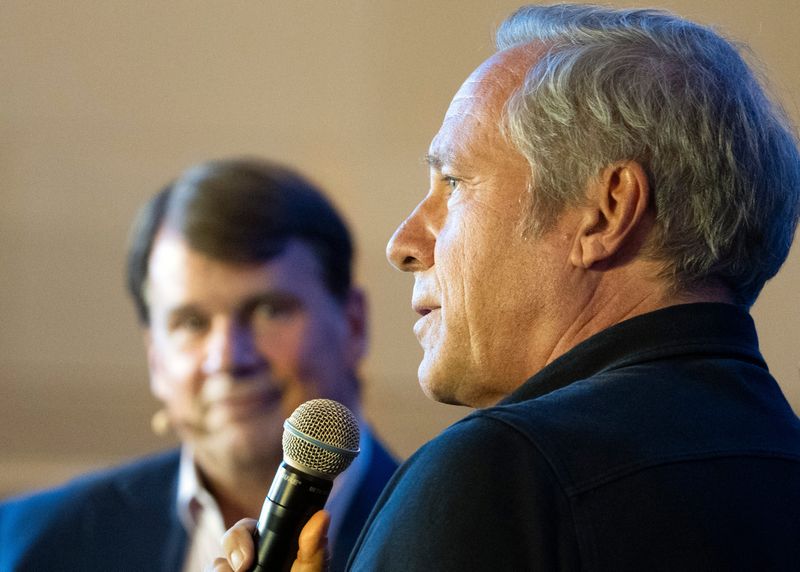
Ford Motor Co. CEO Jim Farley said there’s a “live debate” in his household around his son’s future as his son contemplates a career in skilled trades rather than a four-year college degree.
Farley, 63, shared the issue on Sept. 30 during a summit he organized called Ford Pro Accelerate: The Essential Economy, held at Michigan Central Station in Detroit.

The purpose of the daylong event — which drew big-name speakers and 300 invite-only attendees — was to talk about how to attract and retain people to jobs in industries like manufacturing, utilities, transportation, construction, and energy.
As part of the closing discussion between Farley, U.S. Secretary of Labor Lori Chavez-DeRemer and Mike Rowe — who created and hosted “Dirty Jobs” on Discovery Channel and is now CEO of mikeroweWORKS Foundation, which provides scholarships for skilled trades vocational training — Farley revealed his family dilemma between his son and his wife, Leah.
“My son worked as a mechanic this summer and he said, ‘Dad I really like this work, I don’t know why I need to go to college.’ ” Farley said on the stage. “And Leah looked at me and said, ‘Is he serious?’ Like, should we be debating this? It’s in a lot of American households. It should be a debate.”
Value of vocational vs. liberal arts degree
The debate exists, Farley said, in part because of the cost to go to college now compared with the availability of lucrative jobs once a graduate enters the workforce with their degree.
Meanwhile, there is a low supply versus a high demand in the United States for skilled tradespeople, making those the more lucrative and stable jobs of the future. Ford sees it in its own struggles to find service technicians for dealerships to perform vehicle repairs.
Rowe said he has been most struck by the math each year where for every five people who leave the skilled trades industry, only two new people enter to replace them. It’s a trend that has been going on for a decade, he said.
“The stigma and myths and misconceptions over decades associated with blue-collar jobs have conspired to keep a whole generation of kids from giving the trades an honest look,” Rowe said. “If we don’t change that, first and foremost, it just seems to me everything else we try to throw at this will be quixotic or sisyphean. We have to start with the dignity of the work and then make the opportunities crystal clear and then we have to make a more persuasive case for them.”
As for Farley’s family debate, Rowe said many people ponder whether a liberal arts degree is valuable anymore and he said that’s the wrong question.
“Of course, it’s valuable. But mine cost $12,200 in 1984. Today, same course load, same schools and it’s $97,000,” Rowe said. “Nothing in the history of Western civilization has gotten more expensive more quickly. Not energy, not food, not real estate, not even health care … than the cost of a four-year degree. Everybody’s having that debate Jim, but in the end, it just comes down to … valuable? Of course. At any price? Probably not.”
Human capital is the key to the future, he said. Rowe said artificial intelligence is what is “coming for the coders” jobs, but it’s not coming for the welders, electricians, construction workers and carpenters — at least not any time soon.
“There’s a need and there’s a boom going on right now,” Rowe said. “We awarded just over $5 million in scholarships and we could have awarded $15 million, and I bet next year, we will.”
Chavez-DeRemer said her father was a Teamster and she took great pride in his work, feeling confident he could provide for their family. But for the past few decades the message to young people was to urge them to forsake manual labor jobs for a college degree.
“He did backbreaking work. Then that narrative changed where ‘You need to go to college, you need to be the first to graduate from college.’ Which I did,” Chavez-DeRemer said. “But to counter that 30-year narrative now, for people to understand there’s pride in building back America, that’s what this administration is doing.”
President Donald Trump has been promoting a policy to bring manufacturing jobs back to the United States, in part by imposing heavy tariffs on various imported products.
Farley asks Rowe for advice
Farley then asked Rowe: “What’s your pitch to my 17-year-old kid about why they should consider trade school?”
Rowe said the nation needs a public service announcement to help Farley’s kid and others understand that the negative stigmas and stereotypes attached to manual labor over the years are nothing more than a function of years of pop culture.
He said high school leaders have to stop giving guidance counselors bonuses based on how many kids they recruit to colleges and parents need to think differently about what it means for their kids to do better than they did.
Rowe said some CEOs of the biggest companies in the nation have noted the urgent need for tens of thousands of skilled tradespeople to come work for them.
Rowe told Farley that watching those CEOs “ring the metaphorical alarm bell, that’s what I would say to your kid. I would say: ‘There’s a macro problem and there’s an opportunity for you to learn a skill that’s in demand. Do that. Show up early. Stay late. Bide your time and you will prosper. ‘ ”
Chavez-DeRemer added that to have a mortgage-paying job today, meaning a job starting at $100,000 a year, “You’re not going to get that if you go get a four-year degree. As a matter of fact, a tradesman is going to come out making about $11,000 more dollars right out of that than a college graduate will.”
She said most people ages 35 to 40 will not be able to afford to buy a home in the near future. But the demand for electricians, welders, construction workers, health care workers and shipbuilders will grow “into the millions” in years ahead. Chavez-DeRemer said there “will be 250,000 new jobs in shipbuilding as part of an executive order, 25,000 new jobs over the next 10 years. And that is all of the trades.”
That prompted Rowe to offer Farley one more piece of advice for his son.
“I’d say this to your kid too, it’s not just, ‘Hey you can do better as a plumber than you thought,’ ” Rowe said. ” ‘Hey, maybe the opportunity for me is, this is a matter of national security.’ You and I have talked about the automotive industry, collision repair, technicians … that’s another 80,000 or so jobs sitting there.”
Farley: ‘That’s a very provocative thought for me’
Rowe and Chavez-DeRemer said the skilled tradespeople of the future are presently in elementary and middle school. The nation’s companies need to start now to make the persuasive case to those kids about the benefits of skilled trades work.
“They are out there already, if you’re going to get to 250,000 (shipbuilders) over 10 years you have to start early on and it’s with the families and understanding they’re countrymen, they’re not just tradesmen,” Chavez-DeRemer said. “This is for national defense. We can’t build one submarine a year and think that we’re going to be able to defend our waterways.”
She and Rowe said the nation needs that labor force ready to protect the United States and help it prosper, which means starting to recruit them earlier.
“If we want to do that, companies like Ford have to really rethink things,” Farley said. “We do not think about middle school and high school as part of our tribe, so if we want to solve it that way — that’s a very provocative thought for me.”
Jamie L. LaReau is the senior autos writer who covers Ford Motor Co. for the Detroit Free Press. Contact Jamie at jlareau@freepress.com. Follow her on Twitter @jlareauan. To sign up for our autos newsletter. Become a subscriber
This article originally appeared on Detroit Free Press: Debate between vocational school or college is real. Ask Jim Farley, who asked Mike Rowe
Reporting by Jamie L. LaReau, Detroit Free Press / Detroit Free Press
USA TODAY Network via Reuters Connect