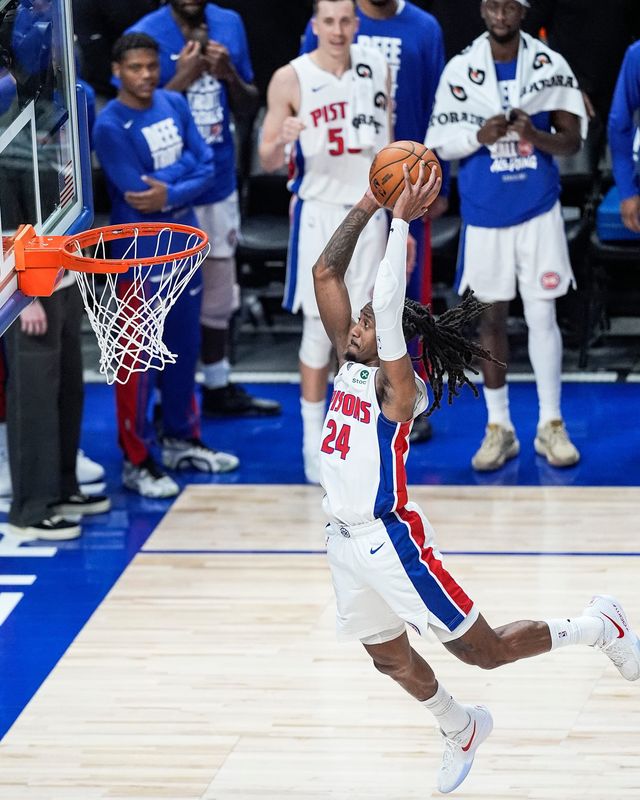
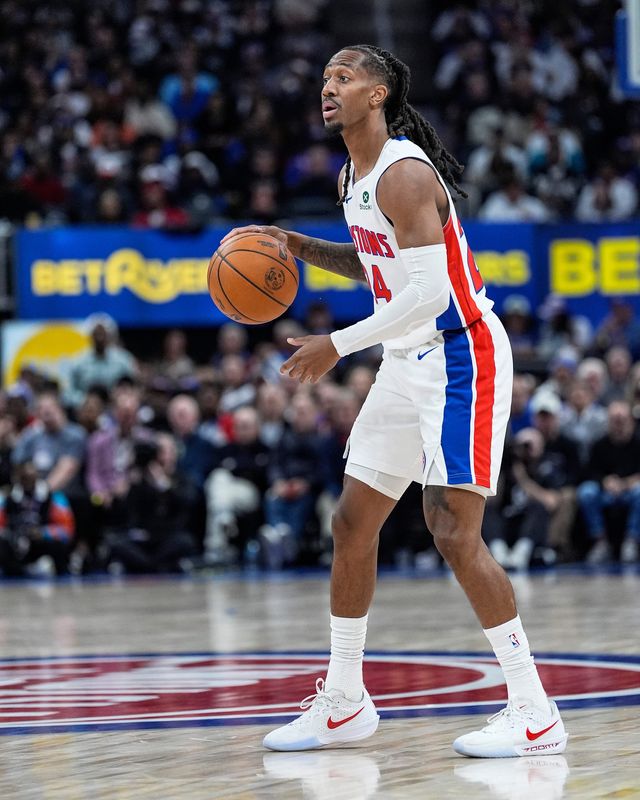
Daniss Jenkins helped the Detroit Pistons win a lot of games the last month of the regular season. In Game 1 of the second round of the NBA playoffs, he did it again.
If this is who he’s going to be, he changes the trajectory – and ceiling – of the team. A heady thought, I know.

But then consider his averages for the 11-game stretch when he started for Cade Cunningham in the final weeks of the season:
18.9 points, 7.6 assists, 4.2 rebounds.
Oh, and he shot 43.1% from 3-point range.
Yeah, yeah, that’s the regular season. But remember the context. He achieved those numbers despite beginning the year on a two-way contract, and despite getting benched for a game in mid-March after his strong play earlier in the year.
“That’s not easy,” he said eight days after his benching, “to go from being low and playing bad, and then you’re out of the rotation, DNPs, and the next thing you know your number is called, and you’ve got to be there.”
That benching, for a loss in Toronto on March 15 − the game before Cunningham suffered a collapsed lung − came after the Pistons’ backup point guard played his way into the rotation, and into a regular contract. From a two-way deal to a life-altering deal, Jenkins – 24 years old – had finally made it.
Topsy-turvy? No doubt. Jenkins describes his journey to the NBA more bluntly:
“It hasn’t been pretty.”
Fair enough. He’s free to describe his path however he chooses.
But so are we, and after watching him help close out the Cleveland Cavaliers in Game 1 of the Pistons second-round series Tuesday, May, 5, I’d chose these words instead:
Difference maker.
Which is to say, after eight playoff games, he finally looked like the player we saw the last four or five weeks of the season, when he recaptured the form that made him such an endearing and critical piece to the Eastern Conference’s top seed.
Will the real Daniss Jenkins please stand up?
That player hit a game-winner against the Los Angeles Lakers.
That player is essentially a rookie − he played in seven games last season − who showed up Tuesday night at Little Caesars Arena and let it fly from the left elbow in a four-point game with a little more than three minutes left – and sank it.
That player scored 12 points and had three assists and grabbed seven rebounds and is most proud of the rebounds because he got bullied in the first round against Orlando and complained to the officials.
That player, he said, was “soft.” And he didn’t like that player. But that player had to adjust to the physicality of the postseason and has. And now that he has, he’s back to thinking he is the best player on the court … every time he steps on the court.
And did again Tuesday night.
“Man, no doubt,” he said after the Pistons 111-101 win over the Cavaliers. “Like I always say, if you look on the court, I guarantee everybody knows everybody out there. So, in my mind, I’m thinking, who am I going to be? You know what I mean?”
Jenkins imagines himself as a player who melds humility with irrational confidence, then fuels the combo by “[trying] to make a name for myself. And just prove to myself that I’m meant to be here.”
He’s clearly proved he belongs. Now he wants to prove more.
Securing that proof is easier when someone else believes, too, and Jenkins finds that external belief in the locker room every day. Teammates routinely tell him to stay aggressive, to keep shooting, to keep taking his time, to keep putting in the extra work, to keep “being a dog on defense.”
They know the distance between the G League and the closing lineup in the second round of the playoffs. They know what he does – and can do – for this team, and for Cunningham in particular.
“His journey is unique,” said Duncan Robinson, who knows something about non-conventional NBA journeys. “It takes somebody with a special will and character to have that story and that career. The talent is there. He has that unshakable confidence for a young player, and he just wears it as a chip.”
As for helping Cunningham?
“Having an extra ballhandler out there makes a big difference for Cade,” said Robinson.
It gives him minutes to play off the ball and take a breath, for one. It forces the defense to rework its strategy, for another. And if Jenkins is hitting shots, as he did Tuesday in Game 1 and as he did in Game 7 against the Orlando Magic, it opens up the floor.
Jenkins struggled for most of the first round of the playoffs. He shot 26.3% through Games 1-6. He was overamped and overly excited, and he tried too hard to make plays. He needed time to adjust. Just as he had to adjust when he signed the two-year contract earlier this winter.
“I felt the pressure of expectation,” he said back in March, “like they expected me to be good. When you’re a two-way, you’re just a great story, an American story, everybody loves it. But then when you get that regular [contract], and you’re actually an NBA player, now it’s like, ‘OK, the pressure of everybody expecting you to be great.’”
Figuring it out
That pressure overwhelmed him for a while. Then he leaned back into the things that got him the two-way contract and rediscovered his groove. He did the same after scuffling early against Orlando.
“You can’t simulate the playoffs,” he said Tuesday night. “That first round, that first game, the first two games, I was trying too hard to make the play … my energy was just too much. I had to relax. I had to go through it … the atmosphere, the intensity of the game. It was just something I needed for my career, to prepare me for the next series.”
Kudos to J.B. Bickerstaff for sticking with Jenkins. He didn’t pull him from the rotation against the Magic. He cut his minutes, but he kept running him out there. It paid off. Jenkins got a little better each game.
“I think that’s the story of D.J.,” said Bickerstaff, “every step of the way you watch him learn and grow and take the experience and become better for it. It was funny, that first game of that first series, he was trying to get comfortable … and then he got comfortable. And I think that’s showing and carrying over to now.”
A comfortable Jenkins is a late-game shotmaker and two-way player, a spark, as Tobias Harris likes to say. Mostly, though, a comfortable Jenkins is a weight that can see-saw the scale.
Closing a tight playoff game in the conference semifinals? Jenkins understands what it means.
“That’s a tough job to put a guy in to close the game that started on a two-way,” he said.
Yes, it is. But then Jenkins earned that trust, and if he keeps playing like this, well, the possibilities are riveting.
“I was just telling the guys today now, it’s just like extended season, just like another game,” he said. “Obviously, it’s still the playoffs, but it’s just another game you’ve got to go out and win.”
Contact Shawn Windsor: swindsor@freepress.com. Follow him @shawnwindsor.
This article originally appeared on Detroit Free Press: Daniss Jenkins’ adjustment to NBA playoffs changes Pistons’ potential
Reporting by Shawn Windsor, Detroit Free Press / Detroit Free Press
USA TODAY Network via Reuters Connect