The state of Michigan is not liable for the damages resulting from the 2020 Edenville and Sanford dam failures in Midland and Gladwin counties and resulting flooding, a Michigan Court of Claims judge has ruled.
Several thousand individual plaintiffs affected by the May 2020 flooding, along with a class-action group, had sued the Michigan Department of Environment, Great Lakes and Energy and the Michigan Department of Natural Resources, claiming the agencies’ actions and inactions led to the May 2020 Edenville and Sanford dam failures. The property owners sought “inverse condemnation,” a legal mechanism allowing property owners to sue the government for just compensation when governmental actions are found to damage or take private property without formally exercising eminent domain.

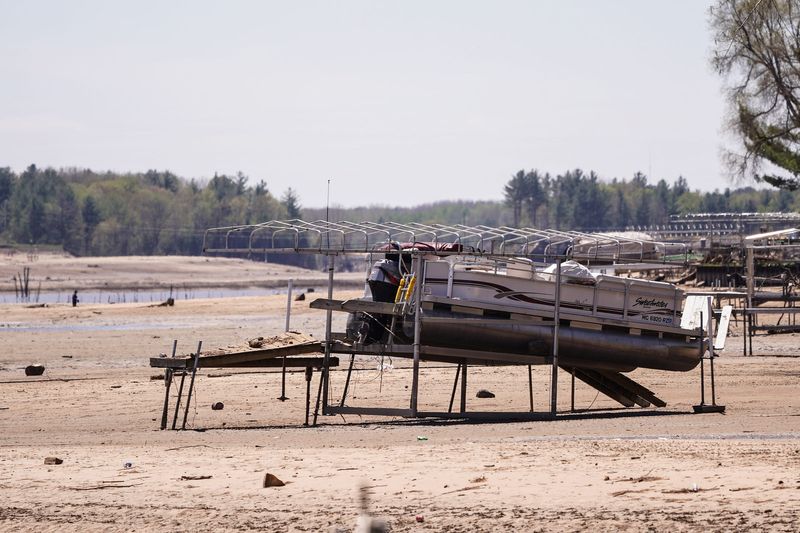
The Edenville Dam is a 6,600-foot earthen embankment up to 54½ feet in height, spanning both the Tittabawassee and Tobacco rivers in Midland and Gladwin counties. The dam failed in record rainfall on May 19, 2020, sending a rushing wall of water downriver that then also caused the failure of the Sanford Dam. The resulting widespread flooding caused more than $200 million in damage and forced the evacuation of more than 10,000 people. Wixom Lake, the 2,600-acre reservoir created by the Edenville Dam, was largely emptied.
The Edenville Dam had a private owner, Boyce Hydro Power LLC, owned by Lee Mueller of Las Vegas. Boyce had its hydro power-generating permit revoked by the Federal Energy Regulatory Commission in September 2018, the agency citing the dam owner’s repeated failure to address safety concerns at the dam — especially its ability to withstand heavy rains.
Judge: State agencies didn’t abuse their authority
In their lawsuit against the state agencies, the affected property owners alleged EGLE and DNR officials knew about the Edenville Dam’s inability to withstand significant rainfall because of insufficient spillway capacity and knew that the dam’s poor condition posed a danger to the surrounding area and properties. They also alleged EGLE and DNR officials actively prevented efforts to repair the dam and threatened enforcement actions if the water levels were drawn down; acted to conceal the risks posed by the dam; and raised lake levels to dangerous levels, concerned more with protecting environmental conditions at the lake.
But in his ruling April 23, Court of Claims Judge James Robert Redford found the state’s actions related to the Edenville Dam did not justify an inverse condemnation judgement.
EGLE authorized raising Wixom Lake to summer levels in April 2020, shortly before the Edenville Dam failure. But Redford in his ruling stated that did not mean what was done or not done at the privately owned dam was in state control. He noted that the Wixom Lake summer level was ordered by the Midland County Circuit Court in a procedure under state law to set normal lake levels called a Part 307 hearing, and was also the level ordered by FERC prior to the revocation of Edenville Dam’s hydro-power license.
“The record lacks evidence that either defendant abused its governmental authority in issuing this permit or otherwise failing to take more prompt action in remedying the dam’s deficiencies,” the judge stated.
Historic rainfall, not state agency action, caused dam failure
Plaintiffs argued that EGLE should have reduced water elevations behind the Edenville dam to run-of-the-river levels after the state agency took over regulatory authority following the FERC license revocation, when EGLE staff discovered that the dam had inadequate spillway capacity. But Redford cited an independent forensic team of experts’ evaluation after the flooding that concluded that the record rainfall just prior to the dam failure − up to 8 inches in less than two days − led them to conclude that operating the dam at run-of-the-river levels might have delayed the Edenville Dam’s failure but was unlikely to have prevented it.
“It is undisputed that the dam did not fail at a lake level set by the 2020 permit but, rather, it failed in the context of a 100-year flooding event over which neither (EGLE nor DNR) had any control and limited, if any, ability to predict,” Redford stated.
“Plaintiffs’ claims essentially rest on the state’s failure to abate a nuisance or prevent destruction of plaintiffs’ property due to the actions of a nongovernmental entity. Neither is a sufficient basis for an inverse-condemnation claim under Michigan law. “
State Attorney General Dana Nessel reacted to the ruling in a statement.
“The Edenville Dam failure was tragic, and while the evidence has always shown the state was not responsible, we have taken decisive action against those who were,” she said. “We acknowledge the lasting impact this has on Mid-Michigan, and our thoughts remain with those affected.”
Southfield attorney Jason Thompson, who represented the affected property owners in the case, did not immediately return Free Press messages seeking comment.
Judge recognizes tragedies faced by plaintiffs
Though his ruling sided with the state, Redford expressed his support and understanding for the affected property owners.
“This does not mean that what plaintiffs suffered and continue to suffer is not an immensely difficult and heavy burden,” the judge stated. “When the Edenville Dam breached that evening in May 2020 and the waters of this river went downstream, the persons, families, communities, and business owners who had primary residences, family cottages and cabins, businesses, favorite campsites, and other places of recreation and enjoyment on these waterways suffered an incalculable loss. The impact of that day and the days leading up to it and since will be felt by all those alive that day and for many years to come.”
As dam owner maneuvers in bankrupcty, rebuild is ongoing
Boyce Hydro Power LLC filed for Chapter 11 bankruptcy in mid-2020, shortly after the dam failure. A U.S. District Judge in November 2023 found Mueller liable for $119 million in environmental damage caused by the dam failure. A U.S. Bankruptcy Court judge in Nevada denied Mueller’s attempt at a personal Chapter 13 bankruptcy, in February 2024, finding he misrepresented facts before the court and that his effort “smacked of bad faith.” Boyce and Mueller liabilities to creditors remain unresolved.
The Edenville Dam rebuild is advancing, with the nonprofit Four Lakes Task Force, consisting of area property owners, securing final permits from EGLE in March 2025 to reconstruct the dam following its 2020 failure. Construction is currently underway with a projected completion date set for 2027. The goal for refilling the adjacent Wixom Lake is 2028.
The overall rebuild project for all four area lakes in the affected region is estimated at up to $400 million. The State of Michigan committed $200 million toward the rebuild in 2022, and nearly $10 million in additional funding aimed at restoring the dams last year.
Contact Keith Matheny: kmatheny@freepress.com.
This article originally appeared on Detroit Free Press: Court rules Michigan not liable for 2020 Edenville dam failure, floods
Reporting by Keith Matheny, Detroit Free Press / Detroit Free Press
USA TODAY Network via Reuters Connect