Madison Blood knew that pursuing a career in automotive design meant one day trading her sketchbook for a MacBook.
But she also knows that learning to draw, sculpt and calculate the curves of a potential vehicle by hand are still vital to landing a job designing cars.

The 21-year-old artist enters the auto industry when technology and external pressures prompt massive changes in the performance expectations for early career workers. American companies aim to cut costs and shorten production cycles amid widespread use of artificial intelligence and the concurrent rise of Chinese automakers.
The Detroit Three in particular have culled thousands of what they consider unwanted or overstaffed roles over the past several years.
But Blood, a senior in transportation design at the College for Creative Studies, based in Detroit, has already landed a role at Ford Motor Co. and feels confident in her job security even with those stressors.
At CCS, “we’re taught why things are the way they are, and I feel like AI gives something, but there’s no problem-solving,” she told the Detroit Free Press. “A lot of what we start our projects with is a person, starting with somebody that has an issue. And, sure, you could type that in (to an AI platform), but it would take so much longer to have AI try and create something meaningful.”
CCS is one of two universities in the United States to offer a major in transportation design. As the only one in the Midwest, CCS has the advantage of proximity to and long-term working relationships with the surrounding automakers and suppliers.
One of the benefits is learning from the automakers directly on how AI is deployed in studios.
The small arts college has 1,433 students and operates out of the onetime site of General Motors’ Design department and keeps its finger on the pulse of what the automotive and transportation industry expects from up-and-coming designers even amid rapid shifts in technology.
Blood is among 101 undergraduate transportation design students. There are another 24 in graduate transportation design.
Paul Snyder, who has chaired the department for the past 11 years, said students aren’t even allowed to touch AI tools until their senior year.
“The idea is that they progress through these very formative experiences of working in a traditional way and they develop their own aesthetic sensibilities and their own critical judgement about what constitutes a beautiful design versus something that should be passed over,” Snyder said. “They’re doing all that before they have access to these AI tools.”
Why? Because introducing AI too early in their development could actually disadvantage students, according to Snyder.
“The hiring managers that come to CCS to hire our graduates, they’re looking for students who can sketch,” Snyder said. “What we’ve always considered the entry point is really a masterful level of drawing; that’s the price to entry.”
Becoming an auto designer
When Blood entered high school in Meadville, Pennsylvania, she was accepted into her school commercial art program. Her instructor served as her greatest influence, and often spoke about his son, who was a designer for General Motors and had attended CCS in Detroit.
Before her introduction to auto design as a career, Blood simply thought of cars as objects on the road ― objects that all looked more or less the same.
Blood said her decision to attend was more inspired by her mentor’s path than dictated by it, but it solved a long-standing problem for her: how to make a career out of being creative.
“I thought, ‘wow, you can do something creative and be financially stable and have a house and experience the life milestones that you’d want,’ ” she said. “For a long time, I thought, ‘Fine arts? Man, I don’t know how I would survive doing the things that I love to do.’ I saw how this becomes a career and something that people are able to do on a daily basis.”
After the two-year program, Blood landed a scholarship from GM to take a transportation design course at CCS ― taught, strangely enough, by her teacher’s son.
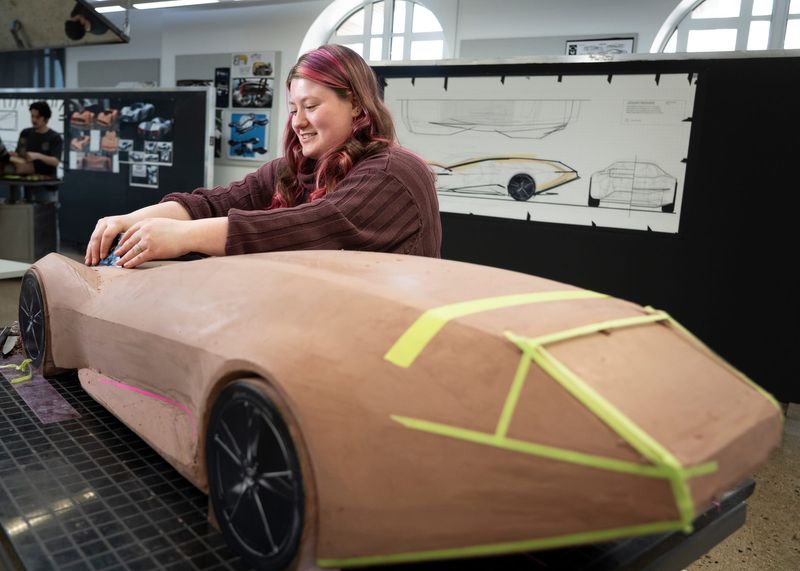
At CCS, her education picked up right where she left off in high school, learning the basics of drawing with graphite and traditional tools and sculpting. The school in recent years introduced polygonal modeling, a digital sculpting tool where students can render vehicle designs in a three-dimensional setting, within the past decade.
But virtual reality and artificial reality tools that can bring a car design into the room, so to speak, are quickly outpacing it.
Still, whether it’s programming a design for the milling machines or sculpting 3D models by hand, the students need to do it all on their own from the beginning.
Blood said she struggled at first working with computer-aided designs, but “it just becomes a tool eventually.”
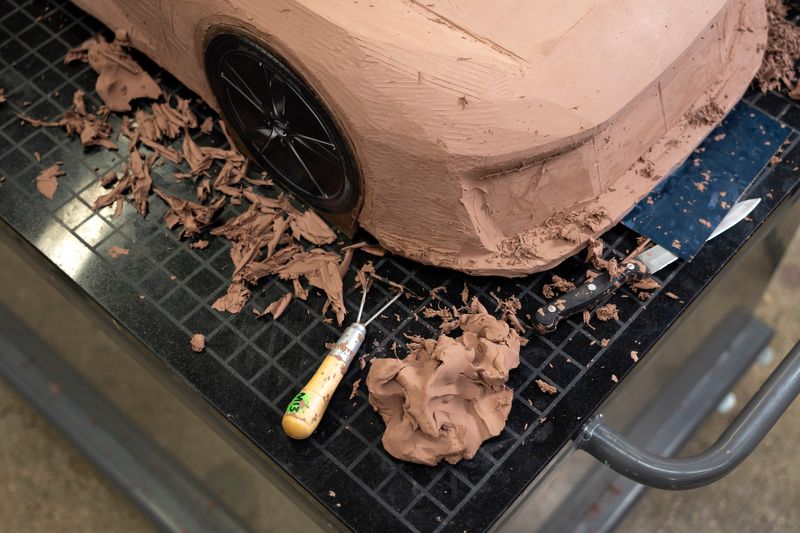
“You learn a lot when you’re starting from nothing. And you learn a lot about craftsmanship and how to make something look realistic even on a smaller scale,” she said. “In school, it’s good to learn and get your hands dirty and truly feel the surfaces as you’re making them so that you can understand how things come together.”
Training with real designers
As juniors, students participate in sponsored studios. Representatives from major automakers, including the Detroit Three, provide students a brief, which could be as simple as naming a vehicle type and a brand name for them to create. The assigning employees then visit the studio every few weeks to review the student’s progress.
“They’ll come in and be like, ‘I see what you’re thinking here; I don’t think this works for this part of the brand,’ ” Blood said. “It’s more, ‘So how can we make this feel more strong as a story, and more realistic in the sense of people who want this?’ It needs to be aspirational, and not necessarily attainable.”
Automaker expectations have climbed year after year, according to Snyder, and students are encouraged to turn around projects that hew more closely to marketing proposals than creative expressions.
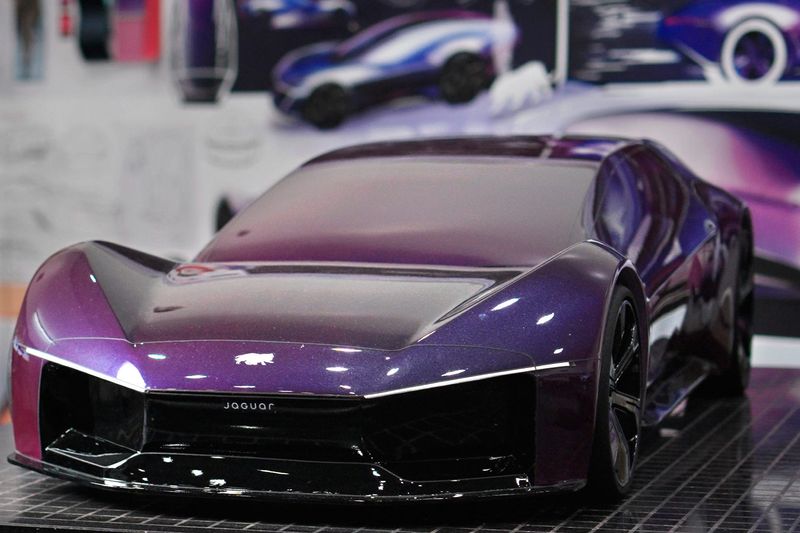
Blood is wrapping up her final project. Her thesis is a pink-and-blue Jaguar concept inspired by the crouch of a literal jaguar before a pounce.
Students, like the automakers where they aspire to work, start with research, figuring out the persona of the hypothetical driver and a price point. After creating a slide deck or presentation based on those findings, students start sketching.
“It starts out pretty abstract for me, and I world-build a lot. I’m creating mood boards and vision boards for my project. There were tomatoes on my mood board!” she said. “It’s like capturing a feeling. It’s less about the object, and more about the energy or the space it’s occupying.”
For Blood, spending too much time trying to learn from previous vehicle designs can detract from developing her own style.
“I don’t think it’s like you’re reinventing the wheel. It’s more trying to find what hasn’t been made. With automotive, you do see a lot that looks similar. But we are taught to think, as far as we can, to use our creativity to guide us towards something unusual or different than you would see on the roads. Something you haven’t seen before could mean it’s unrealistic for this time. Maybe 40 years in the future, it becomes a reality, but you can’t get there without starting somewhere.”
How to create future vehicles
For automakers, the future can’t come soon enough.
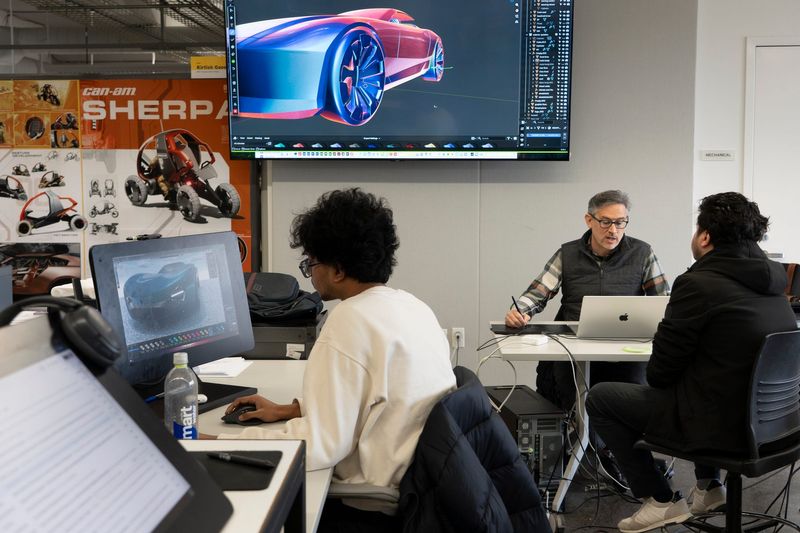
One year ago, forming a vehicle animation from a design took months of work and multiple teams including sculpture, visualization and design. But using a new AI tool means automakers like GM can turn that same animation around with a single designer in less than a day, according to Dan Shapiro, a creative designer for GM Global Design.
Despite the rapid pace, Shapiro said he relies on his artistic judgment ahead of anything else.
“That really enables us to work quicker, explore more ideas and ultimately come up with better designs,” he said.
Shapiro is also an adjunct faculty member at CCS and is pioneering an AI initiative at the school. He educates graduate transportation studies students on his process and the expectations they will likely face at the auto companies.
“It’s the same way we use the tool here,” he said.
Clear design intent first, fancy tools later is also how Ford said it is approaching emerging design problems.
“While the tools designers use continue to evolve, Ford Design stays focused on the core skills needed to design vehicles and experiences customers love — craft, storytelling, and human-centered problem solving — alongside the thoughtful application of new technologies in service of clear design intent,” according to a statement emailed to the Detroit Free Press attributed to Ford Design. “Institutions like the College for Creative Studies remain an important part of our talent pipeline, and we engage through portfolio reviews, campus activations, and sponsored programs.”
Without the rigor of undergraduate study, Snyder said, simply hitting a button to generate a car design won’t produce a winning vehicle.
“When (car designers) do use AI and it iterates 3,000 different proposals, they can make a solid judgment call on which of these proposals have the most potential for success in the marketplace,” Snyder said.
Which, at the end of the day, is all automakers care about, he said.
“Nobody is going to buy a car if they don’t like the way it looks, and nobody is going to buy a car if they don’t like the way it works, the way you interface with it,” Snyder said. “We establish the goals in many cases for what that experience should be, and the engineers have to figure out a way of getting there.”
One of the cars Blood liked before she knew anything about cars was the Mercedes 300 SL, because she thought the gull wing doors added beauty to the sculptural design. But now that she’s older, and designing cars herself, she said she wants a Ford Bronco because, to her, the design feels raw and clearly signals the vehicle’s true capabilities.
“I’m really drawn to that, because I feel most like that. I’ve been like that my whole life ― love me or love me or hate me, unapologetically,” Blood said. “I personally want something that is honest to what it can do, but that doesn’t mean that most other people are. Some people want the lie, they want something that feels like it is powerful to them, even if it’s not.”
Jackie Charniga covers General Motors for the Free Press. Reach her at jcharniga@freepress.com.
This article originally appeared on Detroit Free Press: College for Creative Studies auto design student: AI won’t replace me
Reporting by Jackie Charniga, Detroit Free Press / Detroit Free Press
USA TODAY Network via Reuters Connect