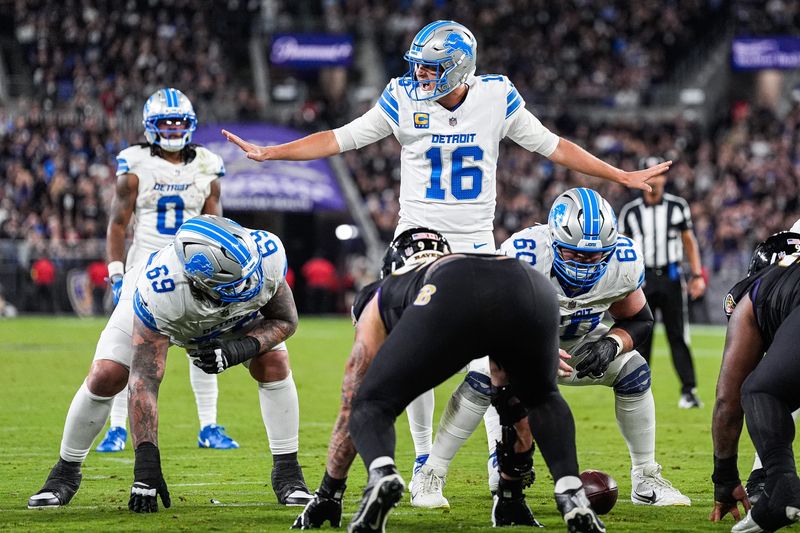
The Detroit Lions are not afraid to hand out expensive, long-term contracts to their franchise cornerstone.
Jack Campbell became the latest to sign such a deal on Thursday, May 21, with the Lions making him the second-highest paid linebacker in the league, behind only San Francisco’s Fred Warner.

According to NFL Network’s Ian Rapoport, the deal is worth as much as $81 million over four years, with $51.5 million guaranteed.
But with the Lions offering so much money to so many players over the past few seasons, are they sacrificing future success for a tight Super Bowl window in 2026?
Or asked another way, how can the Lions keep paying their stars so much money and expect to be consistent contenders?
It’s an important question for one of the NFL’s most noteworthy teams over the past three seasons, but it doesn’t come with a straightforward answer. Let’s take a look at the big contract extensions the Lions have handed out over the past few years to their recent draftees and how it impacts their salary cap.
Biggest Lions contract extensions for 2026
The Lions have signed seven players to rookie extensions greater than $80 million in total value over the past three years.
Those contracts pale in comparison to the most expensive contract on Detroit’s book, a four-year, $212 million extension for quarterback Jared Goff that lasts until 2028. If you add cornerback D.J. Reed’s three-year, $48 million deal he signed ahead of the 2025 season, that’s over $1 billion of contract money committed to just nine players (though not all of the committed money is guaranteed).
And they might not be done handing out big contracts this offseason, with potential rookie extensions coming for running back Jahmyr Gibbs, safety Brian Branch and tight end Sam LaPorta.
If the Lions could pay the players as much money as they wanted to, this wouldn’t be a problem. But the NFL’s salary cap presents the Lions with an important question: Can they build sustained success with a relatively high number of players taking up so much of the salary cap?
Let’s take a look at two examples to compare.
How the Lions compare to the NFL’s best teams
The NFL’s winningest team in the 2020s has been the Buffalo Bills, who are 73-27 in regular-season games over the past six seasons. Much of that success lies with quarterback Josh Allen, who ahead of 2025 signed a six-year, $330 million contract extension that takes up a big chunk of the team’s salary obligations in 2026.
But beyond Allen, the Bills only have two other players who have signed deals greater than $80 million of total value: wide receiver D.J. Moore and edge rusher Greg Rousseau. The Lions, by comparison, currently have eight.
The NFL’s second-winningest team in the 2020s, and the league’s most successful team with three Super Bowl wins and five conference championships since 2019, is the Kansas City Chiefs. And much like the Bills, they have a franchise quarterback in Patrick Mahomes taking up a big chunk of their salary cap with his 10-year, $450 million deal signed ahead of the 2020 season.
But after Mahomes, the Chiefs have just three players on contracts valued at greater than $80 million: defensive lineman Chris Jones, guard Trey Smith and edge rusher George Karlaftis.
Even with mega contracts for Allen and Mahomes, those teams are spreading the wealth to mid-tier players better than the Lions are. The Bills feature 10 players with contracts between $25 million and $75 million of total value, including running back James Cook and left tackle Dion Dawkins. The Chiefs feature six such players, including center Creed Humphrey and Super Bowl MVP Kenneth Walker III.
And speaking of those Super Bowl-winning Seattle Seahawks, they have nine players in that middle range. The AFC champion New England Patriots have 12.
As for the Lions? They have just two – Reed and new center Cade Mays.
This doesn’t mean that Detroit’s top-heavy approach is the wrong strategy, as there isn’t one path to a Super Bowl trophy. But when injuries take some of those top players out for multiple games, like they did last year with Reed, McNeill and Joseph, the Lions can only turn to young or lower-paid players to fill important gaps.
And while that’s not the only reason the Lions finished 9-8 in 2026, it was a big factor, with the Lions missing a lot of the mid-tier talent that helped the Seahawks and Patriots reach the Super Bowl.
How the Lions can still compete for a Super Bowl
Per BetMGM, the Lions have the best odds to win the NFC North (+175) and the fifth-best odds to win the Super Bowl (+1500) one year after finishing in last place in the division. Some of that has to do with an easier schedule in 2026 than 2025, but most of it has to do with the talent on Detroit’s roster, still among the best in the NFL.
If Detroit’s strategy of drafting good players, developing them into stars and signing them to long-term extensions is going to pay off with a Super Bowl ring, it’ll need much better health than it has gotten the last two seasons. The Lions in 2024 were doomed when a majority of the team’s key defensive players missed time with injuries. The 2025 season fell apart when injuries in the secondary and on the offensive line pushed young players into positions they weren’t ready for.
The Lions aren’t built like the Seahawks or Patriots, and with so much money guaranteed to a relatively small number of rostered players, they likely won’t operate with that much flexibility for at least the next couple of years.
That doesn’t mean the Lions’ Super Bowl window is closing after 2026 – it just means their room for error could be a lot smaller than they would like it to be.
Need to catch up on the news during your lunch break? Sign up for our Sports Briefing newsletter to get daily summaries of Detroit sports!
You can reach Christian at cromo@freepress.com.
This article originally appeared on Detroit Free Press: Can the Lions build a Super Bowl roster with so many big contracts?
Reporting by Christian Romo, Detroit Free Press / Detroit Free Press
USA TODAY Network via Reuters Connect