

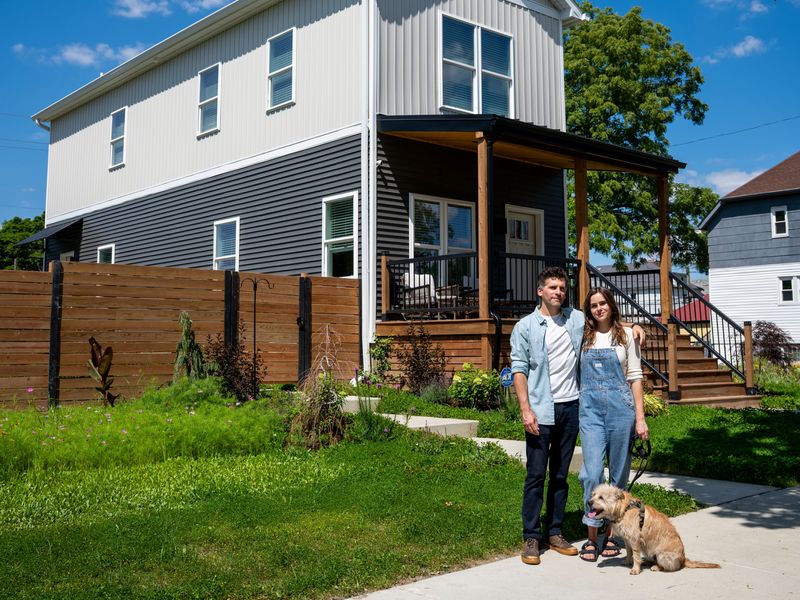
John Boros and Meg Lockhart have lived in a 750-square-foot apartment in New York’s West Village and in a 3,300-square-foot 1940s home near downtown. Their sweet spot, they’ve discovered, is somewhere in between — namely a newly built 1,500-square-foot home in Detroit’s Islandview neighborhood, not far from Indian Village.
Both are Detroit-area natives who spent some time in the Big Apple but decided to come home. “We knew the east side and wanted to come back,” John says. At the time, John was working in the fast-paced world of New York advertising and was looking for a change in careers along with cities. An entrepreneur and problem solver by nature, he found inspiration in something Detroit has in abundance that New York does not — empty land. “We have all this land and a housing crisis that needs to be solved,” he explains, adding, “Why aren’t we turning that land into homes?”

The couple moved back to the Motor City in 2024 and bought a 1940s house on Bagley. They stayed two years. It was “huge, drafty, and far more space than we needed at this stage of life,” John explains. “We were buying furniture for rooms we barely walked into, just so they didn’t look empty.”
They eventually decided they didn’t need or want that much stuff or space. “Living in New York really taught us about priorities,” Boros explains. “You become intentional about what you own, how you use storage, and what you actually need…we carried that philosophy into the design of our home today. Plenty of closet space, but not suburban-scale storage for a suburban-scale life. Instead, we designed it around how we actually live in a walkable neighborhood, where the city itself becomes an extension of your home.”
A business is born
He had a feeling others were looking for a similar experience and decided to channel his advertising experience into a new business as a builder. “I wanted to build something real, something with a tangible and lasting impact on people’s lives,” he explains. “It felt like the right moment to leave something I was no longer passionate about for something that solved a real problem.”
“Housing was the obvious one, and Detroit was the obvious place. Tens of thousands of vacant lots and a growing population looking for somewhere to live. We have roots here, family and friends and we knew it was the right move to come back and take on this challenge.”
Boros got his builder’s license and worked with Andres Valbuena of VR Homes, whom he met through his real estate agent, Brandon Curry. “Andres was instrumental in teaching me the realities of building in Detroit,” he explains. “Just as importantly, he introduced me to the network of trusted trades and subcontractors… that gave me the foundation to build my own.” Keylight Development was founded soon after.
One house at a time
The company bought its first lots from the Detroit Land Bank on Townsend St. in Islandview. “It’s a beautiful neighborhood and the block just keeps getting stronger. After a successful build, we acquired seven more lots across the street, and that’s where we’re building now. We’re also kicking off our East Village development this summer.”
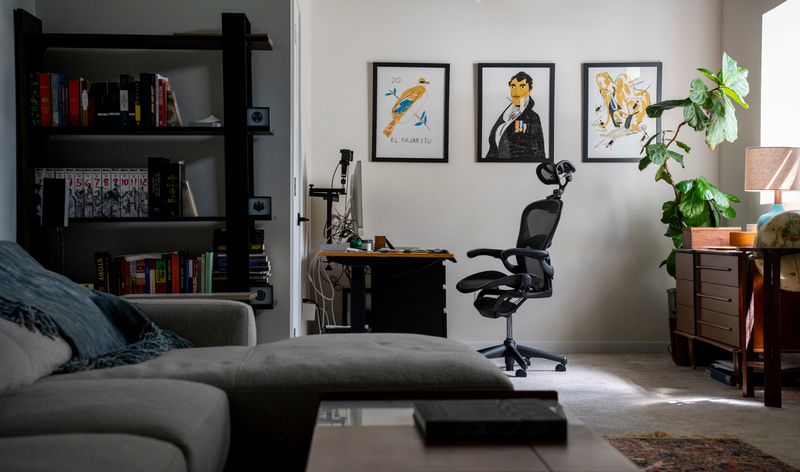
They started with one house on Townsend, now their own home. “We built the Townsend house to be right-sized, for us and for anyone living in a city. It’s 2,100 square feet with 1,500 of that above the basement. Three bedrooms, one of which is Meg’s office. The downstairs is open: kitchen into dining into living, which is how we actually live. Most Detroit housing stock is the opposite. Compartmentalized, small rooms walled off from each other, a flow that doesn’t match how people live now. We wanted a modern space built for today.”
Modular vs. manufactured
They also wanted a more efficient building process and ultimately decided to concentrate on modular homes, which account for less than 10% of homes being built nationally, Boros says. They work with Ritz Craft, a factory based in Jonesville, MI.
One of the challenges has been educating home buyers on what modular means. “Most people conflate modular with manufactured,” Boros says. “It’s genuinely confusing, because a modular home is manufactured off-site in a factory.” Modular homes, he says, exceed codes because they are built in a factory under controlled circumstances by a full-time team who work together every day and are accountable for the finished product from start to finish. “If anything, construction is more robust… framing has to be stronger than a site-built house, because the house has to survive being driven down a highway on a truck before it ever reaches the foundation.”
The Townsend home, he says, arrived in two prefabricated sections, stacked on a permanent full basement foundation. “In a single day, a house that’s about ninety percent complete goes from a truck to a foundation. The floors are in. Walls, trim, cabinets, appliances, light fixtures. Tile is already on the shower and the bathroom floor. The mirrors are on the walls. There’s no other method of construction that does that. We’re seeing timelines under six months, and in some cases under five. We’re also exploring panelized systems built right here in Detroit, to refine our off-site strategy further and give buyers more options. On quality, consistency, and predictability, there’s no comparison.”
Best-laid plans
The couple moved in a few months ago. “The original plan was to sell the first home and roll the proceeds into the next one,” Boros explains. “Then it became obvious we’d be giving up the best sales tool we could possibly have, so we kept it as a model. From there, moving in ourselves made sense. I wanted to know firsthand what it’s actually like to live in what we build.”
Despite spending two years refining pre-engineered plans to maximize every square inch and get the flow right, he has found at least six design changes for future homes. “None of those would have turned up if I weren’t living in it.”
“What I like best is the main floor, living into kitchen into dining, one continuous space. And the neighborhood. We’re half a block from the park, where we walk the dog several times a day, and a ten-minute walk from everything on Kercheval. There’s a real community here and we’re glad to be part of it.”
Future plans include building an innovative steel-framed home in Detroit designed to produce as much energy as it uses. “The house is the national showcase home for the Housing Innovation Alliance, which means builders, manufacturers, and housing press from across the country will come to Detroit to walk through it for a full year after it’s finished. Every one of those tours starts on a Detroit street. That’s the part I care about most.”
Making a difference
His eyes are on the future. “There’s a lot of work to do. The land bank alone controls more than 60,000 vacant lots, and there are close to 123,000 vacant lots citywide. Mayor Sheffield wants 1,000 new homes built in four years. We want to contribute to that in a big way.”
The couple has hosted New York friends who have marveled at their new space, which includes an extra lot and garden next door, a favorite of the couple’s dog, Walter, who they adopted in New York. All three seem quite happy with their new life.
“We had friends visit recently, including someone I lived next door to in a tiny one-bedroom in East Williamsburg. It’s funny watching their faces when you tell them what the mortgage is and they’re standing in the house looking at exactly what that buys. There’s no comparison on value.”
This article originally appeared on The Detroit News: Can modular homes fix the Detroit housing crisis?
Reporting by Khristi Zimmeth, Special to The Detroit News / The Detroit News
USA TODAY Network via Reuters Connect

By Khristi Zimmeth, Special to The Detroit News | USA TODAY Network
