Ford Motor Co. Executive Chair Bill Ford appears to be hardening the automaker’s stance over the issue of Chinese automakers entering the United States market.
On July 14 at an Axios event in Washington, DC, media reports state that Ford, who is the great-grandson of the carmaker’s founder Henry Ford, said that Chinese automakers will one day break into the U.S. car market and automakers must be prepared for it.

Right now, national security restrictions along with 100% tariffs put on imported Chinese automaker vehicles have effectively kept their vehicle sales offshore. That tariff was first imposed by former President Joe Biden and kept intact by President Donald Trump.
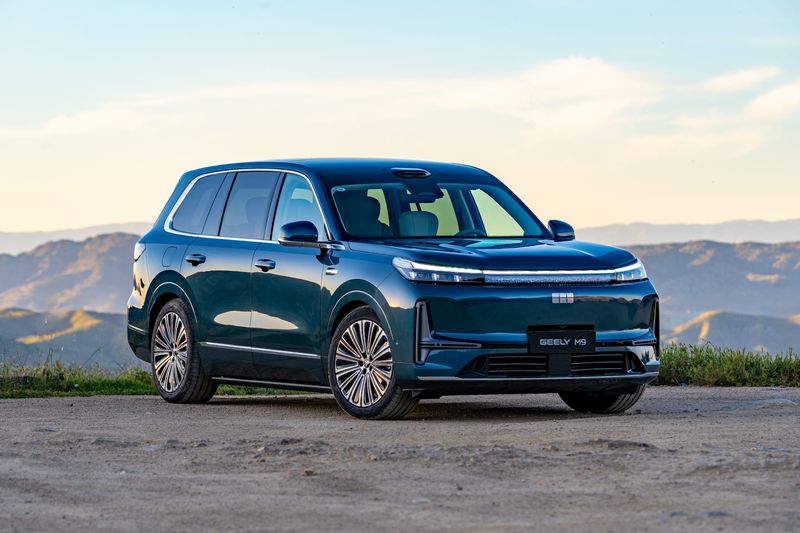
Chinese vehicles are considered high quality with advanced technology and sell at lower prices — thanks to China’s goverment subsidizing many costs. For example, a highly loaded Galaxy M9 three-row plug-in hybrid SUV typically sells for about $26,000 to $36,000 in U.S. dollars.
Therefore, competing against such cars would be challenging for U.S. carmakers. But it is likely to be inevitable, Bill Ford said.
“We have to go toe-to-toe with China,” Ford reportedly said Tuesday at the event as reported by the Wall Street Journal. “We can’t expect to keep them out forever, and we have to be able to beat them at their own game.”
Ford fights to protect U.S. industrial base
Ford Motor has said it supports a bipartisan bill that is moving through Congress aimed at essentially banning Chinese car sales in the United States so as to protect the U.S. industrial base. The Detroit Free Press confirmed that a Senate committee is expected to vote next Wednesday, July 22, on the anti-Chinese car bill and a similar bill is pending in the U.S. House of Representatives. General Motors spokeswoman Liz Winter said the automaker also supports the current proposed legislation.
Bill Ford urged that the United States have an industrial policy that keeps the nation competitive with China, Japan and South Korea so that the U.S. industry can withstand policy changes brought about when there are administration changes in Washington.
“Our lead times are longer than political lead times,” Ford said in published reports. “I think an industrial policy that is a bipartisan one — which, as I say today, even saying that might sound difficult — we really need that.”
As the Detroit Free Press reported in April, Ford CEO Jim Farley said the U.S. government and the U.S. auto industry are at a critical moment in history and must act with caution before allowing Chinese automakers to sell cars in the U.S. market.
“My point is not anything against anyone, it’s to be an advocate for a strong U.S. auto industry, an industrial base, and to really figure out our policy — both company policy and government policy — because the stakes are so high at this moment,” Farley said in April. “The China market is around 28 million to 29 million units. We export from China like many companies, with our partners, who do an amazing job. I have nothing but respect for these competitors. In our home market, we just have to be very thoughtful.”
Farley has repeatedly expressed concern about the Chinese automakers potentially dominating the North American market with vehicles priced cheaper than most other automakers can offer.
“They have enough capacity in China to cover all of the manufacturing and all of the vehicle sales in the U.S. We should not let them into our country because of the economic impact,” Farley said earlier this year, referring to China’s incursion into the West. “Manufacturing is the heart and soul of our country, and for us to lose that to those exports would be devastating for our country. There is no way this is a fair fight.”
Chinese spread out globally
Chinese carmakers such as BYD, Geely and Chery Automobile, to name a few, have saturated China and need to sell in other markets to grow their businesses. Many have increased exports around the globe in recent years and are quickly gaining market share in other countries. According to the China Passenger Car Association, EV and hybrid vehicle exports from Chinese automakers hit about 877,000 vehicles in June.
Chinese automakers have sold cars in Mexico for several years now and Chinese cars make up 20% of all light-vehicle sales there. As the Detroit Free Press reported in January, Canada will soon allow a limited number of Chinese vehicles to be sold there too.
Ford already competes against Chinese automakers in other markets and Farley has expressed interest in forming partnerships with Chinese automakers to gain some cost advantages. In Europe, Ford formed a strategic partnership with French carmaker Renault to potentially jointly develop and manufacture certain Ford and Renault light commercial vehicles and make two small Ford-branded EVs there.
The United States’ current restriction on China’s car companies, which includes a ban on Chinese connected-vehicle software, is the reason EV maker Polestar said in June that it would no longer sell cars in America, the WSJ reported. Polestar, controlled by Chinese company Zhejiang Geely Holding Group, was seeking U.S. authorization to sell vehicles under a provision in the restrictions, but the government denied it, published reports said.
Swedish-based automaker Volvo, which is majority-owned by Geely, did get the U.S. goverment’s green light in May to continue operating in the States.
Ford’s solution to Chinese competition
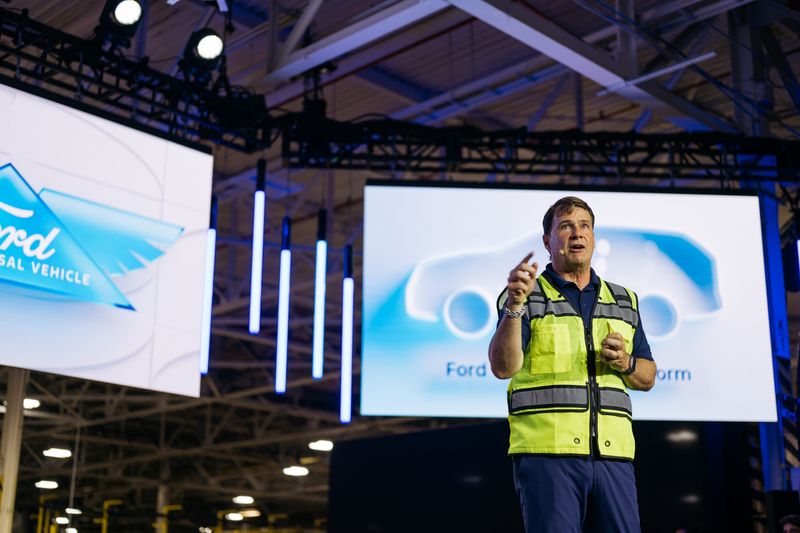
Ford’s answer to the Chinese for now is the launch of a family of new EVs to come off of Ford’s new Universal Electric Vehicle platform that will be prices around $30,000.
Ford will start launching the vehicles in 2027 with an all-electric midsize pickup to be the first off the line at Louisville Assembly Plant in Kentucky, where Ford is retooling the facility to later build more EVs in the same price range. A small SUV and possibly an electric sedan could follow. Ford has said the line will help it compete with Chinese automakers on costs by using a new “assembly tree” design process. The vehicle comes together in three stages such as the front, rear and battery. Then they are merged as one at the end of the production line.
As the Detroit Free Press reported earlier this month, Ford released two videos that include sneak peeks of the new electric midsize pickup that the automaker says will carry the company into the future. Ford confirms prototypes of the trucks are being driven on public roads in Dearborn, where the company has its headquarters.
Ford has even launched its own web page at www.ford.com to promote the new pickup and show the videos. This midsize all-electric pickup is the first product being designed by Ford’s whiz kids, the “Skunk Works” team, at the Dearborn-based automaker’s secretive Electric Vehicle Development Center (EVDC) in Long Beach, California.
As to what this pickup will be called, Ford filed a trademark on the name “Ranchero” with the U.S. Patent and Trademark office on Aug. 5, 2025. Six days later, Ford announced the Universal EV platform and its plans for the midsize EV pickup at an event in the Louisville Assembly Plant.
When asked whether Ford plans to call the new midsize EV pickup the Ranchero, Bergg said: “We have not announced the name yet and do not comment on speculation.”
(This story has been updated to correct Bill Ford’s title and to include new information.)
Free Press staff writer Todd Spangler contributed to this article.
Jamie L. LaReau is the senior autos writer at USA TODAY Co. who covers Ford Motor Co. for the Detroit Free Press. Contact Jamie at jlareau@freepress.com. Follow her on Twitter @jlareauan. To sign up for our autos newsletter. Become a subscriber.
This article originally appeared on Detroit Free Press: Bill Ford said automakers must ‘go toe-to-toe’ with China to survive
Reporting by Jamie L. LaReau, Detroit Free Press / Detroit Free Press
USA TODAY Network via Reuters Connect

By Jamie L. LaReau, Detroit Free Press | USA TODAY Network