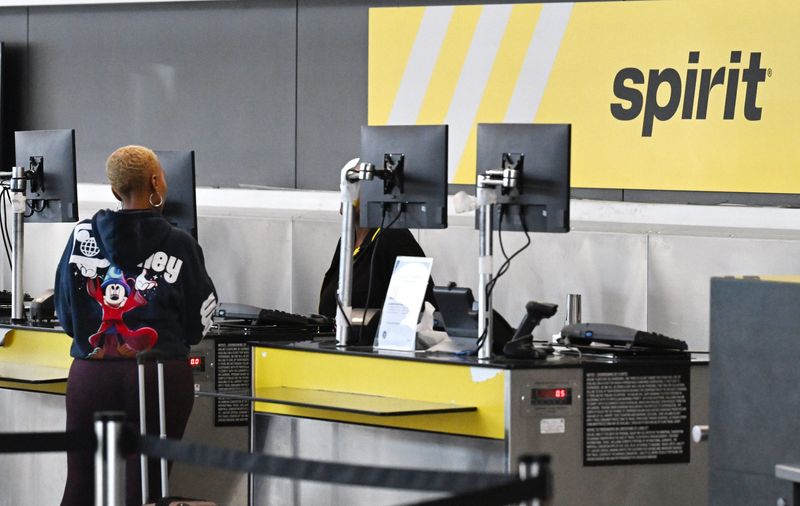
Romulus — Spirit Airlines is Detroit Metropolitan Airport’s No. 2 carrier, and that’s why thousands of travelers like Jeanne and Alan Koval are waiting to learn whether the budget airline founded decades ago in Macomb County will be rescued by a proposed federal bailout or collapse into liquidation.
“We’d be heartbroken,” said Alan Koval, who with his wife, Jeanne, was headed last week to Orlando on a Spirit flight from Detroit Metro, which ranks among the carrier’s top four hubs nationwide. The Milford couple says they like Spirit because it’s cheaper, “very pleasant” and “always on time.”

Yet continuing uncertainty over the airline’s future threatens to increase risks for Spirit and make would-be travelers increasingly leery about booking flights on an airline poised to go out of business, analysts said. The result: flyers facing the likelihood of fewer choices and higher fares should Spirit significantly scale back or disappear.
“Fares would likely rise, especially on routes where Spirit keeps prices low by competing aggressively,” said Selim Ozyurek, assistant professor at Western Michigan University’s College of Aviation. “Smaller or leisure-focused airports could lose service altogether. It means fewer choices and higher prices for travelers, and less competition and higher prices for the airlines.”
A federal bailout for Spirit Airlines, reported last week by Reuters and the Wall Street Journal, could include up to $500 million in government-backed financing as the airline continues to operate through bankruptcy. Prior to talks of potential relief from the Trump administration, reports suggested that Spirit Airlines was on the verge of liquidation, putting thousands of jobs at risk.
Budget carrier flies into turbulence
Spirit Aviation Holdings, the airline’s parent company, has faced mounting headwinds, with rising jet fuel costs tied to the conflict in the Middle East, where Iran has shut the Strait of Hormuz, adding strain as it works to restructure after multiple bankruptcy filings. The carrier last turned a profit in 2019, according to Reuters, and has lost more than $2.5 billion since 2020, when the COVID-19 pandemic disrupted the aviation industry.
“While Spirit continues to sell tickets, it is unable to raise fares commensurate with a doubling of fuel costs since the hostilities in the Middle East,” said Robert Mann, principal at Port Washington, New York-based R.W. Mann & Company Inc. and Aerodevelopments Ltd. “That makes every ticket sold in advance of the onset of hostilities loss-making, and tickets sold now somewhat less so.”
Spirit Airlines has not responded to requests for comment regarding its operations or its reported request for federal help. A spokesperson for the Wayne County Airport Authority, Matt Morawski, said it “does not have any financial concerns with Spirit at this time.”
Based on Detroit Metro Airport passenger data, if Spirit were to fold, mainline carriers such as Delta and American would add flights, said Dan Bubb, an aviation historian and professor in residence at the University of Nevada, Las Vegas.
“Ultra-low fare carriers such as Frontier will increase their presence as well,” he said. If an airport loses a carrier, it likely would reach out to other airlines to gauge interest in adding more flights and occupying vacant gates.
“Because DTW is a substantially busy international airport,” Bubb said, “I would think that other airlines will be interested in those open gates.”
Even if Spirit stays aloft, flight cancellations are still unavoidable in some cases, such as discontinued routes and staff shortages, said WMU’s Ozyurek, noting that Spirit’s flight network is being restructured, based on its latest Chapter 11 bankruptcy filing.
In October, the airline filed its second Chapter 11 bankruptcy filing in less than a year, as it worked through restructuring efforts, route reductions and workforce cuts aimed at stabilizing operations.
Gerald Cook, an adjunct professor at Embry-Riddle Aeronautical University Worldwide Campus, said he can’t recall an airline filing for Chapter 11 bankruptcy twice within a single year. While there have been several “double bankruptcies,” he said, noting Continental and US Airways, those filings were separated by years.
Low-cost carriers like Spirit feel more pressure from rising fuel costs, Cook said: “Low-cost carriers are particularly vulnerable to fuel price spikes because fuel represents a higher percentage of their total operating costs compared to full-service legacy airlines.
“While all airlines pay roughly the same price per gallon, an LCC’s ‘simple product’ is less expensive to produce, making fuel a disproportionately large variable in their cost structure.”
Ozyurek said legacy carriers have fuel hedging contracts or different financial arrangements so they can absorb shocks better.
“But low-cost carriers operate on razor-thin margins like 3-5% profit in good times,” he said. “Low-cost carriers also heavily rely on ancillary revenues such as in-flight products to sell.”
Michigan-founded carrier faces cloudy future
Spirit got its start in Michigan, originally as a small charter company in the 1980s known as Charter One. It has grown to offer the second-most flights at Detroit Metro Airport, behind Delta Air Lines Inc., according to passenger data from the Wayne County Airport Authority.
Spirit Airlines served 1.7 million passengers there in 2025, up slightly from 1.69 million in 2024. Delta served 9.2 million passengers in 2025, down from 9.3 million — not counting Delta connection carriers, which handled 2.7 million flyers, down from 2.4 million.
The discount airline known for its yellow planes is popular among budget-conscious travelers like Nancy Teets of Allen Park. At Detroit Metro Airport recently, she was preparing for a Spirit flight with her son, Timothy Teets, daughter, Megan Sayre, and a family friend, Jim Hernandez. She said she was grateful their flight to Florida wasn’t canceled amid all of the uncertainty.
“We’ve been praying all week that our flight goes out today,” she said. “If we can’t get home, we’ll have to figure it out.”
Nancy Teets said she was disappointed that Spirit recently discontinued its direct flight to Fort Myers, a destination she frequents to visit family and friends. She said she’s drawn to fly Spirit because of its affordable tickets.
“If we just want to go for, like, a long weekend to visit our relatives or friends,” she said. “Otherwise we’ll have to plan trips to where they’re longer to make it (worth it.) If you’re paying that kind of money for a while, you can’t just go on a quick jaunt somewhere.”
Spirit owns and operates a 126,000-square-foot maintenance hangar at Metro Airport, according to company financial filings. It sits on land leased from the Wayne County Airport Authority with an expiration date in September 2032.
As for flight reliability, Spirit recorded a 77% on-time performance rate in 2025, according to U.S. Department of Transportation data. That compares with about 79% for Delta, 78% for Southwest Airlines and roughly 72–73% for JetBlue Airways.
Spirit’s passenger figures at Detroit Metro Airport rank fourth in its network, behind Fort Lauderdale-Hollywood International Airport, Orlando International Airport and Harry Reid International Airport in Las Vegas, according to U.S. Bureau of Transportation Statistics data. The airline holds its largest market share in Fort Lauderdale at 26.6%, followed by Orlando at 11.5% and Detroit at 11.3%.
A company in restructuring is dependent on outside financing, Mann said: “To assure the continuity of that financing, it must repeatedly and reliably hit very frequent, often daily, financial targets for both revenue and costs. Spirit’s lenders have to make a decision whether to continue to fund the restructuring, anticipating further losses, or to decide when to stop.”
The Reuters report noted the federal package under consideration would likely be a loan to keep Spirit running during bankruptcy. The airline would receive a longer-term loan when Spirit exits bankruptcy, giving the U.S. government warrants for a potential stake of up to 90%.
Ozyurek, with the WMU College of Aviation, said tax relief might be in different forms such as tax deductions, credits, exclusions or deferrals: “This gives breathing room to operate … in the near term — certainly not a cure.”
Any federal assistance for Spirit Airlines, such as a loan or equity stake, would likely only provide temporary relief rather than resolve the carrier’s underlying challenges, said Bubb, with the University of Nevada, Las Vegas.
The potential government loan that would reportedly be tied to a roughly 90% equity stake in Spirit would be highly unusual, he said. And it’s contrary to the airline industry’s deregulated model, which is designed to let market forces, not federal intervention, determine winners and losers. It could raise broader policy concerns and prompt questions from other airlines about uneven treatment.
“I think this could be problematic for the administration moving forward,” Bubb said, “because other airlines are going to wonder why they can’t get loans.”
cwilliams@detroitnews.com
Reuters contributed.
This article originally appeared on The Detroit News: As Spirit Airlines teeters, Detroit Metro Airport has a lot at stake
Reporting by Candice Williams, The Detroit News / The Detroit News
USA TODAY Network via Reuters Connect