The search team that rescued the trio who had gone missing from their tube down the Muskegon River did not expect to find them alive.
The chances weren’t good, state Department of Natural Resources Conservation Officer Anna Cullen said. Based on the circumstances — three days missing, little food or supplies, “unforgiving” terrain and the threat of drowning — they had about a 10% chance of survival, according to a metric in “Lost Person Behavior,” a trusted search and rescue manual.

“We had every single resource that we as the DNR and Michigan State Police could provide to search for those people,” Cullen said. “We had helicopters with (thermal imaging equipment), we had multiple, multiple drones, fire agencies out there, multiple boats on the water looking for tracks on the shorelines. As the hours went on, our confidence went lower and lower.”
DNR officers and Michigan State Police troopers located Sarah Vida and Jazmin Hock, both 28, and Vida’s 9-year-old son Kayden Kovalcik on Friday afternoon, Aug. 7. The trio had left on a tubing trip down the Muskegon River on Tuesday afternoon, Aug. 4, and had been reported missing late Wednesday afternoon.
The search team, which included Michigan State Police, local fire and police agencies and others, scoured the remote area of Newaygo and Muskegon counties starting Wednesday night. They found nothing on Wednesday or Thursday.
An idea from Conservation Officer Cameron Wright on Friday morning unlocked the afternoon rescue. He had seen one of the party’s orange tubes on top of a log pile during the previous day’s search. If the tube had floated downstream, it would have been stuck in the water. Instead, it was pulled on top.
“I just had the thought that it might have been the wind, it might have been a wave, but it also might have been a person, so let’s go rule it out,” Wright said.
He and Cullen went to find the tube. They crawled onto the logjam and from there could see the trio’s path into the tall grass. They called for backup and were joined by Rhodea and two Michigan State Police troopers.
A path leads to a child’s footprint. The search was on
It was clearly going to be a brutal walk through grass, muck and into the woods, Wright said.
Then, they found a child’s footprint, Cullen said. They followed the path visible in the 6-foot-tall grass and over time found maybe a dozen more footprints. They started calling out to see if the lost tubers would respond.
It worked. It was distant, but the search party heard a woman’s or child’s voice respond to their call.
“It was all very surreal,” Cullen said. “We all thought we were hearing things, but we looked at each other and thought, ‘Holy cow. We don’t know about all three, but there’s somebody alive still.'”
The search party moved closer. It was 4:30 p.m., close to the end of the second full day of searching.
Cullen turned to Wright and told him the news: They are alive.
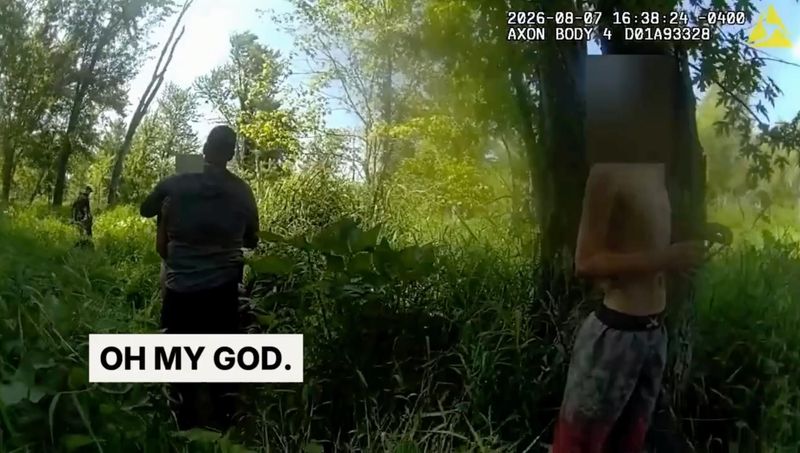
“That’s when I go, ‘Oh my God, are you serious?'” said Wright, whose reaction was caught on the bodycam footage released Monday by the DNR. “It just became so surreal. … You can hear my voice start quivering. I’m trying really hard not to start sobbing on camera.”
Like Vida and Hock, Wright is 28. It was easy to envision himself or his friends in the same scenario.
“I’ve got my own kids at home too, so knowing there’s a 9-year-old boy we’re about to go find is very emotional,” Wright said. “I got flooded with the thought of how close we were to not finding them that night and having them spend another night out there in the woods.”
Vida declined to be interviewed. Hock’s mother declined an interview request on Hock’s behalf.
Hock and Kovalcik were together when the search team arrived, Rhodea said. Hock was farther. She had crossed a bayou. When Rhodea found her, she was almost unable to walk. The women were carried out using rescue baskets similar to stretchers.
Women did ‘phenomenal’ job protecting child
Wright credited Hock and Vida for protecting Kovalcik. They carried the boy, gave him their small stash of food and water, and kept him remarkably upbeat, he said.
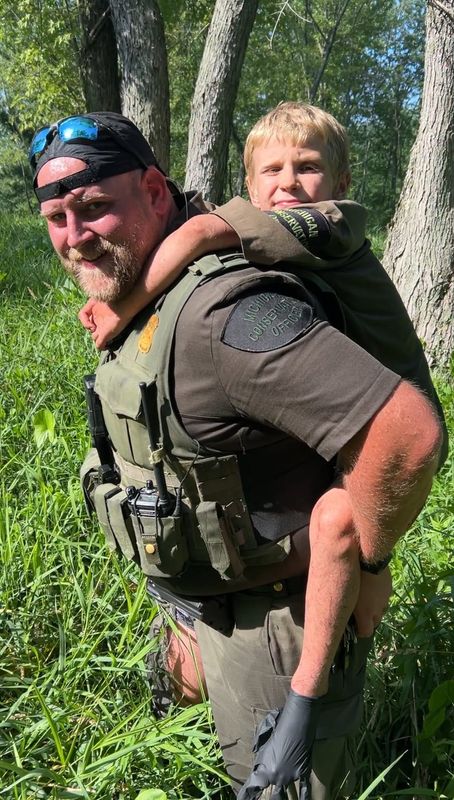
When the rescue team arrived, the women were spent, and the boy was energetic. Wright carried Kovalcik piggy-back style out of the woods and said he chattered about all the treats he would have when he got home — root beer, slushies, doughnuts.
“He talked the entire time,” Wright said. “It was incredible. They did a phenomenal job keeping him in good spirits.”
Wright, Cullen and Rhodea all said they can understand why the tubers got lost.
It was near nightfall Tuesday when they pulled to the side of the river, Wright said. They had already lost some of their tubes by then. They knew they could walk in a straight line and eventually hit a road.
“What they didn’t realize is how horrible the terrain was,” Wright said. “It’s poison ivy, it’s all stinging nettles and sharp horrible grass.”
The grasses they walked through were taller than them, Cullen said. It was difficult to maneuver through, and they were barefoot and wearing bathing suits, not hiking gear, she said.
Cullen said they may have walked into the woods to shelter for the night and then gotten lost trying to return to the river. They had floated approximately seven miles downstream from the Maple Island Boat Launch where they had started, she said.
The terrain in that area is hard to navigate, Rhodea said.
“It’s very thick. It’s hard to get your bearing at times,” he said. “When I was even 50 yards from the river, the terrain was so thick it was hard to tell where the river was. … It’s very easy to get turned around. Most of that marshy swamp, that wooded area, it all looks very similar. There’s very little landmarks that stick out that would aid in navigation in there.”
DNR started search and rescue team this year
To stay safe while tubing or during other outdoor excursions, Rhodea recommended people give their itinerary to someone else and check in periodically with that person. Then, if a party goes too long without contact, someone knows to call for help.
Cullen recommended doing research about the terrain before a trip and taking extra supplies and proper equipment, including a waterproof bag if the trip involves water.
The DNR started a search and rescue team this year, said Rhodea, who serves as the sergeant in charge of the southern half of Michigan for search and rescue.
Those missions are popping up more frequently for the DNR. Rhodea said that’s because search operations are more publicized with social media. DNR officers are trained to track people outdoors and have equipment such as airboats and off-road vehicles that can aid in searches.
“We’re often called upon to assist with search and rescue, (so we developed) a team that can respond to various parts of the state,” Rhodea said. “We have a lot of resources at our disposal that can assist in these types of situations.”
The DNR workers all credited the teamwork from MSP and other local police and first-response agencies who helped find the tubers.
ckthompson@detroitnews.com
This article originally appeared on The Detroit News: A log. A footprint. How officers found missing Muskegon River tubers
Reporting by Carol Thompson, The Detroit News / The Detroit News
USA TODAY Network via Reuters Connect
By Carol Thompson, The Detroit News | USA TODAY Network