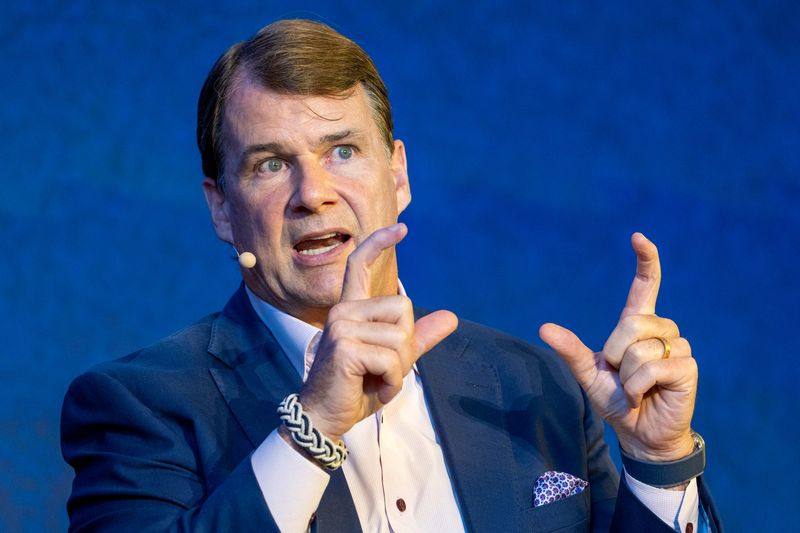
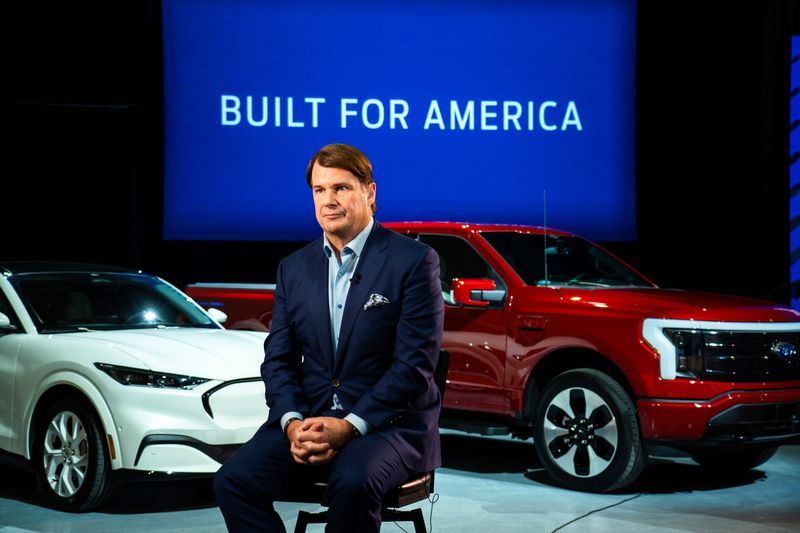
Ford Motor Co. CEO Jim Farley addressed a number of topics during a far-reaching conversation with Wall Street analysts during an hour-long evening call on April 29 following Ford’s first-quarter earnings results.
Among the highlights: Farley said the company is considering more global partnerships with other automakers, including Chinese; it is carefully monitoring the war in Iran for impact on its business and employees near the region, and it is in talks with the U.S. government on how it can help in the war effort.

Ford reported its first-quarter revenue rose 6% to $43.3 billion compared with $40.7 billion in the first quarter a year ago despite lower new vehicle sales in the United States. It reported its adjusted earnings before interest and taxes was $3.5 billion compared with $1 billion a year ago. Its net income for the quarter was $2.5 billion compared with $471 million in the year-ago quarter.
The rosy results. along with Ford leaders believing the underlying business — with its strong product mix, net pricing and growth in software and physical services — has the momentum to carry the company through the second half of the year delivering gains, prompted the Dearborn automaker to boost its estimated 2026 adjusted pretax profits by $500 million to a range of $8.5 billion to $10.5 billion.
Here are some of the highlights of things Farley said on the call with Wall Street after Q1 results were released:
On Ford supplying the Pentagon with munitions
In mid-April it was widely reported, including by the Detroit Free Press, that senior defense officials in the Trump administration are seeking help from Ford and General Motors to increase the nation’s supply of military equipment.
When asked about the status of it, Farley said Ford has always answered the call to duty to support the country, noting its work to make lifesaving ventilators during the COVID-19 pandemic and making military equipment during World War I and World War II.
“We are very successful with our government sales and business and Ford Pro and so we have very close relationships through the vehicle side,” he said. “What I’d be able to say at this point is … we are in early discussions with the U.S. government on some defense-related projects. We’re not gonna go into details of those today.”
On critical minerals and other supply chain vulnerabilities
In addition to possibly helping the government with munitions, Farley said Ford would help with “onshoring critical minerals and many other supply chain vulnerabilities we have in our country. I think you should expect Ford to play an outsize role in manufacturer-grade semiconductors, critical minerals like batteries, and rare earth and our supply chain is heavily engaged, not only with our government, but new companies that are starting to emerge in our country to onshore some of this capability. Perhaps in the short term, that’s the biggest role Ford can play in helping our country.”
On Chinese carmakers and possible partnerships
Farley said Ford is dedicated to a thriving U.S. auto industry and safeguarding the country’s industrial base for both economic vitality and national security.
“When we see China and Japan and South Korea, they’ve really prioritized their domestic auto industry and manufacturing for these same reasons that I mentioned. We leverage global partnerships and even IT sharing, including with the Chinese (automakers), to grow our business around the world.”
But, Farley said, Ford seeks a level playing field in the United States and to protect national security, therefore, “how I would think about it is Ford continues to be a global company. We want to have the rights to win around the globe. We need IT and partnerships outside the U.S. to do that and when it comes to the U.S. industry itself, we are extremely protective, as we should be, like China, South Korea, and Japan are.”
He declined to provide any specific policies of Ford’s strategy beyond that comment.
On the war in Iran
Farley said the Ford will “remain resilient in the face of global uncertainty regarding the conflict in the Middle East. Of course, our priority is our team and the safety of them.”
As the Detroit Free Press reported in March, the Detroit automakers have minimal exposure in that part of the world. Ford’s closest factories are in Turkey.
Farley said Ford is monitoring the war and working to minimize risk “and find opportunities in much the same way we have navigated the pandemic, semiconductor shortage, tariff headwinds, and others. We have the muscle memory to find cost offsets, adjust our product mix quickly, interactively manage our supply chain in times of stress and crisis. My main message today is this: Ford is a fundamentally stronger, more modern company. We have a foundation built on industrial fitness.”
On Ford’s future goals, including EVs
Farley said by the end of the decade, 90% of Ford’s global nameplates will offer electrified powertrains, including advanced hybrids, extended-range electric vehicles, and full EVs.
“Our financial health is driven by a leaner, more effective industrial system,” he said. “We’re on track to deliver another, over $1 billion in material and warranty cost improvements this year. And we will never stop. Our focus on quality is paying off. JD Powers recently ranked Ford No. 4 in the 2026 U.S. Customer Service Index, our best performance in 30 years.”
Jamie L. LaReau is the senior autos writer for USA TODAY Co. who covers Ford Motor Co. for the Detroit Free Press. Contact Jamie at jlareau@freepress.com. Follow her on Twitter @jlareauan. To sign up for our autos newsletter. Become a subscriber.
This article originally appeared on Detroit Free Press: 5 things Ford CEO Jim Farley told investors. 1 concerned munitions
Reporting by Jamie L. LaReau, Detroit Free Press / Detroit Free Press
USA TODAY Network via Reuters Connect