


Sinking of SS Eastland biggest Great Lakes maritime disaster
By Barb Pert Templeton

When the SS Eastland, a passenger ship, sank while docked along the Chicago River in 1915 killing 844 people it was certainly a shocking and headline worthy event. Yet still today, most people have never heard about the disaster.
Digging into why that is while also sharing the harrowing story with people across southeast Michigan is the focus of Port Huron based Historian Andrew Kercher’s lecture series Great Lakes Titanic: SS Eastland.

Kercher’s next local stop will be at the G. Lynn Campbell Library in Kimball on Thursday, Nov. 21 at 6 p.m. The SS Eastland, constructed in Port Huron, represents the greatest loss of life from a maritime disaster on the Great Lakes, according to the tagline for the event being promoted through the St. Clair County Library website.
“This is a live show lasting about 60 minutes and I’ll chronical the history of the ship and I have hundreds of photos too,” Kercher said.
Local people are likely very familiar with Kercher, who most recently worked for the Port Huron Museum. He provided seemingly endless knowledge about the city through lecture series and appearances on board a trolley that took visitors to interesting places around the city.

The passenger ship the SS Eastland sank while it was docked on the Chicago River in 1915 killing 884 people.
Kercher left his employment with the museum in June and is now a freelance historian making appearances to present programs at senior centers, libraries and other organizations across Southeast Michigan.
The upcoming presentation about the SS Eastland is one he’s shared a few times across the state and proves to be of great interest simply because few people have even heard the tale.
The great ship was constructed in Port Huron in 1903 by the Jenkins Shipbuilding Company and the Michigan Transportation Company for a price of $286,000, according to an article dated July 15, 1915 in the Times Herald newspaper.
The ship was built for speed according to a designer quoted in the article and had 100 state rooms when is first sailed although those were removed and the ship became an excursion steamer.
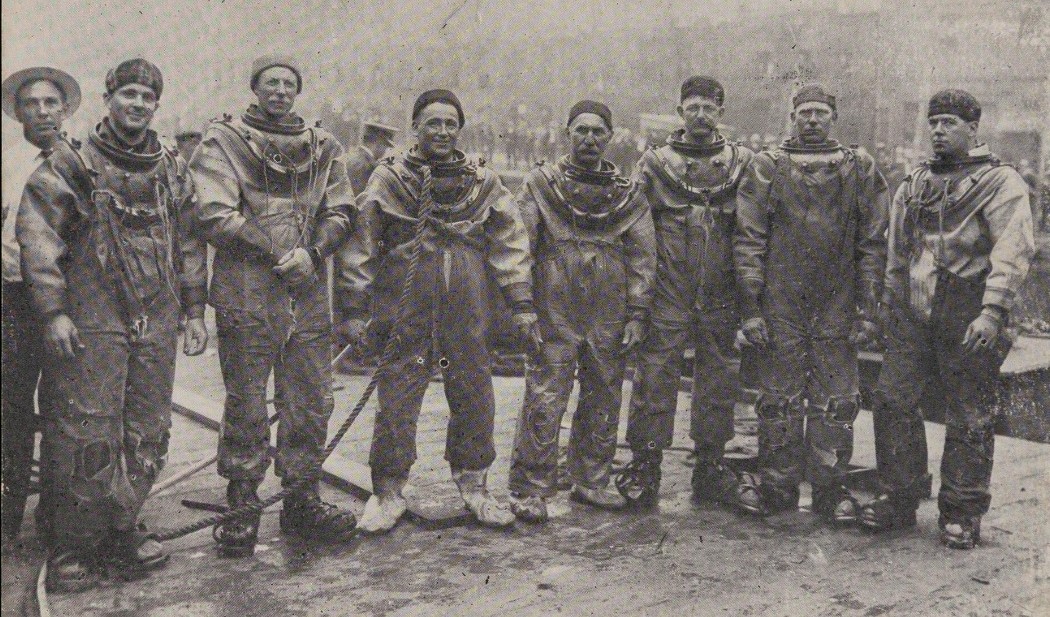
This photo has seven of the men who worked tirelessly to recover bodies from the river after the sinking of the SS Eastland in 1915.
When the ship sank in 1915 there were over 2,500 passengers on board. The majority of the fatalities, from being crushed or drown, was to women, most under the age of 24 and children.
“Many children under five years of age among those unaccounted for” blared a headline from the day.
“This was the worst maritime disaster in the Great Lakes and nobody ever heard of it,” Kercher said.
One theory he poses as to why that fact remains today is that the people onboard weren’t famous or celebrities but instead all working-class families. Most were employed by the Western Electric Company who had chartered the ship to take employees and their families to a picnic in Michigan City, Indiana.
The other news of the day, as this was in the midst of WWI, seemed to quickly bury this shocking tale of disaster.
Kercher said the ship literally flipped on its side in just seconds and people were quickly trapped underneath. Other, not so pleasant, details of the event include the fact that the Chicago River was awash in raw sewage at the time because the city lacked a sewer system and responders to the sinking had to install nets in the river so bodies didn’t float out into the ocean.
The theories as to why the sinking occurred, including over-crowding on the ship and that there were too many lifeboats stacked in the center of the vessel, were never solidified.
In fact, no one was every held accountable or responsible for the incident although officials tried in vain to charge the ship officers with manslaughter for the hundreds of deaths.
The Western Electric Company compensated families with $100,000 checks for the relief and recovery efforts of the victims.
The G. Lynn Campbell Library is located at 1955 Allen Road in Kimball. It is part of the St. Clair County Library System and the library can be reached at (810)982-9171.
To contact Historian and Lecturer Andrew Kercher visit his website at kercher.info or call (810)841-4569.
