

By Michigan Department of Natural Resources
With the school year wrapping up and warmer temperatures setting in, Michigan’s waters are calling. But before you pack your beach bags and head to a state park, the Michigan Department of Natural Resources reminds residents and visitors of two vital beach safety systems that help keep everyone safe while swimming and soaking up the sun.
Choose buoyed swim areas
For the safest experience, swim only in buoyed swim areas at state parks. These areas offer added safety measures and visual cues – the swim buoys mark the boundaries of swim areas – helping visitors stay clear of hidden hazards like dangerous structural currents around piers. DNR staff inspect and adjust these areas approximately every two weeks to ensure they match changing water conditions.

However, cooler spring temperatures have delayed buoy installation at some locations. This means not all buoys will be in place until conditions are safe for DNR staff to install them.
It’s important to note that not all state parks have buoyed swim areas; to find them, visit the beach safety page or visit Michigan.gov/RecSearch and use the filters and search for “swimming” or “buoyed swim areas.”
Follow the Great Lakes flag warning system
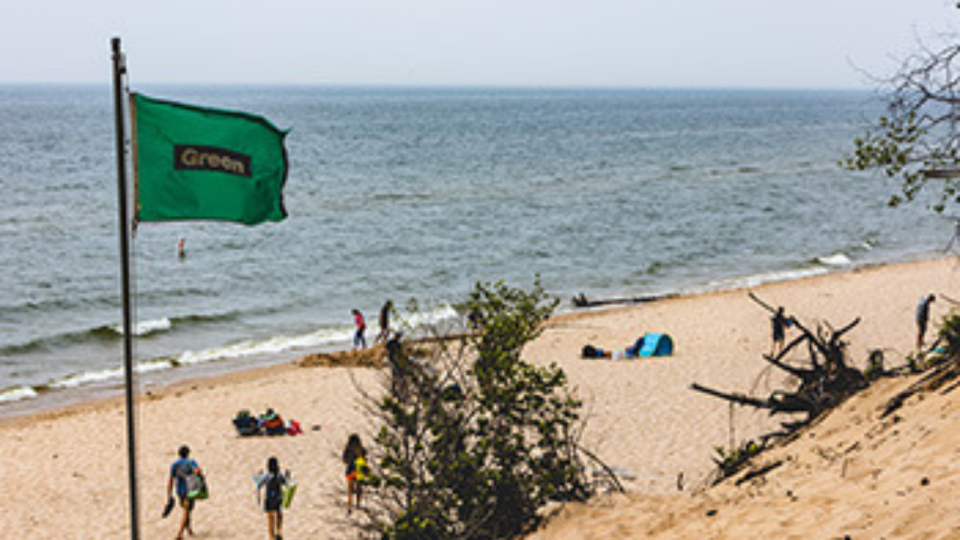
Before stepping into the water at any buoyed swim area in a state park along the Great Lakes, always check the beach flags. Operating much like a traffic light, the system conveys current conditions: green for low hazard, yellow for medium hazard and red for high hazard.
Double-red flags: If you see double-red flags, water access is completely closed, and entering the water is against the law. An exception is made for surfers using wind-powered or self-propelled wave-riding boards when they enter at their own risk and follow safety rules.
“By staying within buoyed swim areas and paying close attention to the flag warning system, visitors can ensure their beach days are both memorable and safe,” said Pat Whalen, Plainwell District supervisor for the DNR Parks and Recreation Division.
Beyond buoyed swim areas and the flag warning system, the DNR has implemented safety measures at specific state parks in west Michigan along the Lake Michigan shoreline:
- An electronic, web-enabled beach warning system installed at Grand Haven State Park in 2024 features real-time, automated safety updates and equipment for visitors. Additionally, the park’s emergency towers received upgrades, including lighting, solar panels and an audible chime that notify beach visitors when the flag color changes.
- Life rings (flotation devices) are now available at all buoyed swim beaches in state parks.
- ResQmax onshore line throwers, which are used for shoreline or pier-based rescues, are now available to trained park staff at Holland, Grand Haven and Warren Dunes state parks. The ResQmax can be deployed considerably farther distances than a traditional hand-thrown rope or life ring and includes an auto-inflating personal flotation device that activates when it lands in the water.
- To communicate the current Great Lakes flag status to visitors before they even reach the sand, roadside electronic signs are deployed during the swim season at Holland, Grand Haven, Ludington and Warren Dunes state parks.
- Ludington State Park now uses an EMILY (Emergency Integrated Lifesaving Lanyard) rescue robot, a high-tech tool to assist in Lake Michigan water rescues.
- Holland State Park staff collaborated with Park Township to install a new security gate on the adjacent pier at the park. The gate restricts pier access during hazardous weather and deters dangerous pier-jumping, while still allowing access for anglers when conditions permit.
- The DNR is actively working on a new training program to help park rangers recognize rapidly changing water conditions and clearly define their responsibilities during water-related emergencies.
Other beachgoer info and safety tips
- Please be aware that there are no beach guards in state parks. Visitors swim at their own risk and are asked to always prioritize safety.
- Never swim alone, especially children.
- Keep close watch on children and less experienced swimmers. Stay within arm’s reach, have them wear U.S. Coast Guard-approved life jackets, be conscious of their limits and take frequent breaks.
- Remember that water currents near piers, breakwalls and outlets of rivers can be extremely hazardous.
- Be cautious of cold-water temperatures. Sudden immersion and/or sustained time in cold water can cause cold shock or hypothermia, making it hard to breathe and increasing your risk of drowning.
- Respect the Great Lakes. These are large, powerful water systems that hold more than 20% of the world’s fresh water. Strong currents can catch even the most experienced swimmer off guard.
Learn more about these and other safety tips, including information on the benefits of buoyed swim areas, the beach flag warning system, how to spot (and escape) Great Lakes currents and more at Michigan.gov/BeachSafety.
