

By Jim Bloch

On June 28, Detroit’s air quality was the second worst in the world, behind Dubai, thanks to the Canadian wildfires. The air quality index stood at 309. Indices above 300 are so “hazardous” that the St. Clair County Health Department began distributing free N95 masks.
We generally associate wild fires with California. But over the last few years, wild fires have been charring massive tracts across Canada, from west to east.

A 2,000+ acre wildfire in Grayling shutdown I-75 for much of the day June 5, following the fifth driest May on record in the state.
But in contrast to the 110 degree days in the Southwest, the drought in the Great Plains, the floods in Vermont and the Northeast, the July 13 tornadoes in Chicago, Detroit and Michigan have fared relatively well this summer.
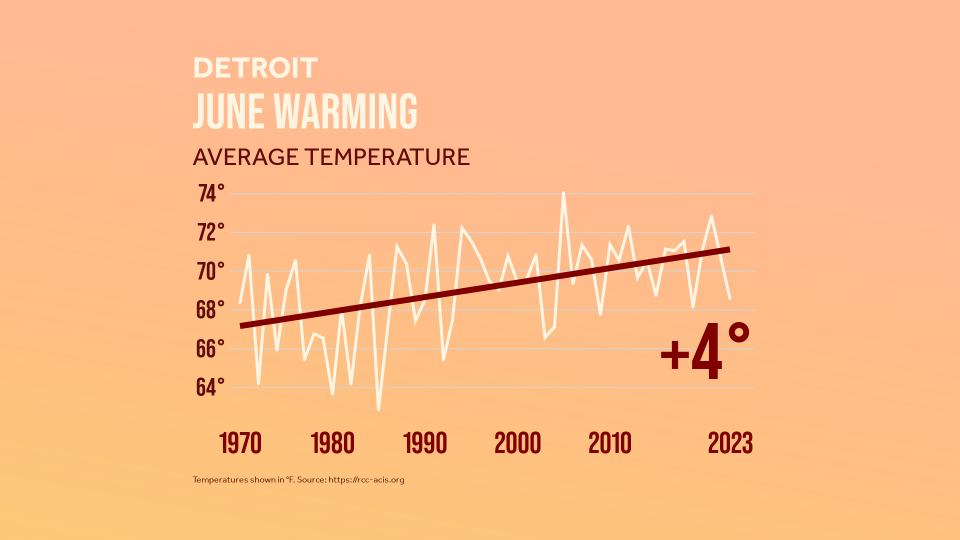
“This June, Detroit was much cooler than normal and drier than normal,” said Peter Girard, the communications director of Climate Central, the nonprofit organization dedicated to the science of climate change. “The average temperature of 68.6 degrees F was 1.4 degree below normal … Despite this month being cooler than normal, Junes in Detroit are getting hotter, leading to a change of 4.0 degrees F since 1970. The forecast for July from NOAA’s Climate Prediction Center suggests that Michigan is slightly favored to be warmer than normal.”
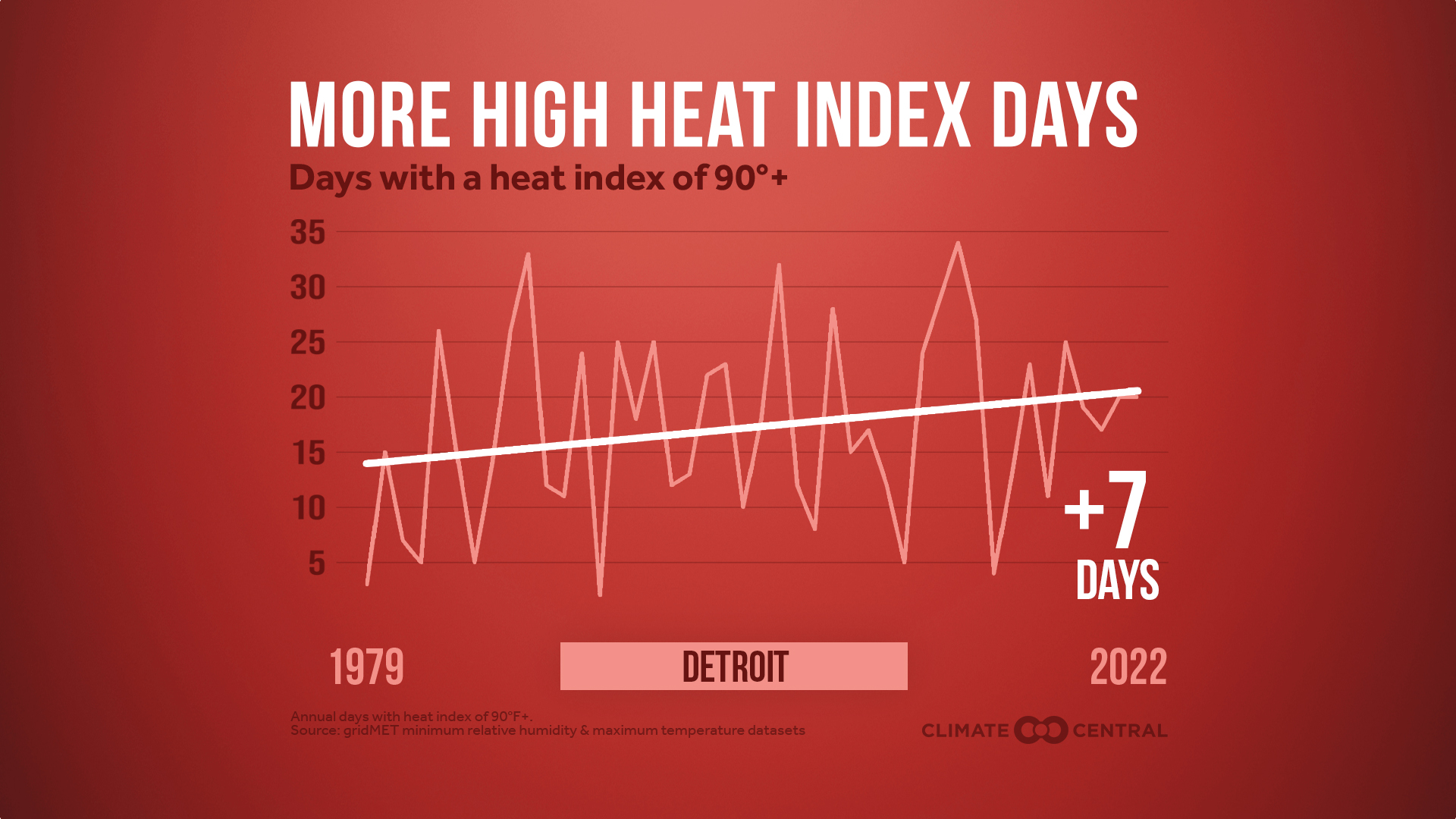
Detroit has seven more high heat index days now than it did in 1979.
Humidity makes days above 90 degrees feel even hotter.
Since 1979, the number of days with a heat index of 90 or higher have increased by 84 percent in 201 locations across the country studied by Climate Central. On average, there are 10 more such dangerous days per year. In Detroit, there are seven more high heat index days than in 1979.
As the heat index approaches normal body temperatures of 98 degrees, sweat no longer evaporates as easily and the body does not cool itself, which can lead to heat exhaustion, heat stroke and death.
The heat on the Earth’s land masses have been complemented by the heat of the seas. The world’s oceans have set temperature records for the third straight month. Water temperatures in south Florida reached 98 degrees on July 12, more than five degrees above average. The hot water can bleach coral reefs, contribute to mass fish kills, spawn algal blooms and fuel hurricanes.
Sea ice levels were at record lows worldwide.
Nowhere is immune from climate change.
Earth as a whole endured its three hottest days, July 3-5, since at least 1940, according to the University of Maine.
June turns out to have been the hottest June on record at 61.79 degrees Fahrenheit, according to the National Oceanic and Atmospheric Administration, which has been keeping records since 1850.
Much of the southwest has seen daily temperatures of 110-plus. Death Valley has approached 130.
Climate crisis
“This is a dangerous heat event that will impact tens of millions of people. Carbon emissions from burning coal, oil, and natural gas made this event more likely, longer, and more intense,” said Dr. Andrew Pershing in a statement; Pershing is the vice president of science at Climate Central.
Carbon dioxide, the main byproduct of burning fossil fuels, is the primary gas responsible for trapping the radiant heat from the sun in Earth’s atmosphere and causing global warming.
According to NASA, human activity has caused the amount of carbon dioxide to increase by at least 45 percent since the start of the industrial revolution. Half of that has been generated since 1980; 25 percent of it has been injected into the atmosphere since 2000; methane gas, a more effective heat-trapper, has risen 2.5 times, nearly all of the leap since 2000.
The concentration of carbon dioxide in the atmosphere has risen from 280 parts per million at the dawn of industrial capitalism to 370 in 2000 to 419 today.
Warmer weather means more rapid evaporation of water from the land and seas, which can trigger both droughts and, with more water in the atmosphere, more intense rain and snow events. The heat also makes weather more volatile.
Even humans stopped burning fossil fuels today, the Earth would continue to warm and the wild weather we’ve seen this summer would likely intensify.
That’s because carbon dioxide is an extremely long-lived. Carbon dioxide generated today will be in the atmosphere for 300-1,000 years, according to NASA.
Jeff Goodell, the author of the new book “The Heat Will Kill You First,” thinks we’re entering a new chapter in the climate crisis.
“We don’t really know what we’re heading into and how chaotic this can get,” Goodell said July 11 on the radio show Fresh Air.
Jim Bloch is a freelance writer based in St. Clair, Michigan. Contact him at bloch.jim@gmail.com.