

By Jim Bloch

The Opening Ceremonies for the 2024 Olympic Games begin today, July 26 at 1:30 p.m. EST and 7:30 p.m. in Paris. Temperatures are forecasted to a mild 72 degrees Fahrenheit.
But Paris is getting hotter.

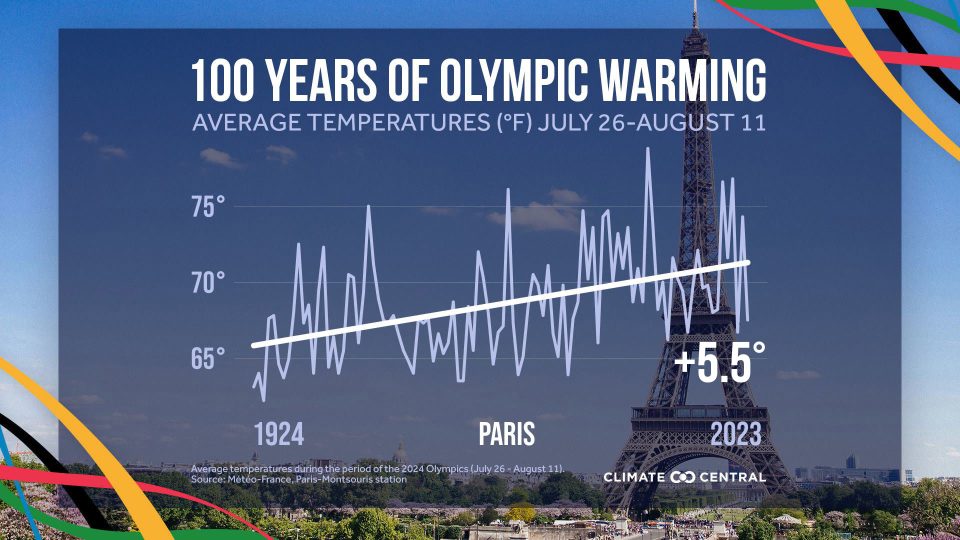
It has been a full century since Paris last hosted the Olympic Games. In that time, the average temperature in the city during the end of July and early August has risen 5.5 degrees.
Very hot days of 86 degrees and above are now three times more frequent than they were in 1924. Hot nights of 68 degrees or higher now occur 20 times more often than 1924.
Those are among the results of a joint study by The British Association of Sustainable Sport, Front Runners and Climate Central. The report is titled “Rings of Fire II: Extreme Heat at the Paris Olympics.”
Monday through Wednesday next week, July 29-31, forecasters predict highs of 86. 92 and 85 degrees. The increased heat may put athletes competing outdoors, Olympics workers, security people and fans at risk.
“Dangerous summer heat is not uncommon in Paris,” the report said. “The Paris area has experienced 50 heatwaves since 1947. The deadliest of these, in August 2003, resulted in 14,800 excess deaths across France and was made at least twice as likely due to human-caused climate change.”
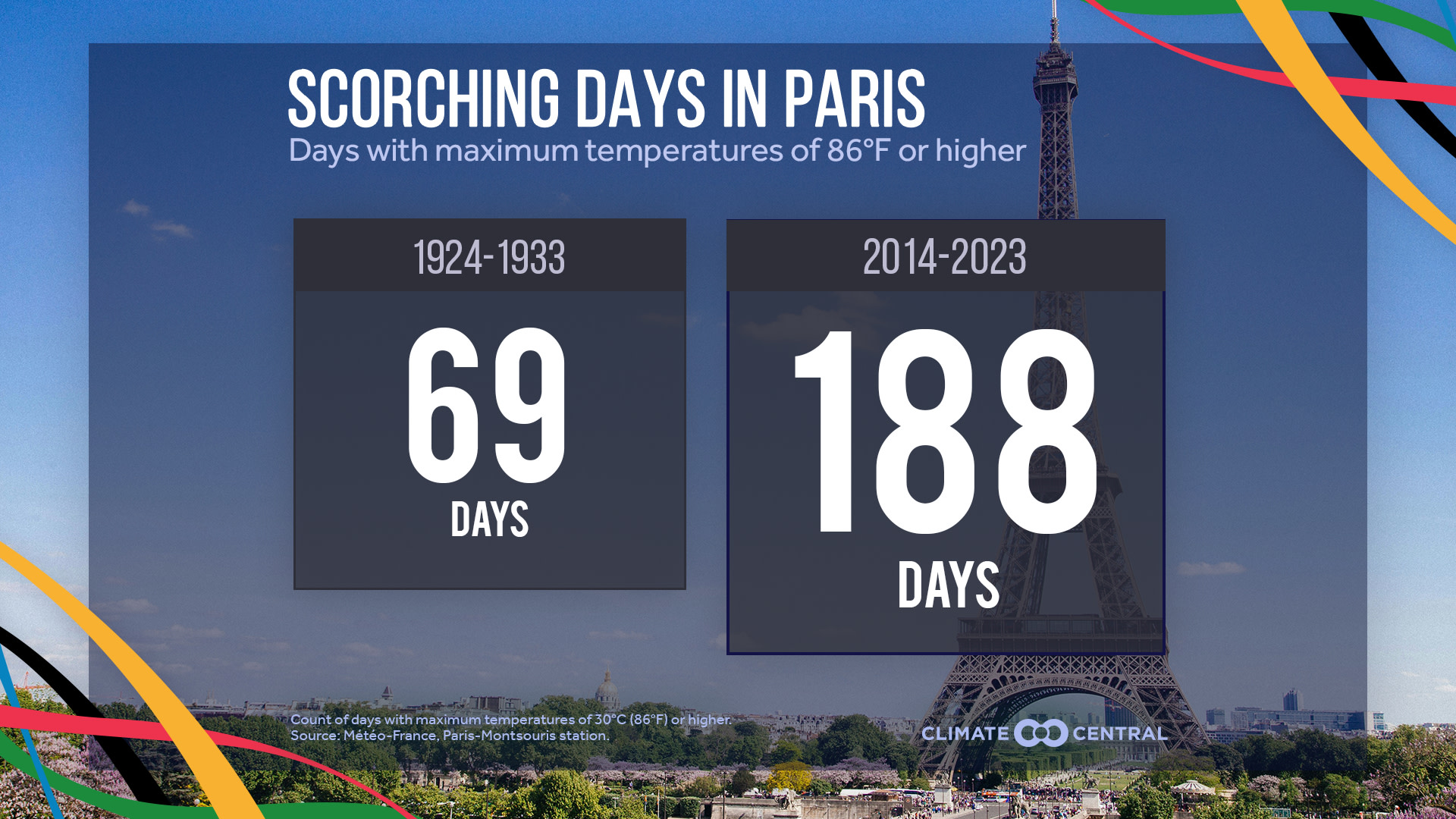
Hot days are nearly three times more frequent in Paris now than a century ago.
The burning of fossil fuels such as oil, coal and gas since the early days of the Industrial Revolution in the mid-19th Century has resulted in emitting heat-trapping gases, particularly carbon dioxide, into the atmosphere, which prevents the heat of the sun from rebounding back into space, warming the planet about 2.7 degrees Fahrenheit.
The Tokyo Olympics in 2021 were the hottest on record, averaging nearly 90 degrees. There were 146 cases of heat related illnesses among the athletes.
“Exertional heatstroke is one of the top three causes of sudden death in athletes and explains why heatwaves tend to kill a disproportionately high number of 15 to 19-year-old men,” according to an Aug. 5, 2021 story in The Guardian about the Tokyo Olympics heatwave. “It occurs when strenuous exercise, often in hot and humid conditions, pushes core body temperatures to 40C, beyond which sweating and other cooling techniques are inadequate and organ functions start to collapse.”
Nobody knows precisely if Paris will be a repeat of Tokyo. We do know that June 2024 marked the 13th consecutive month of record-shattering temperatures worldwide.
July 21 and July 22 were the hottest days ever recorded on the earth, peaking at 62.24 degrees F on Monday. Some climate scientists said it was the warmest the Earth has been in 120,000 years.
“Extreme heat and humid heat can affect everyone, but athletes face higher risks of heat-related illness and mortality because the body produces 15 to 20 times more heat while exercising,” the report said. “When nights don’t cool off enough relative to peak daytime temperatures, people have a harder time cooling off and recovering from the heat of the day.”
Jim Bloch is a freelance writer based in St. Clair, Michigan. Contact him at bloch.jim@gmail.com.
