

By Derek Smith

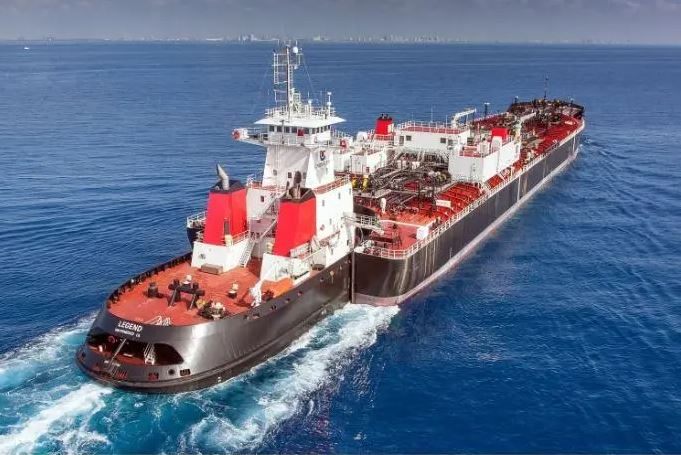
A local man and his crew of fellow seafarers, sailing aboard the Crowley-operated ATB Legacy, a 700-foot articulated tug and barge, recently rescued eight Cuban migrants floating on a makeshift raft 145 miles south of Southwest Pass, one of the channels at the mouth of the Mississippi River.
Six men were from Nueva Gerona, a small island south of Cuba. The other two men were from the mainland.

The men had left Cuba on February 2nd, intending to make land in five days on a passage to the Cancun Peninsula in Mexico, 265 miles due west.
Winds and currents drove them into the Gulf of Mexico, far from their intended destination.
They had planned on a voyage lasting five days. When found on March 1st, they had been at sea for one day short of a month.
Taking part in the rescue were Captain Gus Cramer, a resident of Sherman Woods here in Port Huron, Michigan, and his crew Chief Mate James Steltzien, Second Mate Brett Stepanski, Third Mate Devon Haffner, A/B Tankermen Collins, Thomas Tramutola, Jarred Moylan, and Dominique Calvy, Chief Engineer Cle Popperwill, First Assitant Engineer William Ziadeh, Second Assistant Engineer Andrew Burns, Third Assistant Engineer Joseph Krajnik and cook America Cacho.
Collins and Stepanski were on night watch. At approximately 1:30 am, they spotted a flashing light. When they went outside to investigate, they heard screams from the water’s surface.
Collins yelled to the voices that they would be coming back; turning around a 700-foot A.T.B. is a challenging task.
As the Legacy approached the raft, they contacted the U. S Coast Guard, who dispatched an aircraft.
Eight individuals were on board the rickety raft, all in dire need of food and water.
Captain Cramer said, “Our first plan was to supply the men with food, water, Gatorade, life jackets, and other gear until the USCG arrived to provide further assistance. The Coast Guard aircraft would remain on station until one of its cutters arrived. The transfer of supplies would take place utilizing the Legacy’s rescue boat. I maneuvered the Legacy within one hundred feet of their raft, where it became apparent that it would not remain together for the 14 hours needed for the Coast Guard cutter to arrive.” Collins agreed with my sentiments, stating, “The seas were getting bigger, and the migrants were not going to make it to the next night, the way we saw it,”
Captain Cramer continues, “At that point, I asked the crew to prepare the pilot ladder to bring them on board.
I notified the USGC aircraft on station with us of our intentions. I then maneuvered our vessel alongside their raft to begin the transfer up the pilot ladder to our deck.”
“They were in pretty bad shape,” remarked Collins. “We were unsure if they had the strength to climb up the ladder.”
The crew members of the Legacy inquired if the men could climb the 20 feet on the pilot ladder, and all eight responded with an enthusiastic yes.”
Collins added, “They were grateful when they came aboard.
Once on deck, we fed them, gave them liquids, and mustered up some old coveralls and rubber boots. They did not have shoes.”
With Cacho and Ziadeh serving as interpreters, the eight males told the Legacy crew they had survived by grabbing food scraps from the water (perhaps available from the many cruise ships sailing in those waters). The men mentioned that numerous vessels had passed them while stranded at sea.
They said they initially had an engine on the raft but lost it.
As a precaution, the Legacy personnel searched the migrants for contraband, but nothing was found.
All eight men had Cuban identification cards; five had passports and 6 Cuban driver’s licenses.
About 10 hours after the Legacy crew had rescued the migrants, they were transferred to a Coast Guard vessel.
Reflecting on the experience, Collins stated, “We all felt great helping. Many of us were probably emotional about it because people don’t understand that others are desperate to leave that country and its totalitarian system.
If one migrant didn’t have an LED flashlight, he’d have never been seen.”
This is not Captain Cramer’s first involvement in a rescue mission.
On January 7, 2013, Gus was Captain on the Crowley ATB Achievement. Crew members noticed a person bobbing in the waters of Tampa Bay. Captain Cramer and Tampa Bay pilot J. Michael Buffington brought their vessel to a stop and sounded the man overboard signal.
A man had jumped off the Skyway Bridge that connects lower Tampa Bay with St Petersburg.
The crew lowered the fast rescue boat and motored to the man calling for help.
They pulled the man onto the boat’s safety within eight minutes of the original sighting.
The conditions were windy, and the water was choppy, making the rescue dangerous and challenging.
Captain Gus and the crew worked closely with the Coast Guard and St Petersburg Fire and Rescue while saving this man’s life.
Gus Cramer and his wife, Mary, first met in high school in Seneca Falls, New York.
Seneca Falls is located along a branch of the Erie Canal and is often called the “birthplace of women’s rights.” It is also believed by some to be the town that inspired Frank Capra’s 1946 film; It’s A “Wonderful Life.”
They kept in touch through college, with Gus graduating from the State University of New York Maritime in Bronx, New York. Mary graduated from Nazareth College in Rochester, New York, with a bachelor’s degree in management science.
They went their separate ways after college.
Mary’s career began in the food industry with the Marriott Corporation.
She went on to manage the food facilities in IBM and GM buildings.
Seeking a slower pace of employment, Mary joined the accounting division of a small fuel oil company, where she was responsible for sales and fuel taxes, inventory, daily charges, and customer accounts.
Gus and Mary met again 20 years later and have been married for 17 years.
They have two children from a separate marriage and a grandchild.
Michigan was on their shortlist when they were considering retirement because of their love of freshwater lakes and their fascination with ships.
Mary’s family had a cottage in Lexington, where she enjoyed watching the freighter traffic, so the Port Huron area was a great choice, meeting most of their requirements for a retirement home.
They moved into Sherman Woods in 2017, a neighborhood that gives them both the beach and the water while at the same time providing them a great view of the daily queue of shipping traffic.
Gus has now been sailing for 38 years, a career that has taken him to both coasts in the United States, Hawaii, the Mediterranean, Northern Europe, and through the Panama Canal several times.
He has a Masters Unlimited Tonnage Oceans License and works for Crowley Petroleum as Captain of the ATB Legacy.
“A hero is somebody who is selfless, who is generous in spirit, and who just tries to give back as much as possible and help people. A hero to me is someone who saves people and who really deeply cares.”
Debi Mazar
Captain Gus Cramer and his crew of the ATB Legacy certainly meet all these criteria!
Parts of this story originated from an article written by and published on March 9, 2023, in The Seafarers International Union newsletter.
