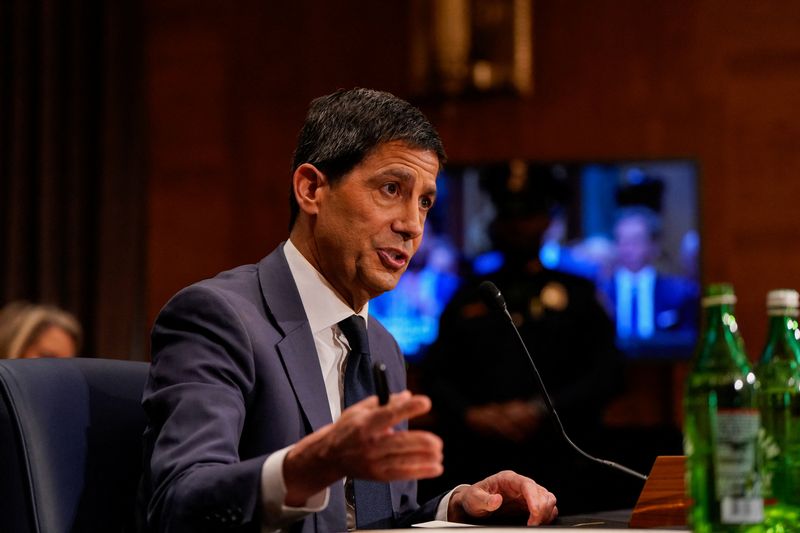
WASHINGTON, May 18 (Reuters) – Kevin Warsh will be sworn in as U.S. Federal Reserve chief on Friday by President Donald Trump, a White House official said on Monday, putting the 56-year-old lawyer and financier at the helm of the central bank as it grapples with intensifying inflation that may make it hard to push through the interest-rate cuts Trump desires.
Warsh is succeeding Jerome Powell, whose eight-year run as Fed leader formally expired on Friday, although he plans to remain as a Board of Governors member until he is satisfied that a Trump administration criminal probe of him is fully wound down. Powell was sworn in as temporary chair on Friday to bridge the leadership gap until Warsh is formally installed.

The investigation into Powell, centering on cost overruns for building renovations at the Fed’s Washington headquarters complex, became a temporary obstacle to Warsh’s confirmation by the Senate. The probe was settled to the satisfaction of an objecting Republican senator, however, and the full Senate confirmed Warsh on an almost party-line vote on May 13.
TARIFFS, WAR DRIVE UP INFLATION
Warsh, who served as a Fed governor through the global financial crisis, returns at a difficult moment for U.S. monetary policymaking. Annualized inflation is running well above the Fed’s 2% target and likely to keep rising, largely because of policy choices by the president who gave him the job.
The tariffs Trump imposed through his first year in office pushed up prices for a broad range of imported goods, and then this year, Trump’s decision to go to war with Iran has triggered a global energy price shock that recent data show is driving up prices across a widening array of goods and services.
The tariffs’ impact on its own had been a factor that some Fed policymakers, including Powell, had been willing to look past as a one-time price increase, not persistent inflation, and that could have allowed the central bank to resume interest-rate cuts that were put on hold early this year.
But the cascading effects of the Iran-war-induced energy price shock have deepened the inflation concerns of a growing number of the Fed policymakers Warsh must now lead and with whom he must try to form a consensus over the direction of rate policy.
“We’ve got an inflation problem … services inflation is high and rising and that’s probably not coming from oil, it’s probably not coming from tariffs,” Chicago Fed President Austan Goolsbee told Liz Claman on Fox Business Network on Monday. “There are going to be a lot of things on the radar screen and we could use some guidance here from the chair.”
A run of hotter-than-expected inflation readings caused upheaval in the bond market as last week ended. Yields on U.S. government bonds shot higher on Friday as investors repositioned for what they now see as sticky inflation and likely Fed rate hikes in response, starting as early as December.
Warsh’s first rate-setting meeting is weeks away in mid-June, and he is likely to find himself confronted with a growing hawkish bloc of policymakers arguing for the Fed to shift its posture explicitly to guard against inflation. Interest-rate futures markets assign effectively zero probability to a change in the Fed’s current policy rate, 3.50% to 3.75%, at the June meeting.
Goolsbee said he feels he and Warsh are “foxhole buddies” because of their shared experience in 2007-2009 battling financial market and economic collapse.
“I feel like I got a window into his character at a time of a lot of stress, and I think he’s coming in with some new ideas,” Goolsbee said. “I’m excited for him to get there.”
.
(Reporting by Dan Burns, Steve Holland, Jasper Ward and Daphne Psaledakis in Washington and Ann Saphir in San Francisco; editing by Michelle Nichols, Rosalba O’Brien, Rod Nickel)