By Trevor Hunnicutt and Sam Li
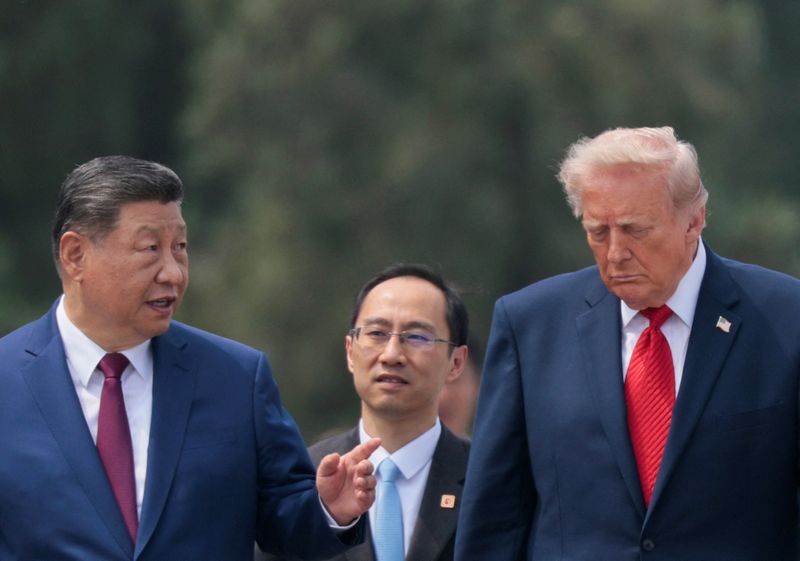
BEIJING, May 14 (Reuters) – U.S. officials raised the prospect of China buying more American energy after Presidents Donald Trump and Xi Jinping held talks in Beijing on Thursday.

The White House said Xi expressed interest in buying more U.S. oil to reduce China’s dependence on the Strait of Hormuz in a readout of the two-hour-plus summit published after its conclusion on Thursday.
Shortly afterwards, U.S. Treasury Secretary Scott Bessent told CNBC they had discussed Beijing buying more energy, and that production from Alaska would be a “natural” for China.
There was no mention of energy purchases in any of the Chinese summaries of the meeting published by state media. China’s foreign ministry did not respond to a request for comment.
Thursday was the first day of a two-day summit which Chinese state media said would set a new course for relations between the countries.
Chinese purchases of U.S. energy and agricultural products have been flagged as possible parts of a deal, although no concrete details have been unveiled yet.
China has not imported any U.S. oil since May 2025 because of 20% tariffs imposed during the trade war and the removal of those duties would likely be a prerequisite to any large-scale resumption of purchases.
Even at its peak, the U.S. has never been a major source of crude for the world’s largest oil importer.
Imports of U.S. oil peaked at about 395,000 barrels per day (bpd) in 2020, accounting for just under 4% of China’s total imports.
In 2024, before Trump returned to office, that had fallen to 193,000 bpd, worth $6 billion.
The chairman of state-owned oil major CNPC, which has long-term contracts with U.S. liquefied natural gas producers, was expected at a banquet in Beijing on Thursday for the U.S. delegation.
Reuters previously reported that the U.S. and China are expected to move toward a trade mechanism for non-sensitive goods this week, with each side possibly identifying some $30 billion worth of goods on which they could reduce tariffs.
(Reporting by Trevor Hunnicutt, Lewis Jackson and Sam Li in Beijing; Editing by Sharon Singleton, Thomas Derpinghaus, Philippa Fletcher)