

By Wen-Yee Lee and Ben Blanchard
TAIPEI, July 20 (Reuters) – TSMC is seeing strong, multi-year demand for its AI chips as it invests a further $100 billion to expand its Arizona facilities, but it needs to address several challenges, such as a shortage of construction workers there, a top executive said.

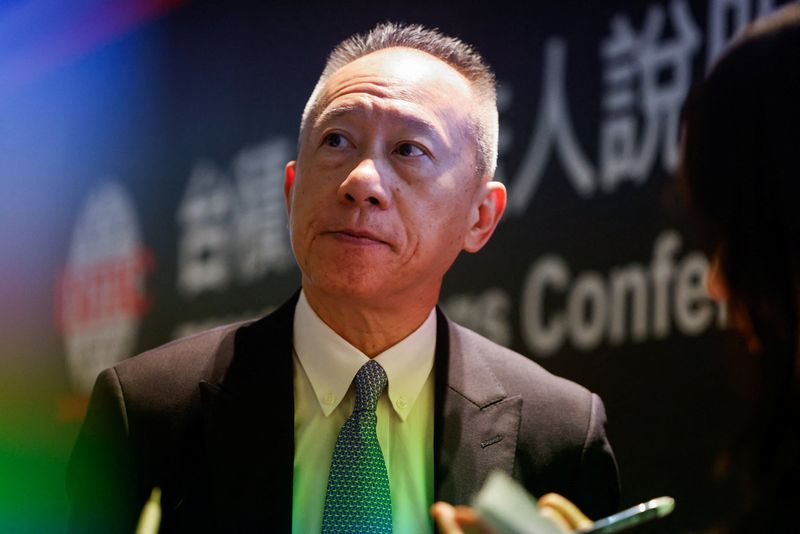
Speaking after blockbuster second-quarter results on Thursday, Chief Financial Officer Wendell Huang said the company is “very happy” with progress in Arizona, which is why it decided to ramp up investment to $265 billion.
“We will continue to invest,” he said in an interview, adding that the company was very grateful for U.S. government support.
“We continue to see customers’ strong demand — multi-year structural demand.”
The world’s main producer of advanced AI chips and a major Nvidia supplier, TSMC’s aggressive capital spending and soaring profit margins have made it a barometer of demand in the global semiconductor industry.
The pledge to expand in Arizona is a win for U.S. President Donald Trump, who has pushed for more chipmaking at home.
Trump has repeatedly accused Taiwan of stealing American semiconductor business. He has said that by the time he leaves office, the U.S. will have 50% of the world’s semiconductor manufacturing capacity.
ARIZONA FABS
TSMC’s first Arizona fabrication plant — or fab — is operational and achieving yields “as good as” the flagship fab in Taiwan, Huang said.
The second fab will shortly begin moving in equipment, while construction of a third fab is under way and preparatory work has started on a fourth fab and the site’s first advanced packaging facility, Huang said.
In total, current and planned projects will bring TSMC’s Arizona footprint to 12 fabrication and advanced packaging facilities plus an R&D centre. He did not provide a timeline for the latest investment.
However, “there are physical constraints — the number of construction workers available, the infrastructures available,” Huang said. “We’ll work closely with the government to solve these issues.”
At the same time, TSMC continues to invest at home, where it is building 13 leading-edge and advanced packaging fabs over the next several years.
“Land is a scarce resource in Taiwan,” Huang said. “Therefore, whenever there are available lands, we will use them for the most leading-edge technologies.”
“When you ramp the most leading-edge technologies, you need very close collaboration between the R&D and operation functions,” he added. “It has to be in Taiwan. And after it stabilizes, then we can consider transferring overseas.”
BOND ISSUANCE
Asked if the company would consider raising money by selling new shares in the U.S., Huang said it would “not rule out issuing new bonds” if market conditions are favourable.
Despite its aggressive expansion plans, TSMC faces headwinds from geopolitical tensions between Washington and Beijing, with the U.S. seeking to control advanced chip exports to China.
Reuters reported last year that TSMC could face a penalty of $1 billion or more to settle a U.S. export control investigation over a chip it made that ended up inside a Huawei AI processor.
Huang referred questions about the status of the case and any potential penalty to the U.S. government, but said TSMC’s internal export control system was constantly being reviewed.
“I have to say there is (only) so much we can do in terms of complying with all the rules and regulations, but when the customers sell to customers, they sell to customers,” he said.
“At some point in time, you lose the visibility. That’s the reality.”
Investors worries about the sustainability of the AI boom amid massive infrastructure spending has re-emerged recently.
TSMC’s Taipei-listed shares fell 7.3% on Friday despite the company’s record results. Even so, its shares remain up nearly 50% this year.
While TSMC has long been by far the market leader in making the world’s most advanced chips, competitors are seeking to narrow the gap, including Samsung Electronics, which has benefited from a recovery in the memory chip market, and Intel, which enjoys backing by the U.S. government.
Huang said the company remains confident in its business model.
“We do not intend to leave anything on the table,” he said. “Our competitors are good, but we are even better.”
(Reporting by Wen-Yee Lee and Ben Blanchard; Editing by Kevin Buckland)
By Wen-Yee Lee and Ben Blanchard | Reuters | © Copyright Thomson Reuters 2026.
