By Anna Szymanski
May 15 (Reuters) –

Everything Mike Dolan and the ROI team are excited to read, watch and listen to over the weekend.
From the Editor
Hello Morning Bid readers!
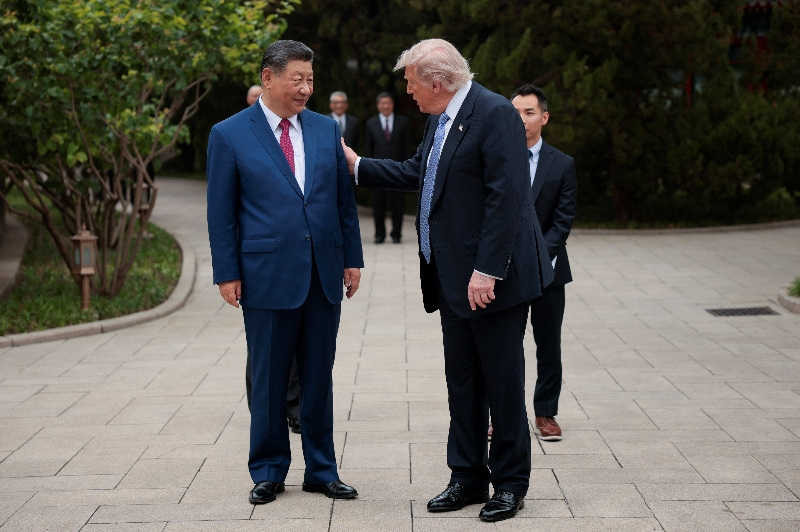
The long-awaited summit between U.S. President Donald Trump and his Chinese counterpart Xi Jinping hogged the spotlight this week, despite producing little market-moving news. The real story remains the stalemate in the Middle East, which is pushing up inflation – and bond yields – around the globe.
Trump entered the summit with a much weaker hand than the one he held when the two leaders met last October – and it showed. The visit featured warm words and lavish banquets but no substantive announcements, other than the finalization of a Boeing deal that was smaller than markets had expected and statements about a potential “double-digit billions” deal for China to buy more U.S. agricultural goods.
Energy markets may have looked to the summit for help to end the Iran conflict – now set to enter its 13th week – but none appeared to be forthcoming. Trump had described the month-long ceasefire as being “on life support” on Monday, before the two leaders discussed the conflict on Thursday.
They agreed that the Strait of Hormuz should be fully reopened, according to the White House, which also stated that Beijing had promised not to send military equipment to Iran. But China – the main buyer of Iranian crude – made no firm commitments to pressure Tehran to reopen the strait, even as the obstruction is starting to have a major impact on China’s imports.
Oil prices stayed firmly above $100 per barrel throughout the week, rising around 3% early on Friday, as last week’s hopes for a quick resolution to the conflict were squashed. But considering the stakes, these moves are remarkably contained.
Even the physical oil market has calmed, as a delicate balance has taken hold globally. The U.S. and other producers have helped plug much of the Middle East supply gap by ramping up exports, while countries around the world have drawn down inventories and China has cut back purchases. Even Russia has played a role by boosting energy exports.
But with peak summer demand season looming, this calm may not last.
Meanwhile, more tankers have reportedly transited the Strait of Hormuz recently, apparently with Tehran’s consent. While this may offer some short-term relief, it also appears to be creating an unsustainable new norm in the Gulf that will likely lead to future conflict.
All this is bad news for global inflation – and bond markets.
Inflation was clearly the big market story this week. Both U.S. consumer and producer prices in April notched their biggest rises in years on the back of the energy shock. Even the “trimmed-mean” inflation rate, which strips out the more extreme monthly price moves, rose.
That is a preferred gauge of incoming Federal Reserve Chair Kevin Warsh, who was confirmed by a Senate vote on Wednesday. He’s in a particularly challenging position. While he might push for more dovish policies – the stated preference of President Trump – that will not be an easy sell. There’s admittedly still a case for rate cuts, but this week’s inflation prints didn’t help it.
Indeed, a hike now appears more likely than a cut in the coming year, as the Fed may have to prove it’s willing to act to maintain its credibility.
Amid this backdrop, global bond markets have taken it on the chin. This week’s 30-year bond sale saw yields hit 5.046%, the highest for that maturity since August 2007 – and borrowing costs are also creeping higher at the short end.
Spiking yields are certainly not just a U.S. phenomenon, as they are rising across the Group of Seven economies in the face of mounting inflation pressures and other aggravators.
Britain has been particularly vulnerable, as political uncertainty has helped drive long-term borrowing costs to their highest level in almost 30 years. Prime Minister Keir Starmer faced calls to step down this week after his ruling Labour Party suffered heavy losses in UK local elections last Thursday. Starmer has resisted those calls so far, but the threat of a challenge to his leadership remains.
Global stock markets shrugged off the negative headlines for most of the week, buoyed by yet more positive AI earnings news. Major U.S. indexes notched yet more record highs on Wednesday, and the momentum continued into Thursday amid a tech rally led by Nvidia following news that the U.S. had cleared about 10 Chinese firms to buy its H200 chips.
While tech-heavy Asian indexes also rose earlier in the week – with South Korea’s SK Hynix looking set to soon join Samsung in the trillion-dollar market cap club – they stumbled on Friday amid the rout in global bond markets.
But how long will that last? With Nvidia, the world’s most valuable company, set to report earnings next week, the AI frenzy may once again drown out all other concerns.
For more data-driven insights on markets and commodities, check out Reuters Open Interest. You can learn:
• Why might immigration crackdowns lead to higher taxes?
• What are likely to be some surprising casualties of the Hormuz closure?
• Which of Kevin Warsh’s potential red lines may worst worry world finance?
• Why might stock market concentration be a feature of future equity markets, not a bug?
• Why are global energy giants unlikely to boost production amid elevated prices?
• How is the Iran war shaping China’s commodity imports?
I’d love to hear from you, so please reach out to me at .
This weekend, we’re reading…
RON BOUSSO, ROI Energy Columnist: This Reuters article explores how the European aviation sector is dealing with the huge disruption in jet fuel supplies from the Middle East. The answer, surprisingly, is pretty well.
MIKE DOLAN, ROI Finance & Markets Columnist: With tech stocks going ballistic around the world on a seemingly unstoppable AI boom, Europe looks slow to the tech rush. Niclas Poitiers and Tillman Schenk at Brussels-based think tank Bruegel explain just where Europe’s chip strategy is at.
ANDY HOME, ROI Metals Columnist: This piece from The Conversation argues that the real bottleneck in U.S. efforts to rebuild its critical metals supply chain isn’t mines or money – it’s workers. Mining employment has been in long-term decline, and so too has undergraduate enrolment in mine engineering. So who is going to operate all the new planned capacity?
GAVIN MAGUIRE, ROI Global Energy Transition Columnist: This guide by consultant Jonno White profiles 35 thought leaders in the electricity sector, including experts on grids, power system development, financing and company strategies.
JAMIE MCGEEVER, ROI Markets Columnist: This thought-provoking piece from David Andolfatto, economics professor at Miami University, offers a counterintuitive take on Fed rate hikes: they could be inflationary. Or, at least, tighter monetary policy may be much less effective than hoped. Why? Because of the country’s alarming fiscal situation.
We’re listening to…
CLYDE RUSSELL, ROI Asia Commodities Columnist: My latest appearance on Gulf Intelligence’s Daily Energy Markets podcast features a good discussion on the current state of oil markets and what we can realistically hope for from the Trump-Xi summit. I also debut my contribution to the growing list of Trump-related Mexican food acronyms: TAMALES. Listen in to find out what it stands for.
And we’re watching…
JAMIE MCGEEVER, ROI Markets Columnist: Professor Scott Galloway hosts activist and former trader Gary Stevenson on his Prof G Pod to discuss wealth inequality. They debate whether wealth taxes and stricter tax enforcement can reverse the trend – a particularly timely discussion, with data showing U.S. workers’ income as a share of national output is the lowest since records began in 1947.
Want to receive the Morning Bid in your inbox every weekday morning? Sign up for the newsletter here. You can find ROI on the Reuters website, and you can follow us on LinkedIn and X.
Opinions expressed are those of the authors. They do not reflect the views of Reuters News, which, under the Trust Principles, is committed to integrity, independence, and freedom from bias.
(By Anna Szymanski)