By Leika Kihara and Marc Jones
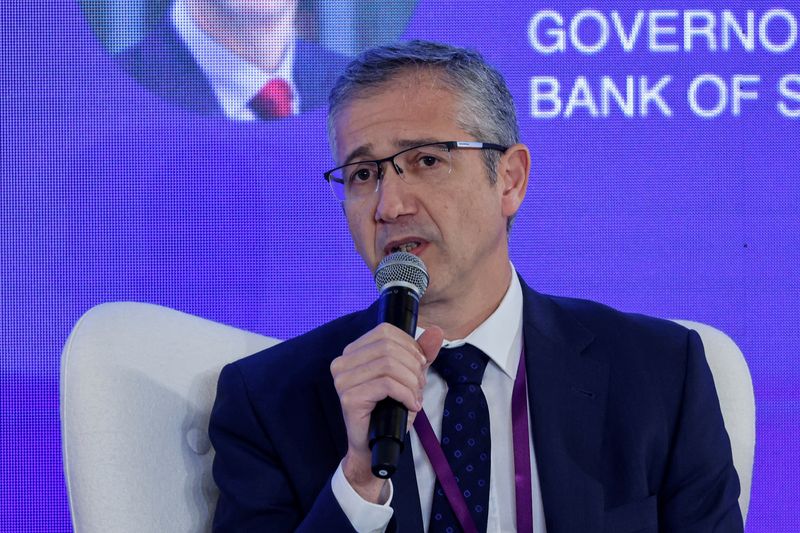
TOKYO/LONDON, April 20 (Reuters) – The head of the Bank for International Settlements made a fresh call on Monday for international cooperation on stablecoins, describing it as vital to prevent severe market fragmentation.

Tether, issuer of one of the largest stablecoins, later rejected as “ignorant” a comparison by BIS General Manager Pablo Hernandez de Cos of its USDT coin to exchange-traded funds.
Known as the central bankers’ central bank, the BIS has long raised concerns about stablecoins – a type of cryptocurrency usually pegged 1:1 to the U.S. dollar.
Speaking in Japan, de Cos said their potential to undermine monetary and fiscal policy, cause financial market stress and hamper the fight against illicit financing, meant global coordination was of “critical importance”.
Without it, “divergent regulatory frameworks for stablecoins across jurisdictions could lead to severe market fragmentation or enable harmful regulatory arbitrage,” de Cos said, referring to when firms seek out the least onerous rules.
His comments come as the United States and other leading economies race to build regulatory frameworks for stablecoins and catch up with the likes of Abu Dhabi and Singapore that already have them in place.
Bank of England Governor Andrew Bailey, who chairs global financial watchdog the Financial Stability Board, also said last week that progress on international standards for stablecoins had slowed over the last year.
If regulators classify stablecoins as securities then issuers will face tougher disclosure and compliance rules, analysts say. Alternatively, regulating them as money – which the crypto industry has lobbied for – could fuel an explosion in their use for mainstream payments.
De Cos said some features of Tether’s USDT coin and the USDC coin issued by Circle, such as imposing “redemption frictions” that lead to frequent deviations from par, mean they resemble “securities rather than money”.
“In this respect, they currently operate more like exchange-traded funds (ETFs) than like money,” the BIS chief added.
USDT and USDC are the world’s two largest stablecoins, together accounting for roughly 85% of the $315 billion worth in circulation globally.
De Cos’s comments drew criticism from Tether, whose USDT coin has nearly $190 billion in circulation.
“Comparing them (stablecoins) to exchange-traded funds is simply incorrect and ignorant,” Tether said in a statement to Reuters on Tuesday, adding: “Users don’t buy USDT expecting a return, they use it as a digital dollar.”
USDC issuer Circle declined to comment.
In the U.S., where Donald Trump has been championing crypto assets, the Securities and Exchange Commission recently said it would not treat stablecoins as securities under its GENIUS Act.
DOLLARISATION DANGERS
De Cos also reiterated that “runs” on stablecoins could trigger market stress, although that risk could be “much reduced” he said, if stablecoin issuers had access to deposit insurance-type arrangements or central bank lending facilities.
Growing stablecoin use could also accelerate the “dollarisation” of developing countries’ economies and make it easier to evade capital controls and “thus allow for both greater inflows (surges) in good times and outflows (capital flight) in times of stress,” de Cos said.
He also gave his view on the other crucial global debate around whether stablecoins should be allowed to pay interest in the same way that traditional bank accounts do.
“Shifts from bank deposits to stablecoins may also be less pronounced if stablecoin holdings remain unremunerated and the opportunity cost of holding them is high, such as during periods of high interest rates,” the BIS head said.
“And if prohibitions on paying interest on stablecoins can be enforced.”
(Additional reporting by Elizabeth Howcroft and Phoebe Sears in London; Editing by Catherine Evans)