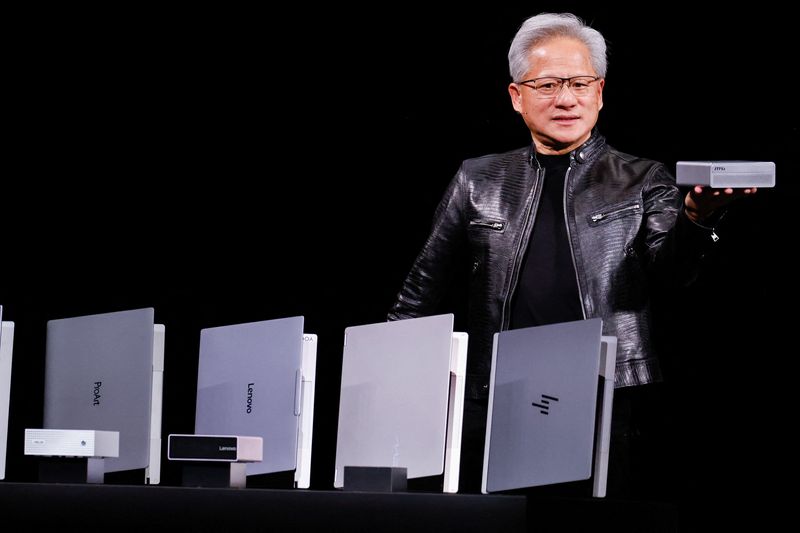
June 1 (Reuters) – Nvidia has turned the spotlight on AI PCs after CEO Jensen Huang launched a new chip that would put artificial intelligence capabilities directly into laptops and desktop computers, amid mixed demand for such devices already in the market.
HP last week said AI-optimized computers helped lift its quarterly results, whereas Dell said in January that the AI boom had not generated the kind of demand it had anticipated.

Here’s everything we know about AI PCs:
WHAT DOES “AI PC” MEAN?
Manufacturers say AI PCs can process data more swiftly than traditional ones and can handle a greater volume of AI tasks directly on the device, including chatbots.
They do not have to rely on cloud data centers powering most AI applications like OpenAI’s ChatGPT and Anthropic’s Claude, and some variants can also support training AI models — a compute-intensive task typically done on servers — locally on the device.
The rise of AI agents, or software that can perform tasks on the computer by itself with minimal human intervention, is also drawing fresh attention to AI PCs.
Nvidia’s RTX Spark, unveiled ahead of the Computex conference in Taiwan, is part of what the company called an effort with Microsoft to “reinvent the PC” for the AI era. The new chip has been developed in collaboration with MediaTek to run agents locally rather than relying on cloud computing.
PC makers are hoping such powerful AI features will help draw in buyers as more people lean on generative AI for everything from sending emails to planning vacations.
HP said late in May that AI PCs made up 44% of its PC shipments in the second quarter, up from more than 35% in the previous quarter, helping it top revenue and profit estimates.
However, AI PC adoption could be hampered by the memory chip supply squeeze and rising costs.
Market research firm IDC expects total global PC shipments to decline in 2026 due to memory shortages, rising component prices and supply constraints, even as higher average selling prices lift market value.
WHAT TECHNOLOGY IS USED IN AI PCS?
AI PCs come with specialized processors called neural processing units that handle the majority of on-device AI workloads.
These NPUs work in tandem with central processing units and graphics processors to manage complex tasks, deliver enhanced processing speeds and power applications such as AI assistants.
WHAT ARE SOME OF THE AI PCS AVAILABLE ON THE MARKET?
Nvidia said RTX Spark laptops and compact desktops are expected this fall from ASUS, Dell, HP, Lenovo, Microsoft and MSI, with Acer and Gigabyte to follow.
Several of these brands, along with Microsoft and Qualcomm, already offer Copilot+ PCs, which require processors designed specifically to handle AI tasks on the device.
ARE THERE ANY CONCERNS?
When announced in 2024, Microsoft’s “recall” feature had raised some privacy concerns. The feature would track every action performed on the laptop from voice chats to web browsing, and create a detailed history stored on the device. The user can then search this repository and go through past actions.
Following a strong backlash over privacy and security, Microsoft delayed the release of the feature and instead made it available through a preview mode for certain users after adding stronger protections. The optional feature is available in the newer Copilot+ PCs.
On the other hand, some experts maintain that managing more AI-related tasks directly on the device offers greater privacy, by eliminating the need to use personal data to train large AI models.
(Reporting by Anhata Rooprai in Bengaluru; Editing by Sriraj Kalluvila)