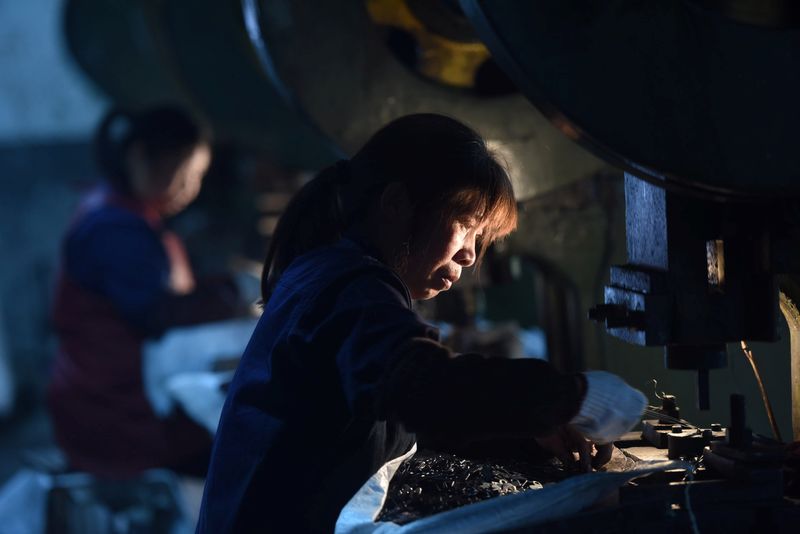
BEIJING, May 29 (Reuters) – China’s factory activity likely remained flat in May after expanding for two months, indicating that weak domestic demand and cost pressures stemming from the U.S.-Israeli war on Iran may have begun to weigh on the manufacturing sector.
The official manufacturing purchasing managers’ index (PMI) is expected to drop to 50 from 50.3 in April, hitting the threshold separating growth from contraction, according to the median forecast of a Reuters poll of 14 economists.

Results of the PMI survey, set to be released by the National Bureau of Statistics on Sunday, will shed some light on the impact of another month of logistics disruptions and price shocks on China’s manufacturers, as the Middle East conflict dragged on and the Strait of Hormuz oil supply chokepoint remained largely closed.
Economic indicators released earlier this month painted a mixed picture of the Chinese economy in April, with goods exports surging while growth in retail sales and industrial production sagged. Producer prices soared, raising input costs, yet profits of industrial firms recorded their fastest growth since November 2023.
On one hand, persistently weak domestic demand and industrial overcapacity expose the economy to external risks like energy price volatility and trade partners’ protectionist measures. On the other hand, a global artificial intelligence boom has fuelled demand for China-made electronics, underpinning expansion in advanced manufacturing sectors and sustaining the momentum in exports.
Although U.S. President Donald Trump’s visit to Beijing in May yielded no major breakthroughs, Beijing and Washington did agree, following the summit, to seek reciprocal tariff cuts on $30 billion or more worth of goods. Beijing’s Commerce Ministry also said it hoped the U.S. would “honour its commitment” to ensure that tariff levels on Chinese goods will not exceed the level set under a trade truce reached last year.
So far, resilient goods exports and China’s energy reserves have cushioned the economy from the effects of the war and reduced the urgency for major stimulus measures, especially after policymakers set a softer growth target for the year.
But if cost pressures keep mounting, policymakers will need to further boost domestic demand, stabilise the job market and support the struggling real estate market to shield the economy from external uncertainties.
(Reporting by Yukun Zhang and Ryan Woo; Polling by Pulkit Khanna and Susobhan Sarkar in Bengaluru and Jing Wang in Shanghai; Editing by Thomas Derpinghaus)