

By Cassell Bryan-Low
FARNBOROUGH, England, July 21 (Reuters) – As Russia deploys growing numbers of faster jet-propelled versions of its Shahed attack drone, some defence companies are racing to develop a new generation of faster interceptors.

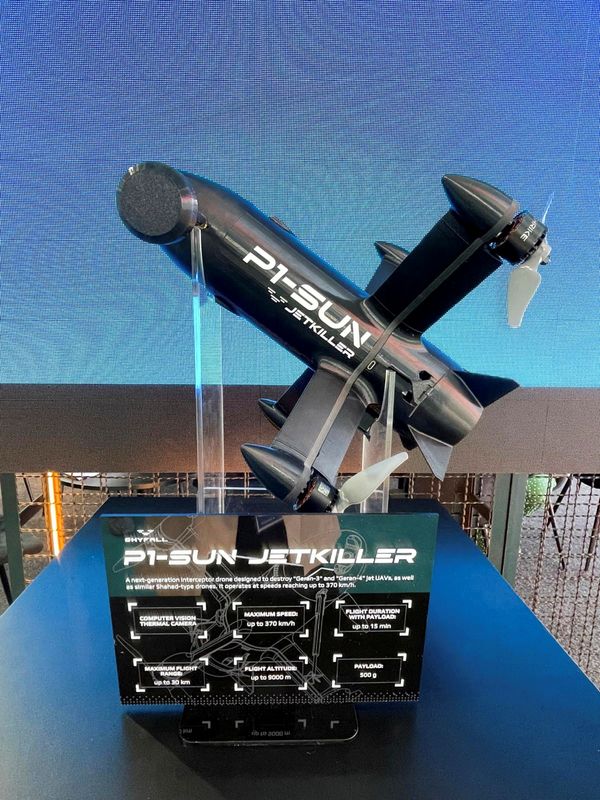
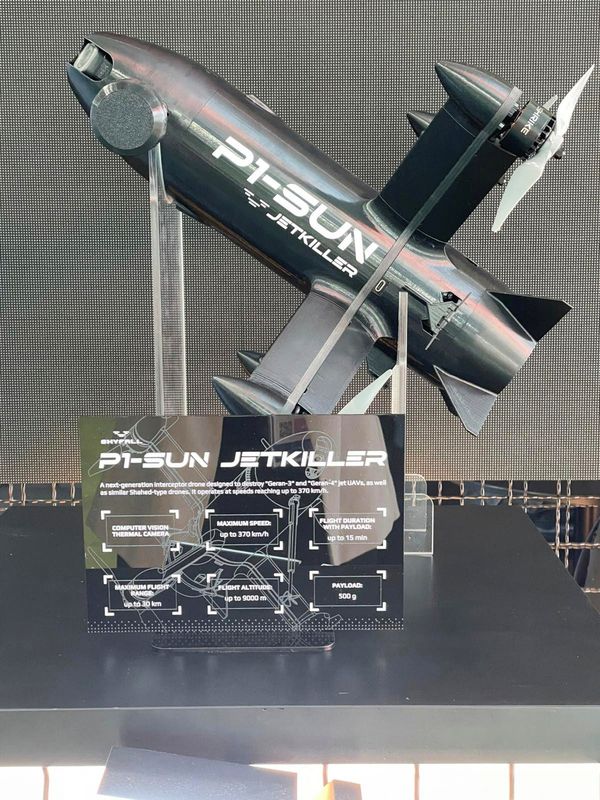
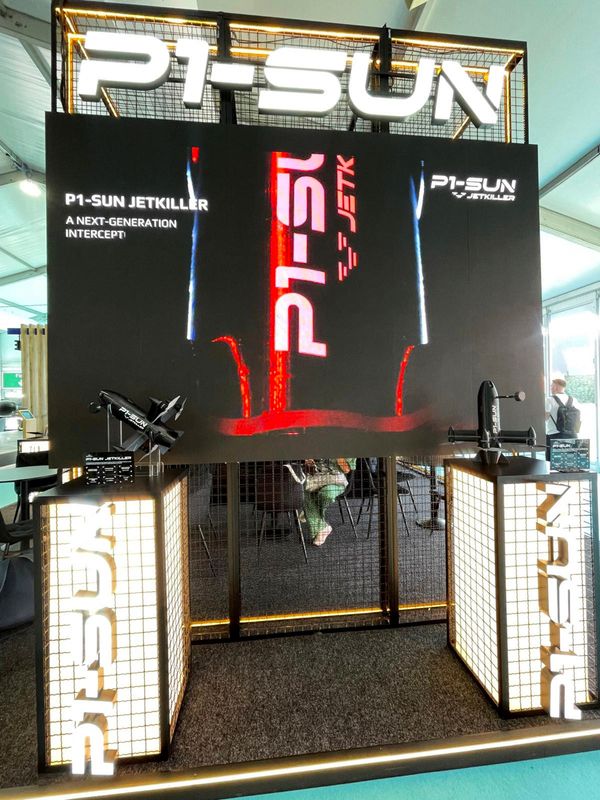
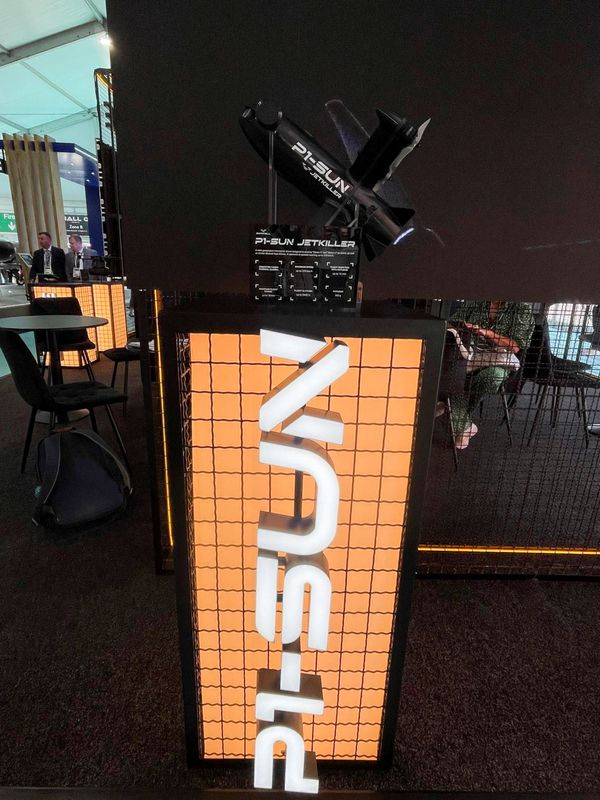
Among them is SkyFall, a major Ukrainian drone manufacturer, which unveiled a new high-speed interceptor on Monday at the UK’s Farnborough Airshow, one of the world’s largest airshows.
The drone, named the P1-SUN Jetkiller, is a faster version of the company’s existing interceptor that has been deployed in Ukraine since late last year.
Drones are a key focus at this year’s air show, as wars in Ukraine and the Middle East expose the limits of traditional defence systems against mass-produced threats. European missile manufacturer MBDA is launching an interceptor to counter attacks by large numbers of low-cost munitions such as drones, while Lockheed Martin (LMT.N) announced a lower-cost Patriot interceptor on Monday.
Shaheds are the pioneering low-cost, long-range Iran-designed attack drones that have become the scourge of Ukraine, with Russia unleashing thousands of them on its enemy every month. Moscow has adapted the design of the Shahed, which it calls the Geran, to include new features, including jet-engines, which it is using to penetrate deeper into Ukraine, including Kyiv.
The jet-powered Shaheds can travel at speeds of up to 500 kph (311 mph). That reduces the time Ukraine has to detect them and deploy countermeasures, and those speeds are much faster than most current interceptors can fly.
SkyFall says its new high-speed interceptor can reach 370 kph, versus the original model’s speeds of up to 310 kph. A SkyFall spokesperson told Reuters that they started working on the new version about three months ago, that it has been tested on the battlefield and has downed more than a dozen jet-powered Shaheds. He added the company plans to start mass production in August.
The regular P1-SUN has hit more than 5,500 Shaheds since its launch in November 2025, according to the spokesperson. The company says it has the capacity to produce 50,000 units a month.
Reuters was not immediately able to independently verify the battlefield claims.
SHAHEDS INCREASINGLY POWERED BY JET ENGINES
Russia’s use of jet-powered Shaheds has increased sharply over recent months, specialists say. About 15-20% of the Shaheds sent by Russia are powered by jet engines, rather than the usual propeller ones, according to Yuriy Cherevashenko, a senior commander in Ukraine’s air force, as Reuters reported in April.
Another Ukrainian drone maker called General Cherry says it is also working on a faster version of its existing Bullet interceptor that is designed specifically to combat jet-powered Shaheds.
Company spokesperson Marko Kushnir said the new version, which is in the final stages of development, can reach speeds of more than 400 kph, and the company is hoping to increase that to 500 kph.
One key matter to be resolved is how it will be powered, said Kushnir, with the company still trying both electric and small turbo-jet engine propulsion. The aim is to conduct front-line testing at the start of August with a view to starting mass production in September.
However, the main challenge is keeping costs down, Kushnir said, adding the aim was to keep the price point close to the existing Bullet, which costs about $2,000 or less.
He said the existing Bullet had destroyed more than 1,000 regular Russian Shaheds since last November.
JET-POWERED INTERCEPTOR
Also looking to tackle high-speed Shaheds is a British-Ukrainian company called Firebolt Engineering that says it has developed a jet-powered interceptor.
Firebolt’s jet-powered Griffen interceptor drone can currently reach speeds of up to 350 kph, said Chief Executive Mykola, who asked to be identified only by his first name for security reasons. It intercepted its first Russian Shahed in May, a non-jet propelled one, and the company is working to scale up production, Mykola said, speaking to Reuters by phone on Sunday.
Firebolt is currently working on a new engine with a British company called Dynamic Propulsion that they hope will increase speeds to up to about 400 kph.
Dynamic Propulsion CEO Gus Gingel also said keeping costs down was a key issue. “It’s about the compromise on materials in order to be able to produce something that is disposable rather than expensive.”
The price point for the jet-powered interceptor is under $10,000 for Ukraine, according to Tomasz Wozniak, a partner at Grenadyr, which invests in defence technology including Firebolt Engineering and Dynamic Propulsion. That is several times more expensive than existing non-jet powered interceptors.
(Cassell Bryan-Low; Editing by Sharon Singleton)
By Cassell Bryan-Low | Reuters | © Copyright Thomson Reuters 2026.
