By Fred Fuller

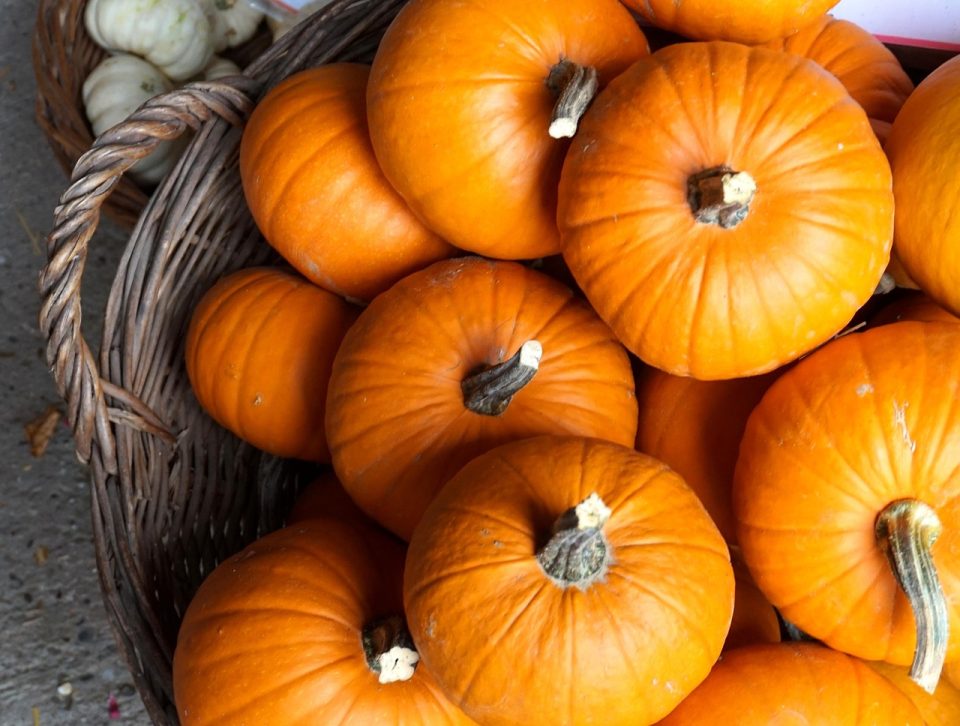
It’s pumpkin time. Today, we think of pumpkins mainly as the raw material for jack-o-lanterns at Halloween, or as the main ingredient in pumpkin pie at Thanksgiving. I guess we should add to that the popularity of pumpkin spice flavoring in recent years.
But in early America, pumpkins were a very important food source. I first became aware of this when I heard Vermont folksinger Margaret MacArthur sing “Our Forefathers’ Song,” which has verses about pumpkins such as:

“For pottage and puddings and custards and pies,
Our pumpkins and parsnips are common supplies,
We have pumpkin at morning and pumpkin at noon,
If it were not for pumpkin we should be undone.”
Margaret explained that when the first Europeans came to New England—the Pilgrims and Puritans—they soon ran out of food. Their traditional crops from England did not grow well in America. Many people starved to death in the first winter. But then they learned from the Native Americans to grow corn and pumpkins, which were native to the Americas and not found in Europe. Pumpkins could be preserved through the winter by drying or burying below frost in the ground, and without pumpkins, the first colonists might have all died.
Native Americans had been growing pumpkins and other squashes for thousands of years and had gradually adapted wild squashes into prolific garden plants. Squash, beans, and corn were known as the “three sisters,” the most important Native American foods. Agriculture was more important to most of the tribes than we generally think.
The pumpkin was particularly important because it grew vigorously on vines and produced numerous large fruits. It was well-adapted to the New England climate and soils. The colonists learned how to make pumpkins into sauces and soups. They stewed pumpkins with cider to make a type of butter. They mixed dried pumpkin pulp with cornmeal to make bread. They roasted the seeds and baked pumpkins stuffed with fruit as a sort of pie. Eventually, pumpkins were used for livestock food, too; for horses, cattle, pigs, and sheep.
The colonists even learned how to make beer from pumpkins, as also documented in the Forefathers’ Song:
“If barley be wanting to make into malt, We must be contented, and think it no fault; For we make liquor to sweeten our lips, Of pumpkins and parsnips and walnut-tree chips….”
Pumpkin pie, as we know it, came later, and jack-o-lanterns even later. As meat and other foods became more plentiful in America, pumpkins became known as “poor man’s food,” and as food mostly for animals. Pumpkin pie survived as the only main human food use for pumpkins.
Joseph Plumb Martin, a colonial soldier who served under George Washington at Valley Forge in 1777, wrote in a memoir published in 1830 about how half of a small pumpkin helped him survive during that cold and hungry time of the Revolutionary War:
“I lay here two nights and one day, and had not a morsel of any thing to eat all the time, save half of a small pumpkin, which I cooked by placing it upon a rock, the skin side uppermost, and making a fire upon it; by the time it was heat through I devoured it with as keen an appetite as I should a pie made of it at some other time.”
The tradition of jack-o-lanterns at Halloween came from Ireland and Scotland in the mid-1800s, based on the ancient Celtic holiday of Samhain, which marked the beginning of the year in the Celtic lands of Europe. In the hours between the old year and the new year, the spirits of dead ancestors were believed to cross into the world of the living.
Just as the Celtic year began in the darkness of approaching winter, all Celtic festival days began in the night, on the eve before the holiday. It’s surmised that the Catholic Church intentionally tried to convert the pagan holiday of Samhain into a Christian holy day named All Saints Day or All Hallows Day. The eve of All Hallows Day became known in Ireland and Scotland as Hallowe’en.
It was not until the large influx of Irish and Scottish immigrants in the 1800s that the traditions of Halloween became popular in America. The Irish and Scots had a practice of hollowing out turnips (which are what they call rutabagas), carving faces on them, and lighting them up with a candle. These frightful “lanterns” were placed in houses on All Hallows Eve to keep the houses safe by scaring away the roaming spirits of the dead.
When that tradition was brought across the ocean, Americans found that pumpkins were much easier to carve and light up than turnips. The term “jack-o-lantern” is believed to have originated from an Irish folktale about a character named Stingy Jack, who bargained with the devil and was doomed to roam the Earth with only a hollowed turnip lantern to light his way.