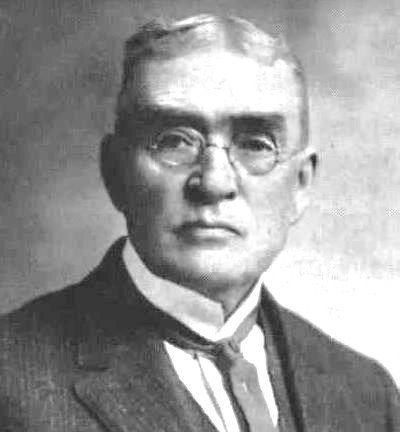
By Fred Fuller

Charles Keene Dodge was a Port Huron lawyer from 1876 to 1893, and for several years, he served as Port Huron’s City Attorney, a Circuit Court Commissioner, and the City Comptroller. In 1893, he retired from his legal practice to serve as a Deputy Collector and Inspector for the U.S. Customs office in Port Huron, partly so he would have more time to devote to what had become his true passion—botany, studying the native plants of Michigan.
By the time Dodge died in March 1918, he was heralded as the best field botanist in Michigan and southwestern Canada. “No other botanist knew the flora of Michigan as he did, and certainly no Canadian botanist has given the same study to the adjacent parts of Ontario,” said his obituary in the Canadian journal, The Ottawa Naturalist.

While he surveyed and studied trees, plants, and shrubs (scientifically, all known as “flora”) in many parts of Michigan, he focused particularly on what today we call the ‘Blue Water Area.” In 1900, he published Flora of St. Clair County, Michigan and the Western Part of Lambton County, Ontario, the culmination of at least a decade of intensive collecting in the area. In 1911, he wrote the chapter, “Flora in the County,” for the seminal history book, St. Clair County, Its History and Its People, by William Lee Jenks.
He also published many other studies, papers, and plant lists, such as “Observations on the Flowering Plants, Ferns and Fern Allies growing without Cultivation in Tuscola County, Michigan;” “Observations on the Wild Plants at Whitefish Point and Vermilion, near the South Shore of Lake Superior, and other parts of Chippewa County, Michigan;” “Catalog of Plants in a Biological Survey of the Sand Dune Region of the South Shore of Saginaw Bay, Michigan;” and “Annotated List of Flowering Plants and Ferns of Point Pelee, Ont., and Neighboring Districts.”
Bill Collins, a native of Fort Gratiot in St. Clair County, a botanist himself, and Executive Director of the Thumb Land Conservancy, discovered several years ago that the important accomplishments of Charles Dodge were little known outside of academic circles. Bill has since researched and written about Dodge, as well as producing a short video about him. Most of the information in this article is based on research that Bill has done.
Charles Keene Dodge was born on April 26, 1844, and grew up on a farm with nine siblings in Blackman Township, Michigan, five miles north of the city of Jackson. He attended country school there, and then between 1865 and 1866, he went to Ann Arbor for his secondary education at the Union School. In 1866, he enrolled at the University of Michigan, where he majored in classical studies. The Greek and Latin he learned would later prove beneficial in his practices of law and botany.
After graduating from the university, he took positions teaching Greek and Latin at schools in the Upper Peninsula of Michigan, for two years in Rockland and two years in Houghton. In his spare time, he studied Law and was admitted to the Bar in 1875. He then decided to settle in Port Huron, Michigan, and start a law practice, because he was impressed with the prosperity of the area. He later wrote, however, that the depression of 1876-77 gave him a tough time as an unestablished young lawyer of “average ability”, as he humbly described himself, and he was “… lucky to get a five dollar case with a thief for a client”.
Dodge was also impressed with the ecological diversity of the Port Huron area, from the Lake Huron shoreline, to the marshlands, and to the deep Black River valley ravines. It was while he lived in Port Huron that he began to become enamored with botany. He gradually discovered how much he loved nature, and he wrote: “Without any apparent mental effort I took to botany and was never able to let it alone. Everything described within the limits of Gray’s Manual interested me. Woods, trees, fields, all formed an irresistible attraction.” Asa Gray’s Manual of the Botany of the Northern United States, published in 1848, was the main guide to flora at that time.
Cecil Billington, the curator of the Michigan State University Herbarium, wrote that Dodge told him how “…at first he would go to the woods or fields, bringing in a few plants carefully hidden under his coat so that his friends and neighbors could not see them. They nicknamed him “Posy” Dodge, which name he did not relish and tried to avoid occasion for its use as much as possible. However, this feeling gradually wore off, and Mr. Dodge, carrying his much-battered vasculum [a container for collecting plant specimens], was a familiar figure on the streets of Port Huron, particularly those streets leading to the country.”
Dodge preferred to search the countryside on a bicycle. He penned an article for the Asa Gray Bulletin in 1896 entitled, “The Bicycle and Botany.” He wrote: “I am quite sure I could not have done so well with a horse and carriage. Any point within 12 or 15 miles of Port Huron, Mich., or Sarnia, Ontario, could easily be reached. When the place to be visited was at a greater distance, I would take a boat or railway train, carrying my wheel along.”
Dodge spent all his spare time collecting and studying plants. He was known to “…regularly work far into the night every other night in order that he might have time the next day for his botanical labors.” “New and rare plants always were a source of great pleasure to him,” Kenneth K. Mackenzie wrote in the journal of the Torrey Botanical Society in 1918, following Dodge’s death.
Dodge created his own extensive herbarium, which is a systematic collection of plant specimens preserved by pressing, drying, and mounting on paper. Eventually, he donated his herbarium of nearly 40,000 specimens to the Museum of Zoology in Ann Arbor (now the University of Michigan Herbarium). In 1912, he was appointed Associate Curator of Botany at the Museum of Zoology.
Dodge did not marry until he was 53 years old. In 1897, he married Wilhelmina “Millie” Burns, a Canadian, in Detroit. She was 23 years old. They lived on Gratiot Avenue in Port Huron, just north of the current Blue Water Bridges. Dodge described their home as a “… pretty, quiet home with ample grounds of about four and one-half acres, garden, fruit trees and opportunities for botanical experiments.”
But there was tragedy in their marriage. In 1906, Millie Dodge was sent to the Eastern Michigan Asylum in Pontiac for treatment for a nervous condition, according to an article in the Port Huron Times Herald of August 16, 1906.
Charles Dodge died in the University of Michigan Hospital on March 22, 1918, at the age of 73, after being in failing health for about a year. Sadly, his wife Millie, though only 45 years old, died just seven months later, in October 1918. Her death certificate indicates the cause of death was “shock from falling into the river.” An article in the Port Huron Times Herald onOctober 17, 1918,concluded it was suicide. Her body was discovered on the shore of the St. Clair River at the end of Lincoln Avenue and was reported to workers at the Port Huron waterworks plant nearby.
Cecil Billington wrote of Charles Dodge: “His love of nature and his kindly disposition made him tolerant of his fellow man, and it was a rare thing to hear him speak ill of anyone.”
Dodge was also a visionary. Being deeply attuned to nature, he was greatly troubled by its gradual disappearance due to the march of civilization. He would have witnessed the near-total annihilation of Michigan’s vast old-growth white pine forests, which were once as spectacular as the California redwoods. In 1873, a Michigan atlas speculated there was enough timber in Michigan to last for hundreds more years. But by 1900, the forests were gone, clear-cut to build houses in the western prairies and to rebuild Chicago after its great fire. It has been said that the value of the timber extracted from Michigan was greater than all the gold mined in California.
In his chapter on flora in the Jenks St. Clair County history book, Dodge wrote: “It seems to the writer it has been established beyond cavil that a country cannot be stripped of its trees, shrubs, and herbaceous plants without the greatest danger to its welfare. It is a matter about which, in this country, there is widespread and almost universal popular ignorance and unpardonable apathy.”
He further wrote: “…the natural and congenial homes of many of our native birds and mammals were quite destroyed and their food supply seriously curtailed. Their disappearance or flight to other regions to get food, to nest, and escape the disturbing influences of the white man, became a necessity. Those insects upon which these birds fed and kept reduced to a harmless minimum, suddenly and vastly multiplied beyond control, not only injuring seriously the balance left of the wild plants, but ravenously attacking cultivated vegetation and becoming a menace to the successful raising of crops, especially fruits….So much has man, though calling himself civilized, yet to learn! Today he does one thing. Tomorrow his former act is regretted and recalled. His true course is very probably to seek and rely upon scientific knowledge.”
Dodge called for the preservation of natural areas and wrote: “A public reservation of 3,000 or 4,000 acres in one piece for Saint Clair county would not be too large….The very best place for such a proposed reservation in this county is in the township of Clyde where Mill Creek joins Black River. Here conditions are such that most all species of both plants and animals of our county, if not of the whole of the Lower Peninsula, could find a congenial home and be made comfortable. Such a place left to itself for a number of years and under intelligent management would not only be a benefit to ourselves, but to our successors, a sight worth seeing by lovers of nature.”
As Bill Collins of the Thumb Land Conservancy has written: “This is the very location of the Port Huron State Game Area, established nearly 40 years after Dodge called out the area, which now includes 6,673 acres. Dodge would certainly not like that the land was reserved specifically for hunting and fishing, but would be delighted with the protection of the diverse forest community, the Black River, and the many native species that are within the boundaries of the area.”
The Thumb Land Conservancy has named a small nature sanctuary in Clyde Township after Charles Dodge. It is 2.73 acres of swamp forest and forested sand ridges that were once part of the Port Huron State Game Area. It was purchased by the Conservancy in a state auction of excess land in 2022. You can find out more about it at: