By Fred Fuller

The title of this article is taken from a poem of that name by Roy Hartry.
Most people are probably familiar with the term “Artificial Intelligence,” which is often abbreviated “A.I.,” but here is how Google A.I. defines itself: “…technology that enables machines to perform tasks that typically require human intelligence, such as learning, reasoning, problem-solving, perception, and decision-making. It works by using algorithms and vast amounts of data to allow systems to recognize patterns, understand language, make predictions, and act independently, without explicit instructions for every scenario. Examples include virtual assistants, self-driving cars, advanced search engines, and recommendation systems.”

In the past year or two, we’ve also seen that A.I. can recognize and identify people’s faces, create realistic-looking fake photographs and videos, write and perform songs, write letters and reports for us, drive cars for us, conduct human-like conversations with us, and do just about anything with just a few basic instructions from a human.
Of course, in simpler applications, A.I. has been part of our lives for a long time, ever since computers became available and smartphones were created. Google itself and other search engines on the internet are basically a form of A.I.
But in the past few years, the sophistication of A.I. has grown exponentially. Companies have invested vast sums of capital in it, and many people have begun to worry about how it will change our world.
At some level, there is nothing inherently wrong with Artificial Intelligence. It promises to provide great innovations in the medical field by identifying complex diseases and finding treatments. It already assists with robotic surgery. It can help spread knowledge widely, sort out complex problems, warn us of unperceived dangers, and maybe even help us learn to communicate with other animals.
But it also has ominous implications. Like any technology, it can be used for good or evil, and it appears to be a technology that will be beyond our control. At worst, some experts fear that it could develop superhuman intelligence and lead to the extinction or enslavement of the human race.
Short of that, A.I. portends many dangers for our society, such as allowing much more government control of our lives, or causing us to lose many of our abilities, such as reading, writing, arithmetic, creativity, logical reasoning, social skills, and communication with other human beings. It could be a crutch that we rely on too much.
A.I. “chatbots” have already been blamed for encouraging at least three teenagers to kill themselves. A.I. is already providing religious advice. It is already creating fake videos that often can’t be discerned from reality. It is already causing us to question what is true and what is not.
One of the immediate dangers I see from A.I. is that the U.S. stock markets are being driven unsustainably high by the investments in A.I. Almost every large corporation is pouring huge amounts of capital into utilizing A.I. right now. No company wants to be left behind. This is what is being called the “A.I. Bubble.” When expectations or profits from A.I. stall, the bubble will probably burst, and the stock market will crash.
Another problem with A.I. is the huge amount of energy it requires to make its calculations and run its algorithms. Huge data centers are being built all around the country to process and store the data A.I. requires. This puts a burden on our whole electrical infrastructure—on generating plants and transmission lines. Consumers appear to be paying the price with higher energy bills.
These data centers, and their required new power plants, are also impacting rural and suburban life. No one wants to live next to a huge data center that changes the rural landscape and emits a constant humming noise from cooling fans, or to live next to a new power plant needed to supply electricity for the data centers. Last year, Microsoft Corporation signed a 20-year agreement with the owners of the Three Mile Island nuclear facility, site of the worst nuclear disaster in U.S. history, to restart production of nuclear energy there to power Microsoft’s development of A.I.
Is all this worth it so that we can have A.I. do our thinking and writing and creating for us? Or so we can give the government and big corporations more tools to monitor us?
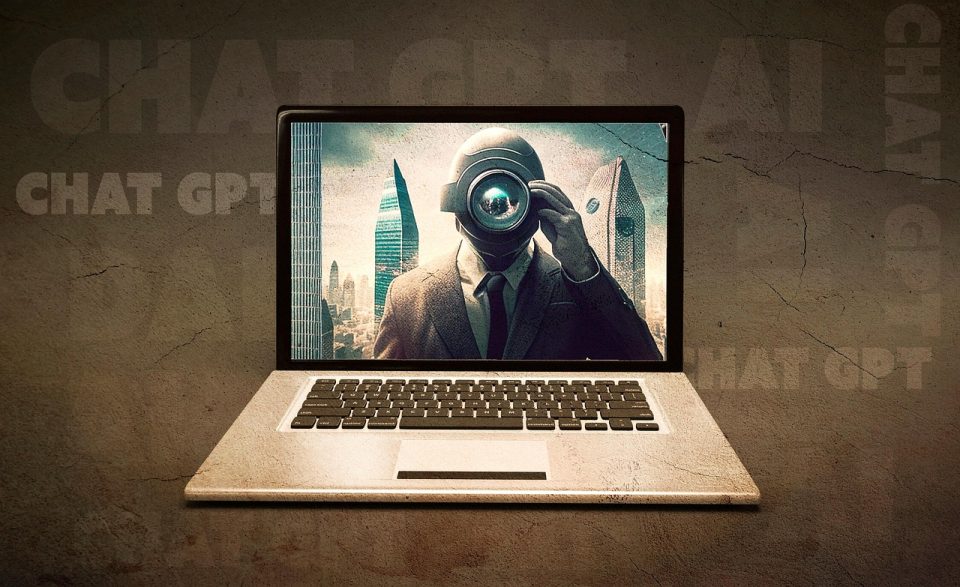
Many years ago, I read George Orwell’s novel, Nineteen Eighty-Four. It didn’t accurately predict the year that “Big Brother” would control us, but I think it did envision the scenarios and tools that could be developed to control us. In the novel, “telescreens” (two-way televisions), hidden cameras, and microphones allow the “Thought Police” to constantly monitor people in their homes for conformity and faithfulness to the ruling regime.
Years ago, I thought that could never happen because it would be just too time-consuming for government agents to monitor all those methods of surveillance for everybody all of the time. But now I realize that A.I. would make it possible to monitor all those sources, because A.I. can sort through all the audio and video recordings and pick out just what it has been programmed to look for. It never gets tired and seldom makes mistakes. It can work around the clock, and it can be everywhere.
Already, we have cameras monitoring us just about everywhere we go—in stores, on the streets, in parking lots, in almost every public building, and even in our neighborhoods where so many people have Ring video doorbells.
Our computers track everything we do on the internet, and our smartphones can track our location as we move about. Every text we send and phone call we make is stored in “the Cloud.” But it can get worse, and uncontrolled A.I. will make it possible.
We are definitely entering a “Brave New World.” Do we want it?