By Fred Fuller

It’s important to look beyond the myths we have all absorbed about the American Revolution to learn the real history and notice how it compares to today’s current events.
Two hundred and fifty years ago, in 1775, the American Revolutionary War had already begun. There was already a tradition of some democracy in Great Britain, which the American Colonists brought with them. Few people realize that there were a couple of revolutions in Britain in the 1600s that brought about changes to the monarchy and influenced the American Revolution.

From 1642 to 1651, there were several wars in England, Ireland, and Scotland known most commonly as the English Civil Wars. Partly, they had to do with religion, with Protestants and Puritans asserting their rights against the government’s church, and also with the balance of power between the English Parliament and the King. A Parliament had grown slowly in power since the Middle Ages, first as the King’s council of advisors, then as a more organized system of governance, but still at the pleasure of the King.
When King Charles I attempted to rule without the advice of the Parliament, a war broke out between Royalists and Parliamentarians, who were led by Oliver Cromwell. Eventually, the Parliamentarians won. They chopped off the head of King Charles in 1649. After the Civil Wars ended, Oliver Cromwell ruled as the “Lord Protector” for nearly five years. In 1659, after Cromwell had died, Charles II was invited back to rule alongside Parliament.
The second English Revolution, the “Glorious Revolution of 1688,” occurred when King Charles II’s brother and heir, King James II, was dethroned for being too Catholic and for trying to rule without Parliament.
The Glorious Revolution replaced James II with his daughter, Mary, and her Protestant husband, William of Orange. It also reaffirmed the power of Parliament, and in 1689, a Declaration of Right was enacted as the “English Bill of Rights,” based on “certain ancient rights and liberties.” It listed the wrongs committed by James II and declared that the King or Queen could not suspend or execute laws without the consent of Parliament; that the religious Catholic commissions and courts James II had established were not legal; that levying taxes without the consent of Parliament was not legal; that citizens had the right to petition the king without fear of repercussions; that the raising or keeping of a standing army within the kingdom in time of peace, without the consent of Parliament, was against law; that Protestants should have the right to bear arms for defense; that members of Parliament should be freely elected and have freedom of speech; that excessive bail ought not to be required, nor excessive fines imposed, nor cruel and unusual punishments inflicted; that all trials should require the presence of jurors; that it was not legal to fine or seize the property of any person who had not been convicted.
You can see that the United States’ Declaration of Independence and our Bill of Rights were based in part on this English Bill of Rights from 1689. (In fact, that bill appears to have given English citizens more rights, in some cases, than we have in America currently! Read it again!)
The thing was, though, that in the 1700s, King George III and Parliament did not think these English Rights should be extended to their colonies.
By the early 1700s, most of the American Colonies had their own self-governing legislatures and courts, inspired by the English models and the philosophical ideas of the European Enlightenment. When the British Parliament passed the Stamp Act in 1765 to raise taxes to support the expenses of the British military, the Colonial legislators resisted. They saw no need for British troops to be stationed in their jurisdictions, because they had their own militias.
The Colonies sent petitions of protest to Britain. They saw it as their right under the English Parliamentary system to not be taxed without representation. They were already electing the representatives to their Colonial legislatures, but they had no representation in the English Parliament. The petitions were ignored.
When British agents tried to impose the Stamp Act in the Colonies, the first direct tax that was not an external trade tax, there were riots in the streets of major cities, British officials were hanged in effigy, and in some cases, the officials’ homes were attacked and looted.
In October of 1765, nine of the American Colonies sent delegates to what became known as “The Stamp Act Congress” in New York City. This Congress crafted and sent to the King and his Parliament a “Declaration of Rights and Grievances” that asserted they had rights, not only as Englishmen, but natural rights solely because they were human beings— “the common rights of mankind.”
Due to the protests and boycotts of imports in the Colonies, Britain repealed the Stamp Act in March 1766, but then it only clamped down harder on the Colonies, issuing the Declaratory Act of 1766, affirming its power to legislate for the colonies “in all cases whatsoever.” The British Parliament then imposed more trade taxes to make up for the revenue lost from the Stamp Act.
The British believed that Americans were less likely to object to taxes on trade, such as customs duties, than to direct taxes like the Stamp Act. In 1767, the British Parliament passed the Townshend Acts, which placed duties on several important products, including paper, glass, and tea, and established a Board of Customs in Boston to more rigorously enforce trade regulations. Parliament’s goal was not only to collect revenue, but to assert its authority over the Colonies. Colonists responded to the taxes by organizing new boycotts of British goods. These boycotts were less effective, however, as the goods taxed by the Townshend Acts were widely used.
In June 1768, a riot broke out in Boston over the British seizure of the sloop Liberty, allegedly for smuggling. The ship was owned by Boston merchant, John Hancock. Customs officials were forced to flee to the British fort in Boston. Because of this, General Thomas Gage, the British Commander-in-Chief for North America, was instructed by the British Colonial Secretary to send “such Force as You shall think necessary to Boston.” Four British Army regiments arrived in Boston in the fall of 1768.
A Boston town meeting of citizens declared that no obedience was owed to British parliamentary laws. In January 1769, the British Parliament responded to the unrest by reactivating the Treason Act 1543, which called for subjects outside the realm to face trials in England for treasonous acts. The governor of Massachusetts was instructed to collect evidence of treason, and that threat caused widespread outrage.
Confrontations between British soldiers and citizens began to occur frequently, and tensions flared when a Boston youth, about 11 years old, was killed by a Customs employee on February 22, 1770. His death was reported in all the newspapers, and his funeral was described as one of the largest of the time in Boston.
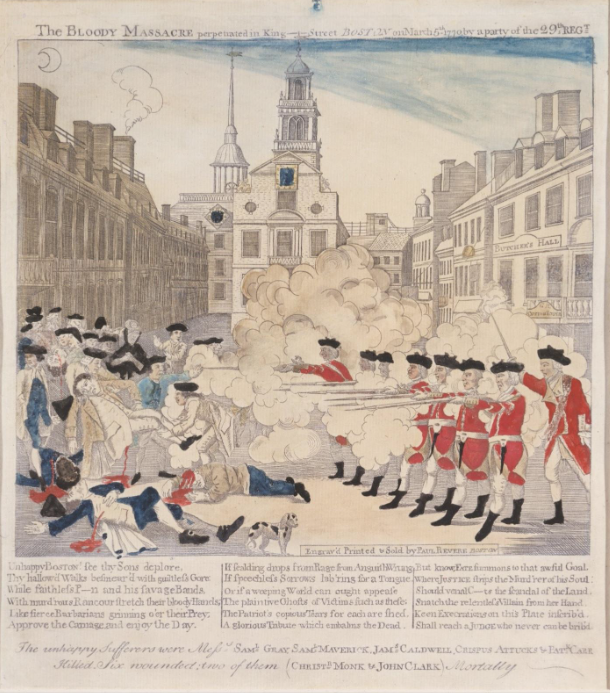
On March 5, 1770, a group of nine British soldiers ordered an angry crowd to disperse, but they refused and threw stones and snowballs at the soldiers. One of the soldiers who was hit fired his musket at the crowd, and then the other soldiers fired, despite no order having been given by the officer in command. Three Americans were killed instantly, and two others died later of their wounds.
The British authorities pledged to investigate the killings and arrested the nine soldiers, but their trial was put off for seven months. Ironically, the soldiers were defended by founding father John Adams, who got seven of them acquitted, and the penalty for the other two, who were convicted of manslaughter, was reduced to having a thumb branded in open court. This was a common punishment in those days, known as “stigmatizing.”
In defending the soldiers, Adams blamed the killings on the threatening mob of Colonists as much as the soldiers, particularly one rioter who was a former slave of African and Native American ancestry—Crispus Attucks. Attucks is believed to be the first one killed by the British in the chaos. Adams claimed, “his very look was enough to terrify any person,” and that, “with one hand [he] took hold of a bayonet, and with the other knocked the man down.” However, two witnesses contradicted this statement, testifying that Attucks was 12–15 feet away from the soldiers when they began firing.
John Adams claimed he was simply trying to achieve a fair trial for the soldiers. On the third anniversary of the shootings, he stated: “As the Evidence was, the Verdict of the Jury was exactly right. This however is no Reason why the Town should not call the Action of that Night a Massacre, nor is it any Argument in favour of the Governor or Minister, who caused them to be sent here. But it is the strongest Proofs of the Danger of Standing Armies.”
In the months before the trial, propaganda from both sides inflamed the populace. Let’s not forget that between 15% and 20% of white colonists remained loyal to the British Crown throughout the Revolutionary War. Only a somewhat larger percentage were Patriots at the beginning of the war, and the remaining majority were neutral or undecided.
The Patriots called the Boston incident “The Boston Massacre,” and the newspapers fanned the flames of anger among the Colonies. An engraving for printing in newspapers and flyers made by silversmith Paul Revere, of British redcoats shooting innocent crowd members on—ironically—King Street in Boston, especially grabbed the public’s attention. Revere actually based his engraving on another print by an artist named Henry Pelham. Prints widely distributed of Revere’s engraving were often hand-colored to show the red blood of the victims and the red coats of the soldiers (see the print below).
The Boston Massacre was one of the most significant events that led eventually to the American Revolutionary War in 1775.