

By Derek Smith and Sally Jett Holt Sherman

Let me re-introduce myself….
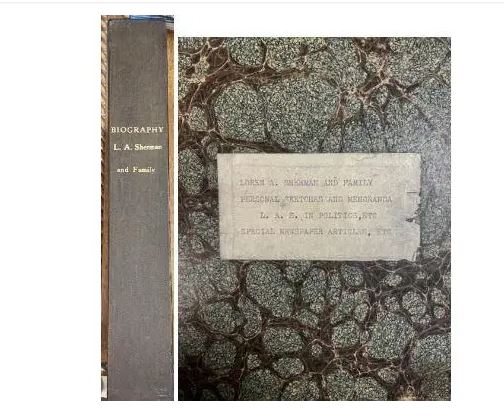
My real name is “Loren A. Sherman and Family, Personal Sketches and Memoranda”.

All my friends just call me “Sherman”, so that is the moniker we will use for this writing.
If you were to define me, you could label me an autobiography of an autobiography or perhaps more simply stated, a memoir of an autobiography. As we all know, definitions can often be ambiguous and misleading!
My journey had its beginning back in 1920, an undertaking by the late Loren A. Sherman family. It is then my pages were filled with Sherman family memorabilia. It is then I took my place in the family’s history. It is there I would occupy a proud spot in the Sherman library. Here in this room of learning, I made myself available to all those wishing to investigate the wonderful information, I so carefully cradled within my covers.
And so, Sherman begins-
Over the last few days, following Estella’s funeral, I started to “gather my wits”, and was beginning to deal with the reality of my new situation.
I once had a book friend called “The Power of Positive Thinking”. His nickname was “Norman” after his creator, Norman Vincent Peale.
What I remember most from Norman’s lessons were, “stop worrying, put an action plan together, nothing can happen, and nothing gets better without that plan”. It is then that I turned my worry into action.
I would have a plan!
After the death of Estella, there were many visitors paying their respects at the Sherman 1433 residence.
I recognized most of them, some were old friends. Many were business associates, such as the McMorran’s, the Harrington’s, the Jenks’s, the Dixon’s, the Ottaway’s, and the Weil’s.
Estella’s longtime friends from the Daughters of the Republic were also in attendance.
There was lots of family, and many local people, folks I had never seen before.
However, on this day they all gathered as one, to honor a family that had played such a remarkable part in the community.
Frederick Ward Sherman of California, Estella’s oldest child, had travelled by rail for over 2000 miles from California to attend the funeral.
Upon Loren Sherman’s retirement, Frederick Ward Sherman had taken over operations of the Port Huron Times.
Sometime after 1910, when the paper was sold, Frederick and his family moved to California, where he would become editor of a newspaper in Santa Barbara.
Frederick Ward married Charlotte Esther Wolfe on January 18th, 1885.
They would have five children, Albert Wolfe Sherman (1885-1965), Admiral Frederick Carl Sherman (1888-1957), Harold Wolfe Sherman (1882-1893, Charlotte Esther Sherman (1900- 1980), Mary Eleanor Sherman (1908-1992).
After the funeral service for Estella, the Sherman family assembled in the library.
Ross Mahon, husband of Edith Sherman, and brother -in -law to Frederick was in attendance.
At that time, Ross was starting to develop a lakefront subdivision in Port Huron, a property which would eventually be named “Sherman Woods”, as a tribute to his father-in-law Loren A Sherman.
It is a moment I remember well, and one I hold most proudly in my memory.
Ross reached up to my perch on the middle shelf, picked me up, and handed me to Frederick Sherman. He stated, “this is the story of the Sherman family, it belongs with a Sherman.”
A new chapter (excuse the pun) in my life was about to begin. I would soon embark on a long rail ride to California.
It is there, where once again, I would find my place in a Sherman family home.
Well, after all, I was family!
I had learned from my book friends that California was a place of much wonder.
They told me of a red sun that climbs effortlessly over the snow-covered peaks of the Sierra Nevada’s, changes color, and performs a perfect dive into the blue waters of the Pacific Ocean to the west, never to witness the glamorous “night life” of California.
They told me California had witnessed the struggles of gold and lumber prospectors, those seekers of fame and fortune, who often found neither.
It was a place of palm trees, warm breezes, the sun-tanned surfers of Malibu, and the movie stars and millionaires of Beverley Hills.
It was a place for dreamers and opportunists, should one be so inclined.
I would dwell on all these thoughts as we made our journey west, riding on our nations Transcontinental Railroad, which for the most part, had been completed in 1869.
Sherman listened to the sounds of the “clickity clack”, as the steel from the train’s wheels met their many sections of rail.
He memorized the pleasant sounds of the train’s whistle, as it said hello to the many rail crossings and small towns, it had become familiar with.
His imagination played with the different shapes, sketched from the engine’s sooty steam, as it bellowed from its stack, and disappeared into an ever-changing landscape.
The journey west would remain on of Sherman’s fondest memories!
It is there, he too would also become a dreamer.
It was a new life, a fresh start; his considerable excitement paralleled only by his heightened curiosity, for all that was waiting at the end of the rail.
Sherman had a plan!
The family would arrive at Central Station in downtown Los Angeles, California, on a bright sunny morning in late summer of 1924.
Sherman could not get over what a busy place this was, certainly much more engaged than the train depot he remembered in Port Huron.
Frederick Sherman hailed a cab from a long lineup of brightly polished vehicles, all waiting patiently to transport the hundreds of people arriving daily, to their final destinations.
It was a Checker cab, and I was pleasantly surprised when the driver told us it had been made in Kalamazoo, Michigan.
In case you are wondering, as I was, the word “cab” derives its name from the cabriolet, a two wheeled, one-horse carriage let out for hire.
As I glanced along our route, I was amazed by the greenness of the landscapes, the legions of palm trees, and the abundance of flowers that populated almost every yard.
The cab proved a much more comfortable ride than the train, and we arrived at the family home at 123 South Hobart Street in little time.
The house was not as large as the one I had left in Port Huron. It was, however, adequate, comfortable, and well furnished.
I found my place, vertically positioned in a small study, that was filled with lots of new book friends, and a great many newspapers.
It was a cozy room, an area filled with much knowledge.
Frederick Ward Sherman and his wife Charlotte would visit me there on a regular basis.
They had not known me during my early years in Port Huron. It was a wonderful experience, learning more about the couple, the extended family, and their lives on the west coast.
I proudly shared with them my many Sherman memories, some of which they found familiar, and others newly discovered.
The residence enjoyed regular visits from family and friends and gave audience to the assorted political conversations of the day, talk which centered the usual suspects, the good, the bad, and the ugly.
Life was good! Or was it?
To be continued in Part 3 “The Life and Times of a Book Called “Sherman”.
