In the fall of 1949, the City of Palm Springs celebrated the planting of 308 palm trees along the main thoroughfare of town. The community had worked diligently to acquire and place the palms to enhance the aesthetics of the city and mark it as distinctive.
The notion of beautifying cities with trees was emerging around the country at the time. That city governments would not just name streets for trees, but plant and care for them, was an idea born in the middle of the 20th century, and Palm Springs enthusiastically embraced this concept.

Trees have figured prominently throughout municipal history. According to the Forest History Society, the settlers at the Plymouth colony designated “woodlots,” communal forests for the common good. By the middle of the 19th century, as gold was being discovered in California, most of the nation’s 20 million people were still living as the pilgrims did and were dependent upon forests to survive.
By middle of the 20th century though, a mere 100 years later, most people in the country were living in cities and desperately in need of trees. Frederick Law Olmsted, the landscape architect of New York City’s Central Park and many other cherished natural spaces across the country, “believed that trees and vegetation enhanced the morale and counteracted the anxieties of city life. A city park, he said, was to ‘provide a natural verdant and sylvan scenery for the refreshment of town-strained men, women, and children.’”
Since the middle of the 20th century, much of the population has certainly been “town-strained.” The corrective prescription for this malady is planting and properly caring for trees.
According to the city’s website, Palm Springs has over 13,000 trees in 1,100 different sites. Many cities undertook such an accounting of their trees as the very concept of “urban forestry” developed. Actively managing the trees punctuating the dense, cement hardscape of modern cities materialized in the second half of the 20th century.
In California, a superlative example was the City of Santa Monica. Fortunate in its geography and perched on palisading cliffs above a sweeping bay, Santa Monica was even more fortunate to have had one gentle soul, George T. Hastings as a resident.
Hastings was born in 1875 and graduated from Cornell University in 1898 after studying with preeminent horticulturalist Liberty Hyde Bailey. Hastings then taught in Chile and in Philadelphia at the Museum of Natural History. He graced the science departments at multiple New York high schools before moving to California in search of a cure for his asthma.
Walking the streets of his Santa Monica neighborhood, Hastings became intrigued with its trees. Soon he was at the UCLA Botanical Garden learning all about the myriad species. His first slim volume “Trees of Santa Monica” was published in 1944. The book is remarkable.
The preface to its 1956 update notes the city “is versatile both in numbers and the kinds of its trees. Early growers and developers planted many, especially north of Wilshire. Later nurserymen and private collectors vied with each other in introducing unusual species which enriched an already significant plant palette. The city itself did not get into tree planting until quite later, 1952 to be exact, and while its selection is somewhat limited due to narrowing parkways and widening streets, there are many fine new trees, particularly where none existed. This policy, plus the horticultural interest of home owners has produced a notable result.”
Not meant as an exhaustive list, he book’s stated purpose was to identify specimens “everyone can see in each section of the city, and to suggest the special neighborhood character that only trees can impart.” The Moreton Bay Fig of the Miramar Hotel at the terminus of Wilshire Boulevard is one of Santa Monica’s most important and character defining trees.
Palm Springs too had its own famous and venerable fig tree.
Situated originally on Judge McCallum’s spread at the corner of Palm Canyon Drive and Tahquitz Canyon Way, the tree was thought to be quite old when Pearl and Austin McManus developed the Oasis Hotel on the original site of her father’s land. McCallum cultivated trees for “early-ripening fruit” to be sent to the coastal markets. The fig was a relic of that endeavor, having survived the drought at the end of the 19th century.
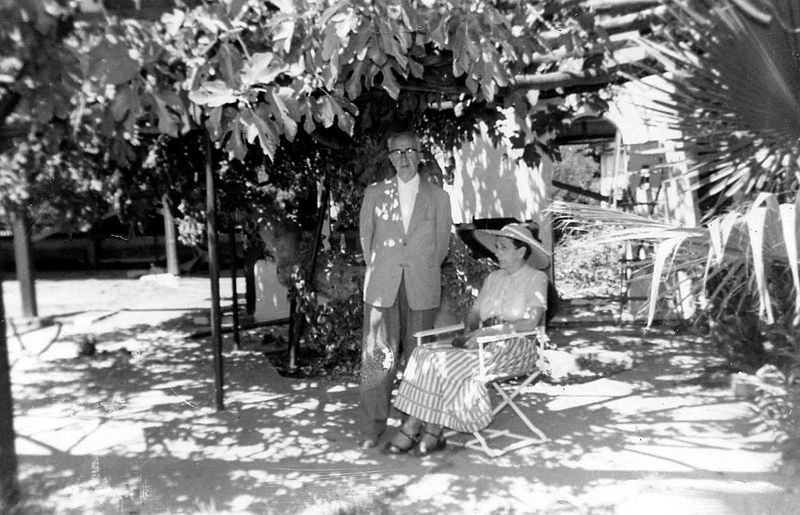
By the middle of the 20th, the hotel advertised the opening of “El Adobe Cocktail Lounge” in McCallum’s home “reputed to be the oldest building in Palm Springs. The Old Fig tree is said to be one hundred years old” and shaded its patio.
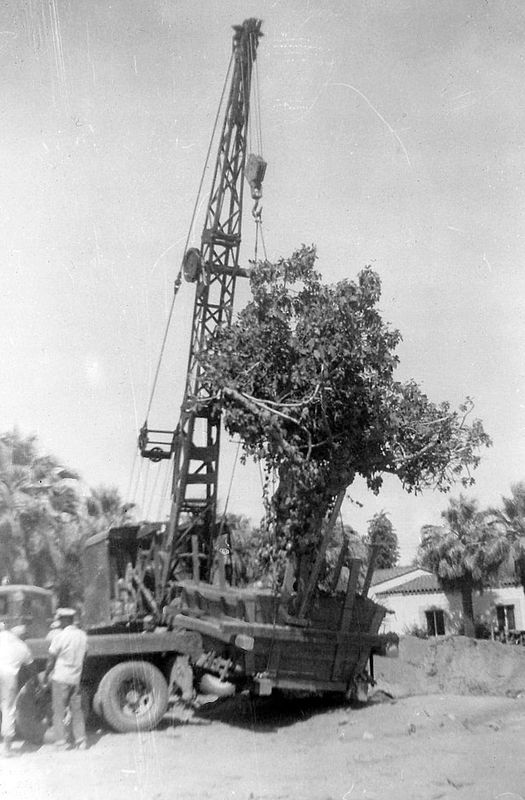
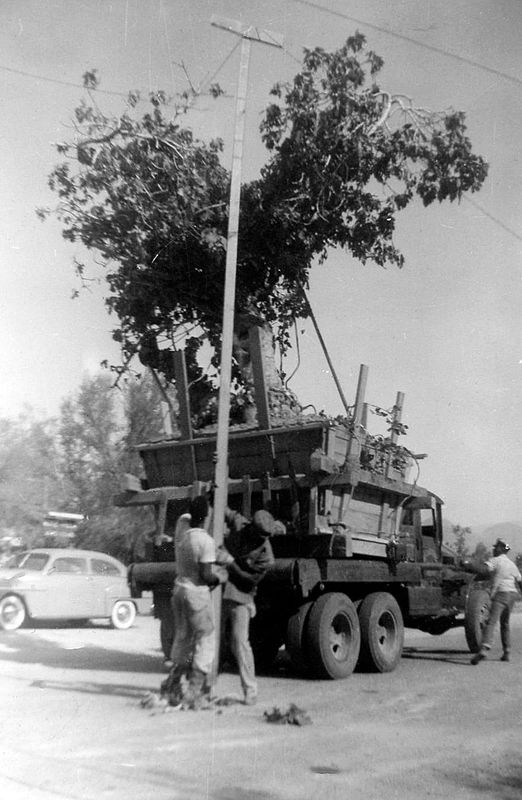
In 1954, the newspaper noted, “Palm Springs’ first ranch house – the McCallum Adobe was built in 1884 by the Hon. John Guthrie McCallum … For many years it was used as a part of the Hotel Oasis. Then in the summer of 1951 it was moved, brick by brick, to its present site at 223 South Palm Canyon Drive. Even the old Fig Tree that shaded the adobe for so many years was also moved, being transplanted in its original position.”
Moving the building and the tree was Pearl’s idea. “Termed the Village Green, her new project includes a group of smart stores around a grass center, where stands the old fig tree first planted at the original Oasis hotel….”
Such care had sadly not been accorded another fig tree in Palm Springs years before.
In September 1937, The Desert Sun reported, “The huge fig tree, said to be about 70 years old which stood in front of Archie Palmer’s real estate office and the Western Union office, was ordered cut down by Kenneth Colburn, owner of the property, because it had become a serious menace. Pedestrians had bumped their heads on the overhanging limbs, they slipped on the fruit which fell on the sidewalk, limbs broke off and threatened plate glass windows, and the stores were hidden from the street. The lower part of the trunk of the tree, which was allowed to remain standing is 11 feet in circumference. New shoots are growing out of the stump, and it will therefore become a very pretty bush. The tree grew from a slip planted there about 70 years ago, the slip having been obtained from on the early Spanish missions.”
The Palm Springs Limelight-News had a very different viewpoint and publicly humiliated the author of the destruction, “We were dismayed and appalled yesterday to see that the spreading fig tree which lent great charm to the façade of Kenneth Colburn’s Palm Springs Shops across from the Desert Inn, had been hewn down. It looked like a pretty ruthless hewing to us, for that dense and leafy tree is one of Palm Springs’ oldest and gave grateful shade to those who paused to lean against its low silver branches. In its lifetime, that tree lent grace and beauty to the whole street and was, in the opinion of many, the only charming thing about Mr. Colburn’s block of shops.”
Tracy Conrad is president of the Palm Springs Historical Society. The Thanks for the Memories column appears Sundays in The Desert Sun. Write to her at pshstracy@gmail.com.
This article originally appeared on Palm Springs Desert Sun: Historic import of trees on Palm Springs landscape and the McCallum Fig
Reporting by Tracy Conrad, Special to The Desert Sun / Palm Springs Desert Sun
USA TODAY Network via Reuters Connect
By Tracy Conrad, Special to The Desert Sun | USA TODAY Network