I got something.
That was my prevailing thought as it became increasingly apparent that although my journey to Iceland had exceeded my expectations, the total solar eclipse on Aug. 12, 2026, may not be as spectacular as I had hoped because of the weather.

So I was thankful the clouds parted enough at a few moments to get some photos of the experience.
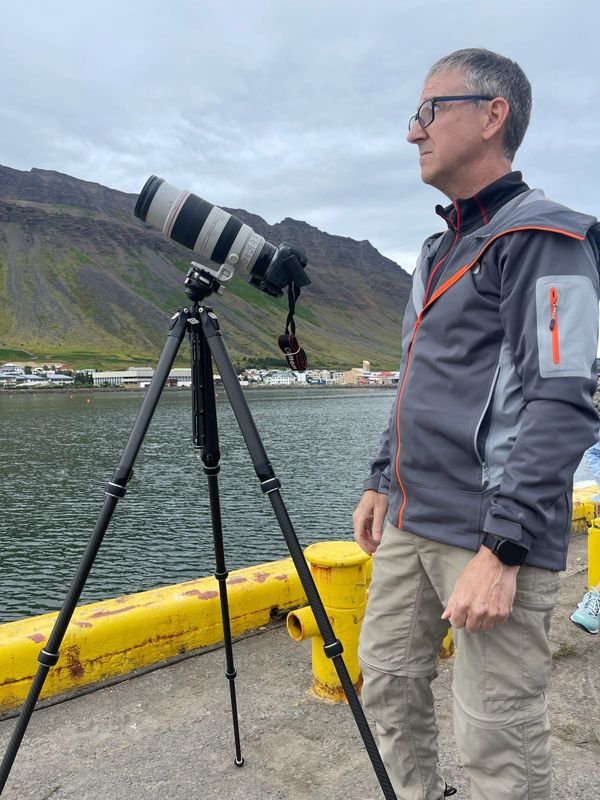
To view the eclipse, I and family members who joined me on the trip found some chairs in a public space near the marina in Isafjordur, a tiny town in the Westfjords region of northwest Iceland.
It was not a spot picked on a whim. The day before we traveled up the side of a nearby mountain to a potential location, a spot suggested by our Airbnb host. We pushed our rental van to its limits to coax it up the steep, rocky road to scout the possibility.
We had also traveled to another potential spot, the village of Flateyri, a coastal fishing village that would have provided a picturesque backdrop.
And earlier today, I clambered up the side of a steep slope near Isafjordur to ponder that possibility.
All had their advantages, and we enjoyed the experience of visiting the venues, but they were ultimately eschewed in favor of the spot we picked, one we could walk to from the place we were staying, had space to set up for photos and viewing, and had a good sightline to the sun’s location.
Hopes were high but expectations were low because of the weather forecast, which was calling for a cloudy sky and a good chance of rain.
Seeds for Iceland solar eclipse trip were planted in 2024
I’m writing this on Aug. 12, 2026, but the story starts 856 days earlier and half a world away.
Because it was on April 8, 2024, near the tiny village of Alto Pass, Illinois, that I viewed my first total solar eclipse.
I was awestruck.
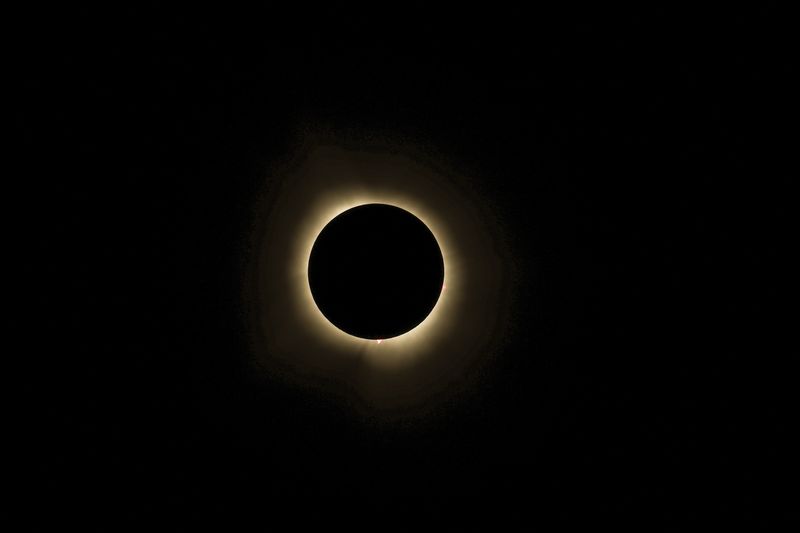
I remember my first thought as the moon completely slid across the sun and cast the countryside into an otherworldly darkness, exposing stars and planets and the dazzling glory of the sun’s corona: This is the most beautiful thing I’ve ever seen.
My second thought: When is the next one?
In the days that followed, I discovered both the date and the locations where the total eclipse could be seen: Greenland, Iceland, Russia, Spain and a small part of Portugal.
I stopped reading at Iceland.
It’s a place I’d always wanted to visit. I’d go there without any eclipse, I thought.
At some point, ruminations turned to reality, and the trip planning began.
Forecast for the solar eclipse in Iceland was iffy
The poor forecast for eclipse day was not a surprise, and it’s certainly not unusual for it to be cloudy in this part of the world. But it came on the heels of three consecutive sunny days.
I was hoping we could squeeze out at least one more.
That’s the thing about solar eclipses. They’re very much predicated on, you know, being able to see the sun.
My mantra in the two-plus years leading up to this trip has been: Yes, it could be cloudy on eclipse day, but hey, we’ll be in Iceland.
As the days neared, and the forecast continued to look iffy, my pitch to my family members changed, then changed again.
The first pivot was, “We just need a few seconds during the 90 seconds of totality to see the eclipse.”
Then I started to think about this story – and how it would read infinitely better if I had a photo of the eclipse to show – and my viewpoint changed yet again.
If my goal was to get an eclipse photo in Iceland – but it didn’t have to be a TOTAL eclipse image – then the window of opportunity is expanded from 90 seconds to around two hours.
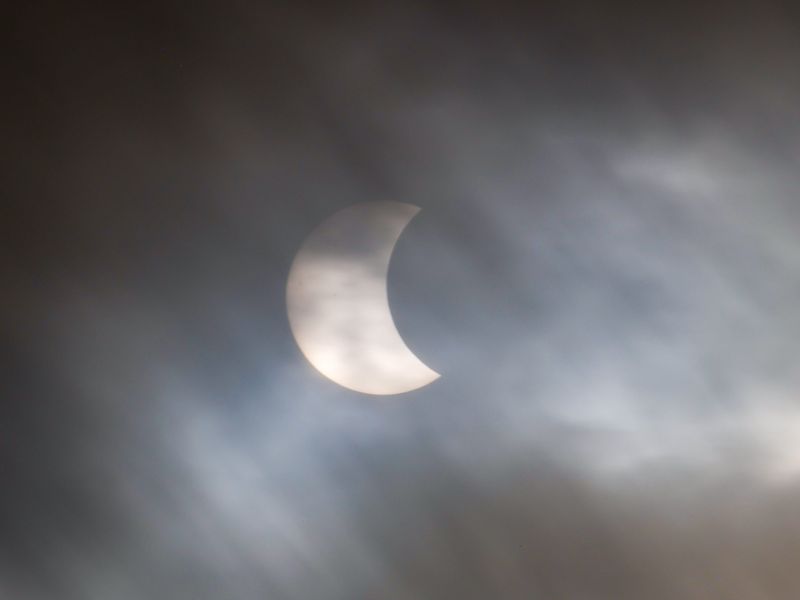
Because although the “main event” is when the disk of the moon completely covers the sun – totality – the eclipse itself is a slow mover. So if I can’t capture THE shot because of clouds, maybe if there are breaks in the gray, I can get a photo of the moon starting to cross across the sun (where it looks like the moon is taking increasingly larger “bites” of the sun), or get the same type of image in reverse, after totality but before the moon completely finishes its path across the sun.
Mission accomplished.
Total eclipse wasn’t visible, but a partial one was
It was a good thing I readjusted my goals.
Because we DID have some windows of opportunity to view the moon starting to cross in front of the sun, but there were only three or four of them, each lasting maybe 10-20 seconds.
During those segments, I was wrestling with camera settings, while I heard my family members saying things, like “There it is!” and “That’s so cool.”
I did manage to snap a couple of acceptable shots in those moments.
Darkness falls, but not for long
I was so wrapped up with the weather being poor that I forgot about a couple of things.
One, even though it was mostly cloudy, it would still get really dark.
Two, it’s going to get colder when it gets dark.
The coldness thing did happen, although it seemed less pronounced than in 2024.
But it definitely got dark.
Birds started squawking. People around us – far and near – started cheering, their voices carrying across the fjord. I noticed one sailboat’s mast light come on automatically.
With totality lasting about 90 seconds, it didn’t take long before the darkness waned and we were back to the illumination level of a regular cloudy day.
And the sun never did make another appearance.
But it was still awesome.
Despite the clouds, I’d do it again
As we made the short walk back from the water’s edge back to our rental place, I reflected on the experience.
One was technical and probably not of interest to many, but it had to do with camera settings and things I’d do differently to be more agile in challenging light settings.
But I gave myself some grace, because I learn best from trial and error, and tons of repetition. And I’ve attended a grand total of two solar eclipses in the last two and a half years, and one was completely sunny and the other was quite the opposite.
I also thought of how lucky and how special it was for me to have perfect conditions in 2024 in Illinois.
Finally, if you’ve ever thought about traveling to see a solar eclipse and wondered if it’s really worth it, I would tell you two things. One, yes. Two, go.
This article originally appeared on Milwaukee Journal Sentinel: I traveled from the U.S. to Iceland to see the 2026 solar eclipse
Reporting by Bob Dohr, Milwaukee Journal Sentinel / Milwaukee Journal Sentinel
USA TODAY Network via Reuters Connect
By Bob Dohr, Milwaukee Journal Sentinel | USA TODAY Network